











 Secure payments
Standard refund policy
Trade Assurance
Secure payments
Standard refund policy
Trade Assurance
| Model | M386AAK40B40-CUC5 |
|---|---|
| Product Type | Memory Module |
| Compliance Standards | EU RoHS,FCC |
| Memory Capacity | 128 GB |
| Memory Technology | DDR4 |
| Product Voltage | 1.2V |
| RAM Speed | 2400MHz |
| RAM Standard | DDR4-2400/PC4-19200 |
| Error Identifying | ECC |
| Signal Type | Registered |
| Column Access Strobe (CAS) | CL17 |
| Rank | Octal Rank x4 |
| Quantity of Pins | 288-pin |
| RAM Genre | RDIMM |
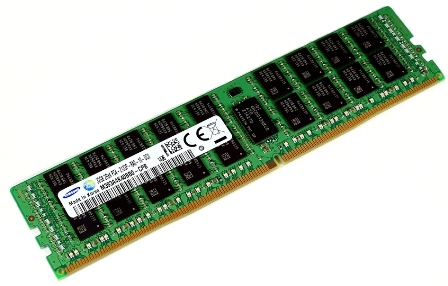
Designed for enterprise servers, this Samsung 128GB DDR4-2400 RDIMM with ECC and Registered signaling ensures data integrity in high-density virtualization and in-memory databases. Its Octal Rank x4 organization maximizes capacity per channel while the 2400MHz CL17 timing delivers reliable, efficient throughput under sustained heavy loads.
1. The 128GB capacity per module enables extreme memory density in 2U servers, allowing far more virtual machines to reside on a single physical host without swapping to slower storage.
2. ECC error correction silently detects and fixes single-bit memory faults in real time, which is essential for preserving data integrity in financial transactions and long-running database instances.
3. The registered signal type buffers command and address lines, stabilizing signal integrity across fully populated 24-DIMM platforms so that memory remains reliable even at maximum rack scale.
4. Octal Rank x4 organization loads all bank groups in parallel, maximizing channel utilization and sustaining high throughput during simultaneous heavy query execution on in-memory analytics workloads.
5. A 2400MHz clock with PC4-19200 bandwidth guarantees consistent interleaved data transfers across all memory channels, preventing bandwidth bottlenecks when dozens of containers request memory resources concurrently.
Designed for mission-critical server environments, the Samsung M386AAK40B40-CUC5 is a 128GB DDR4-2400 Registered DIMM that transforms how data centers handle demanding workloads. Its ECC technology actively detects and corrects single-bit memory errors, which becomes non-negotiable when you run an in-memory database like SAP HANA running financial transactions; a silent bit-flip could corrupt a ledger entry in nanoseconds, but ECC ensures every calculation remains trustworthy. The registered signal buffer stabilizes the entire memory channel despite the massive Octal Rank x4 configuration, enabling a single server to host dense virtualization clusters. In a VMware farm with dozens of active VMs, this buffering eliminates electrical loading that would otherwise crash the host, so live-migration and consolidation proceed without interruption. The 128GB capacity per stick allows you to populate 1.5TB per server channel, keeping analytics workloads or large-scale Redis caches fully resident in memory and eliminating the performance cliff of swapping to storage. Low 1.2V operation compounds across racks, reducing both cooling costs and power draw in a 24/7 colocation facility while maintaining consistent 2400MHz speed. For architects scaling cloud-native platforms or consolidating legacy SQL Server estates, this module means higher VM density per node, uncompromised data integrity, and a total cost of ownership advantage that directly impacts your uptime SLA and operational budget.
General Virtualization
This 128GB Registered DDR4-2400 RDIMM is ideal for dense virtualization hosts running hypervisors like VMware ESXi or Hyper-V. Deploy modules in balanced sets across all memory channels of dual-socket servers (e.g., 8×128GB for 1TB per node) to maximize memory bandwidth and reduce NUMA latency. Leave headroom for memory overcommit by right-sizing your total capacity to roughly 120% of peak anticipated VM working set.
In-Memory Database
For in-memory databases such as SAP HANA or Redis, populate all available memory channels symmetrically to achieve maximum throughput and ECC-protected reliability. A typical scale-up configuration uses 12 or 16 modules (1.5–2TB) per server, enabling large dataset caching and eliminating disk I/O bottlenecks. Octal-rank x4 organization delivers the high logical rank count needed for deep memory interleaving without sacrificing access speed.
High-Performance Computing
HPC workloads benefit from the combination of registered ECC integrity and high-capacity modules to sustain large-scale parallel simulations. Install identical 128GB RDIMMs in multiples of 6 or 8 per node, aligning DIMM population with the memory channel count of AMD EPYC or Intel Xeon Scalable processors for balanced bandwidth. This approach minimizes page faults during distributed-memory jobs and provides the stability required for weeks-long compute runs.
Strictly tested for server compatibility: Dell PowerEdge R740, HPE ProLiant DL380 Gen10, Lenovo ThinkSystem SR650, Cisco UCS C220 M5.
Q: Can I mix this M386AAK40B40-CUC5 with other memory modules of different brands or speeds?
A: Mixing is strongly discouraged for server environments. Mismatched ranks, speeds, or vendors can cause signal integrity issues and system instability. For guaranteed reliability, populate identical Samsung modules with matching speed and rank.
Q: Is this memory compatible with my system? (Server platforms like Intel Xeon Scalable or AMD EPYC)
A: This 128GB DDR4-2400 ECC Registered RDIMM is compatible with Intel Xeon E5-2600 v3/v4 and first-gen Xeon Scalable, plus AMD EPYC 7001 series platforms using DDR4 memory. Verify your motherboard's qualified vendor list.
Q: What is the recommended DIMM population order for optimal performance?
A: Follow your server board's population guide. With Octal Rank x4 modules, typically populate the farthest channels from the CPU first. Balance across memory channels and use identical DIMMs to maintain interleaving and maximize throughput.
Q: Does this module support overclocking or XMP profiles?
A: No. This is an enterprise-grade ECC Registered memory operating at JEDEC-standard DDR4-2400 CL17. It does not support XMP or overclocking, as data integrity and stability are prioritized over frequency tuning in server environments.
Q: What warranty and typical failure rate can I expect?
A: This Samsung module includes a one-year warranty. Typical enterprise DDR4 RDIMMs exhibit an annualized failure rate (AFR) well below 0.5% when operated within specified voltage and temperature ranges, backed by rigorous factory testing.