











 Secure payments
Standard refund policy
Trade Assurance
Secure payments
Standard refund policy
Trade Assurance
| Product Type | Memory Module |
|---|---|
| Compliance Standards | RoHS,WEEE |
| Memory Capacity | 32 GB |
| Memory Technology | DDR3 |
| Product Voltage | 1.35 V |
| RAM Speed | 1600 MHz |
| RAM Standard | DDR3-1600/PC3-12800 |
| Error Identifying | ECC |
| Signal Type | Registered |
| Column Access Strobe (CAS) | CL11 |
| Rank | Quad Rank x4 |
| Quantity of Pins | 240-pin |
| RAM Genre | RDIMM |
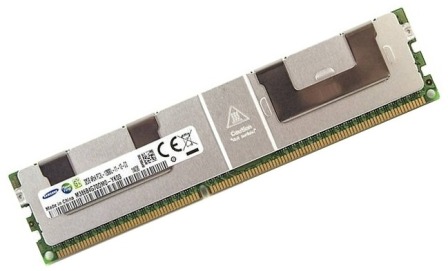
This is a server-class DDR3 RDIMM engineered for dense virtualization and in-memory database workloads, where its 32 GB quad-rank x4 configuration maximizes capacity per channel while Registered signaling maintains signal integrity under heavy load. The combination of ECC error correction and a low 1.35 V operating voltage ensures data integrity and improved energy efficiency in 24/7 data center environments.
1. The high-density module capacity allows virtualized servers to host more concurrent guest machines without resorting to costly chassis expansion, preserving performance headroom for database and collaboration workloads.
2. Integrated error correction eliminates single-bit memory faults silently corrupting transactional data, a non-negotiable safeguard for financial processing and mission-critical analytics.
3. The registered buffer architecture decouples signal loading from the controller, enabling dense multi-slot configurations to maintain timing integrity across fully populated memory channels in blade or rack servers.
4. Quad rank x4 organization keeps all memory bank groups active in parallel, sustaining elevated throughput that prevents bottlenecks during peak consolidation of mixed enterprise applications.
5. Operating at a low 1.35V voltage envelope reduces overall server power draw and waste heat, directly translating to lower cooling overheads and improved energy efficiency in densely packed data center racks.
When you equip a virtualized cluster or a memory-intensive database server, the M386B4G70DM0-YK0 RDIMM is not just a spec sheet entry—it is a risk-management tool engineered for the data center. Its ECC correction silently hunts down single-bit errors that would otherwise corrupt a hypervisor state or slowly poison your transactional database, turning a potential weekend outage into unnoticeable background maintenance. The Registered buffer tames the electrical chaos of a fully populated channel, allowing you to run multiple 32 GB Quad Rank DIMMs with absolute signal stability; in practice, this means you can confidently pack far more virtual machines onto a single node without fearing memory-induced crashes. Operating at a frugal 1.35 V instead of legacy 1.5 V, the module pulls less power at every clock cycle, which compounds into dramatically lower cooling overhead across a rack of servers running round-the-clock online services. The Quad Rank x4 architecture also works harder for your in-memory workloads, using rank interleaving to accelerate access and reduce latency, giving Redis, SAP HANA, or real-time analytics that crucial sub-millisecond edge. These capabilities fuse to protect your data, raise your workload density, and shrink your energy footprint—converting raw specifications directly into infrastructure resilience.
General Virtualization
For general virtualization hosts, maximize capacity while keeping memory balanced across CPU memory channels. Deploy six to eight of these 32GB Registered ECC modules per processor to populate all available channels, achieving a solid 192–256GB per socket. This ensures consistent performance for dozens of mixed-workload VMs and allows room for future scaling without immediately exhausting DIMM slots.
In-Memory Database
In-memory databases demand the highest possible capacity and data integrity. Fill every DIMM slot with these 32GB Quad Rank RDIMMs to reach extreme densities (512GB or more per server), enabling entire datasets to reside in RAM. The ECC protection is critical to guard against bit errors in long-running analytic workloads, and the slight frequency dip caused by quad-rank loading is a worthwhile trade-off for maximum capacity.
High-Performance Computing (HPC)
HPC workloads are bandwidth-sensitive, so a balanced channel population is crucial. Use one 32GB RDIMM per memory channel across all CPUs to deliver peak theoretical bandwidth for vectorized math and simulation code. Although quad-rank modules may force a speed reduction to 1333 MT/s or require relaxed timings, the uniform channel loading minimizes NUMA latency penalties and prevents the bandwidth starvation that uneven configurations cause under heavy MPI traffic.
Rigorously tested, compatible with Dell PowerEdge R720, HP ProLiant DL380p Gen8, and Lenovo ThinkServer RD630.
Q: Can I mix this M386B4G70DM0-YK0 with other memory modules of different brands or speeds?
A: Mixing brands or speeds is not advised for server RDIMMs. Mismatched timings and register logic often cause system instability. We strongly recommend installing identical modules to ensure validated, reliable operation.
Q: Is this memory compatible with my system? (Intel/AMD platforms)
A: This DDR3-1600 Registered ECC module is built for servers with Intel Xeon E5-2600 v2 or AMD Opteron 6300 series platforms. Always consult your motherboard’s Qualified Vendor List to confirm full compatibility and proper voltage support.
Q: What is the recommended DIMM population order for optimal performance?
A: For quad-rank RDIMMs, populate identical modules per channel starting with the slot farthest from the CPU. Balance all memory channels evenly to enable interleaving and maximize throughput on your server board.
Q: Does this module support overclocking or XMP profiles?
A: No. This module operates at JEDEC standard DDR3-1600 with CL11 timings for maximum stability. Overclocking and XMP are not supported on enterprise Registered ECC memory, as reliability is paramount in server environments.
Q: What warranty and typical failure rate can I expect?
A: It includes a 1-year warranty. Enterprise DDR3 RDIMMs exhibit an annualized failure rate typically well below 0.3% under standard temperature and voltage conditions, reflecting stringent manufacturing and component selection practices.