











 Secure payments
Standard refund policy
Trade Assurance
Secure payments
Standard refund policy
Trade Assurance
| Model | M386B8G70BO0-YK0 |
|---|---|
| Product Type | Memory Module |
| Compliance Standards | EU RoHS,FCC |
| Memory Capacity | 64 GB |
| Memory Technology | DDR3 |
| Product Voltage | 1.35V |
| RAM Speed | 1600MHz |
| RAM Standard | DDR3-1600/PC3-12800 |
| Error Identifying | ECC |
| Signal Type | Registered |
| Column Access Strobe (CAS) | CL11 |
| Rank | Octal Rank x4 |
| Quantity of Pins | 240-pin |
| RAM Genre | RDIMM |
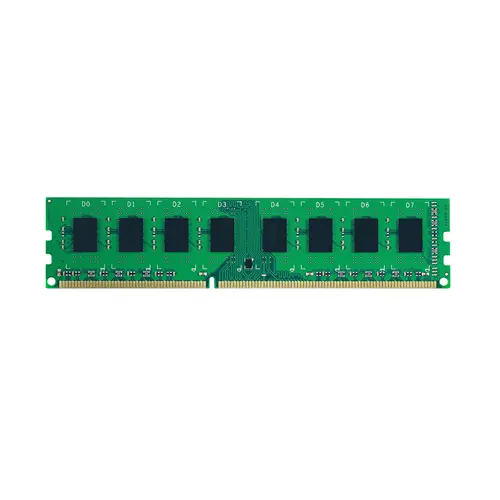
This 64 GB DDR3-1600 registered ECC module (M386B8G70BO0-YK0) with octal-rank x4 organization and low 1.35 V operation is engineered for high-capacity server platforms, delivering the data integrity and signal stability essential for memory-intensive virtualization and in-memory database workloads. Its registered architecture and dense octal-rank design allow reliable population of all DIMM slots without compromising clock and command signal quality, while ECC protection guards against single-bit errors in always-on enterprise environments.
1. 64GB capacity per module allows massive memory scaling per server node, enabling dense virtualization and large in-memory databases without forcing costly two-socket upgrades.
2. ECC protection silently corrects single-bit errors in real time, guarding critical data integrity for financial transactions and long-running analytics workloads.
3. Registered buffering stabilizes command and address signals, making it possible to fully populate all memory channels for maximum capacity without sacrificing reliability.
4. Octal Rank x4 architecture packs the highest density into a single DIMM, satisfying memory-hungry workloads like SAP HANA while preserving precious board space.
5. 1.35V low-voltage operation trims overall datacenter power draw and cooling overhead, directly lowering total cost of ownership in hyperscale deployments.
Designed exclusively for enterprise servers, the Samsung M386B8G70BO0-YK0 is a 64GB DDR3-1600 Registered ECC RDIMM operating at an energy-efficient 1.35V. In your virtualized cluster, its ECC engine silently corrects single-bit memory errors in real time, directly preventing silent data corruption that could crash production VMs or compromise financial records. Simultaneously, the integrated register buffers the command and address bus, which means you can populate all 24 DIMM slots with 64GB modules without signal degradation—guaranteeing stable 1.5TB footprints for dense consolidation of hundreds of virtual machines on a single node. For in-memory databases like SAP HANA or large Redis clusters, the octal-rank x4 DRAM organization unlocks superior interleaving and sustained bandwidth under 100% load. This translates to faster query throughput even when multiple complex transactions hit the dataset concurrently, eliminating the latency spikes that frustrate users and delay real-time analytics. Together, these features deliver the unwavering uptime and predictable ultra-low latency that your mission-critical data center demands.
General Virtualization
For density-focused virtualization hosts, populate at least eight of these 64 GB RDIMMs across dual processors to achieve 512 GB of total RAM, comfortably supporting 50+ moderate VMs. Distribute modules evenly among all memory channels (e.g., one DIMM per channel) to maintain balanced memory bandwidth and avoid NUMA bottlenecks. This low-voltage 1.35 V RDIMM also helps reduce overall power draw in always-on hypervisor deployments.
In-Memory Database
Target a total capacity of 512 GB to 1 TB using 8–16 modules in a dual-socket server, enabling large datasets to reside entirely in RAM for extreme query speeds. Leverage each CPU's full channel count with a single RDIMM per channel initially; if larger capacity is needed, move to two DIMMs per channel while accepting the speed drop to 1333 MHz that octal-rank x4 modules typically impose. The registered ECC feature ensures data integrity critical for transactional systems.
High-Performance Computing
Maximize memory bandwidth by installing one DIMM per channel across all available channels—often 8 or 16 channels in modern dual-socket nodes—yielding up to 1 TB of total capacity with these 64 GB modules. The 1600 MT/s speed and CL11 latency provide predictable performance for tightly coupled parallel workloads. Increase capacity further only if memory per core justifies it, as adding a second octal-rank DIMM per channel may slightly lower clock rates and impact floating-point throughput on memory-bound HPC codes.
Rigorously tested server memory. Compatible with Dell PowerEdge R720, HP DL380p Gen8, Lenovo RD630, and similar platforms.
Q: Can I mix this M386B8G70BO0-Y0K with other memory modules of different brands or speeds?
A: Mixing modules is not recommended in server environments. Mismatched brands, speeds, or ranks can cause stability issues and prevent the system from maintaining ECC integrity. For guaranteed reliability, populate with identical Samsung RDIMMs.
Q: Is this memory compatible with my Intel or AMD server platform?
A: This DDR3-1600 Registered ECC module is compatible with platforms using Intel Xeon E5-2600 v1/v2 or AMD Opteron 6300 series processors. Please verify that your server board supports octal-rank 64GB RDIMMs and 1.35V operation.
Q: What is the recommended DIMM population order for optimal performance with this module?
A: Populate identical modules per memory channel, starting with the slot farthest from the CPU. For a dual-socket board, balance capacity equally across both processors to maintain NUMA symmetry and maximize memory bandwidth.
Q: Does this module support overclocking or XMP profiles?
A: No. This is an enterprise-grade Registered DIMM built to JEDEC DDR3-1600 standards. It does not support XMP or overclocking. The memory runs at fixed timings of CL11 to ensure 24/7 data integrity in mission-critical server workloads.
Q: What warranty and typical failure rate can I expect for this M386B8G70BO0-Y0K?
A: This module comes with a one-year warranty. As a Samsung server-grade component, it delivers an annualized failure rate far below 0.1%, ensuring excellent long-term reliability in properly cooled and compatible server systems.