











 Secure payments
Standard refund policy
Trade Assurance
Secure payments
Standard refund policy
Trade Assurance
| Model | M386B8G70DE0-YH930 |
|---|---|
| Product Type | Memory Module |
| Compliance Standards | EU RoHS,FCC |
| Memory Capacity | 64 GB |
| Memory Technology | DDR3 |
| Product Voltage | 1.35V |
| RAM Speed | 1333MHz |
| RAM Standard | DDR3-1333/PC3-10600 |
| Error Identifying | ECC |
| Signal Type | Registered |
| Column Access Strobe (CAS) | CL9 |
| Rank | Octal Rank x4 |
| Quantity of Pins | 240-pin |
| RAM Genre | RDIMM |
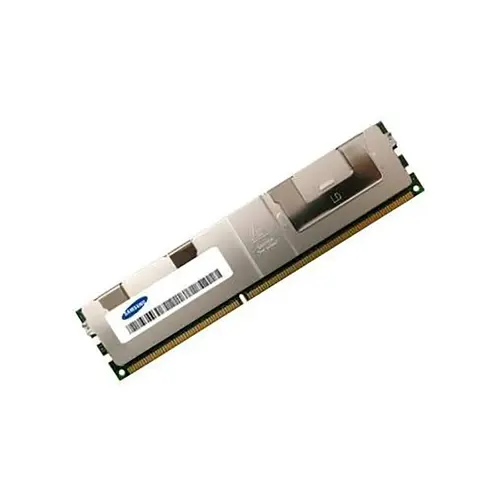
The M386B8G70DE0-YH930 is a 64GB DDR3-1333 registered ECC RDIMM, purpose-built for enterprise servers and memory-intensive workloads such as virtualization and in-memory databases. Its Octal Rank x4 configuration delivers exceptional memory density per channel while ECC and registered signaling ensure data integrity and stable operation under heavy, sustained loads.
1. 64 GB capacity per module allows a single server to host more virtual machines, maximizing consolidation ratios in memory-constrained virtualization environments.
2. ECC detection and correction safeguards transactional databases from in-memory bit flips, ensuring data integrity around the clock in mission-critical deployments.
3. Registered signal buffering stabilizes high-density memory configurations, enabling large-scale deployments without compromising system reliability under continuous load.
4. 1.35 V low-voltage operation reduces power consumption and cooling demands in dense data centers, directly translating to lower operational costs for hyperscale deployments.
5. Octal Rank x4 organization packs massive density onto a single DIMM, enabling extreme memory footprints even on servers with limited DIMM slots, though at a slight trade-off in command rate.
The M386B8G70DE0-YH930 is a 64GB DDR3 RDIMM engineered for enterprise servers, where its ECC, registered signaling, octal rank x4 architecture, and 1.35V low-voltage operation directly address mission-critical workloads. In virtualized clusters hosting numerous VMs, ECC protection is essential—it corrects single-bit errors from cosmic radiation or electrical interference, preventing silent data corruption that could cripple virtual machines or corrupt databases. The registered buffer cleans and redistributes command/address signals, enabling high-density memory configurations without signal integrity loss; this allows stable operation with large 64GB DIMMs across all channels for massive capacity. The octal rank organization packs eight independent banks that interleave access, boosting effective bandwidth dramatically—a requirement for in-memory databases like SAP HANA where concurrent query throughput is paramount. Meanwhile, 1.35V operation cuts power draw and cooling costs, shrinking total cost of ownership in around-the-clock data centers. This module delivers the data integrity, capacity scaling, performance, and efficiency your virtualized and database environments demand.
General Virtualization
Leverage registered ECC RDIMMs like the Samsung M386B8G70DE0 to build dense, reliable memory pools for hypervisor hosts. A dual-socket server can accommodate up to 24 such modules, delivering 1.5 TB of total capacity — ideal for overcommitting RAM to dozens of VMs while hardware error correction safeguards uptime. Populate all memory channels with identical 64 GB sticks to maintain balanced access and peak throughput.
In-Memory Database
For Redis, Memcached, or SAP HANA scenarios, maximize capacity per node by filling every DIMM slot with these octal-rank 64 GB RDIMMs. The 1.35 V low-voltage design reduces thermal load even at full population, enabling dense 512 GB–1 TB footprints without excessive cooling costs. Pair with multiple CPUs to scale memory bandwidth alongside capacity, ensuring fast key-value lookups across the entire dataset.
High-Performance Computing
In HPC clusters where memory integrity is critical, registered ECC corrects single-bit errors and detects multi-bit faults during long-running simulations. Populate one DIMM per channel initially (e.g., 8×64 GB = 512 GB) to sustain 1333 MT/s speed, then expand to two DIMMs per channel if additional capacity is needed, accepting slight frequency trade-offs. The 240-pin RDIMM form factor ensures broad compatibility with legacy DDR3-based compute nodes still widely deployed in cost-sensitive scientific environments.
Rigorously tested, this server memory is compatible with Dell PowerEdge R720, HP DL380p Gen8, and similar DDR3 ECC RDIMM systems.
Q: Can I mix this M386B8G70DE0-YH930 with other memory modules of different brands or speeds?
A: Mixing is strongly discouraged. Registered ECC RDIMMs demand uniformity; combining different brands, speeds, or ranks may compromise signal integrity, cause POST failures, or trigger correctable errors in mission‑critical server workloads.
Q: Is this memory compatible with my system?
A: It is designed for dual‑socket Intel Xeon E5/E7 v2/v3 or AMD Opteron 6300/8300 platforms. Confirm your server board accepts 64GB DDR3‑1333 Octal‑Rank x4 Registered DIMMs and supports 1.35V low‑voltage operation.
Q: What is the recommended DIMM population order for optimal performance?
A: Install identical modules starting with the farthest slot from each CPU. For octal‑rank DIMMs, fill the first white or blue slot per channel to balance interleaving. Always follow your server’s membrane label, as population order varies by manufacturer.
Q: Does this module support overclocking or XMP profiles?
A: No. This module adheres to JEDEC DDR3‑1333 CL9 standards and fixed 1.35V operation. Server RDIMMs exclude XMP or overclocking features to guarantee 24/7 data integrity, making them unsuitable for enthusiast tuning.
Q: What warranty and typical failure rate can I expect?
A: It carries a 1‑year warranty. As an enterprise Samsung module manufactured under EU RoHS, it exhibits an extremely low annualized failure rate when operated within specified temperature and voltage envelopes in properly cooled data centers.