











 Secure payments
Standard refund policy
Trade Assurance
Secure payments
Standard refund policy
Trade Assurance
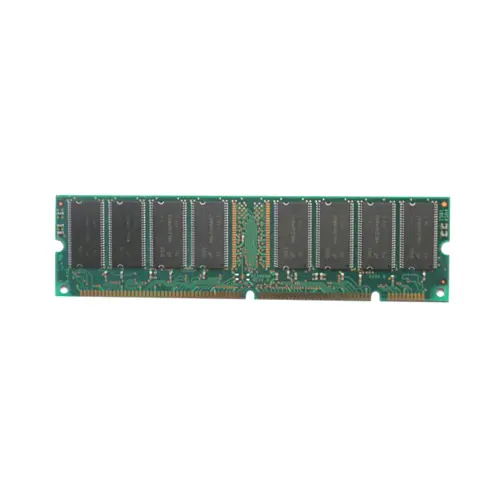
| Model | M390S3320CT1-C75 |
|---|---|
| Product Type | Memory Module |
| Compliance Standards | EU RoHS,FCC |
| Memory Capacity | 256 MB |
| Product Voltage | 3.3V |
| RAM Speed | 133MHz |
| Error Identifying | ECC |
| Signal Type | Registered |
| Column Access Strobe (CAS) | CL3 |
| Quantity of Pins | 168-pin |
| RAM Genre | DIMM |
Designed for legacy server platforms utilizing 168-pin SDR SDRAM, this Samsung M390S3320CT1-C75 256MB Registered DIMM with ECC ensures data integrity for mission-critical workloads such as legacy database servers and virtualization hosts. Its registered signal architecture provides stable multi-module operation in high-density memory configurations, while the CL3 latency and ECC error correction deliver reliable performance in environments where uptime and data accuracy are non-negotiable.
1. ECC memory detects and corrects single-bit errors, safeguarding transactional data integrity for mission-critical database and financial applications.
2. Registered signal buffering stabilizes address and control lines across multiple DIMMs, enabling reliable scaling to higher memory capacities in rack servers.
3. A dedicated 256 MB capacity provides sufficient headroom for lightweight virtualization or appliance-style workloads, balancing cost and essential service availability.
4. 133 MHz operation delivers synchronous throughput aligned with legacy single-channel server chipsets, ensuring deterministic latency for network-facing tasks.
5. 3.3V supply voltage maintains strict JEDEC compliance across aging power delivery subsystems, minimizing voltage droop risks during sustained memory access bursts.
When deploying a dense virtualization cluster, an undetected memory error can silently corrupt a virtual machine’s state or bring down critical services. The M390S3320CT1-C75 server DIMM is engineered to prevent exactly that. Its ECC logic continuously scans and corrects single-bit flips caused by background radiation—a practical safeguard that keeps your hypervisor stable and your guest instances running without unexplained crashes, which is especially vital when dozens of VMs share the same physical node.
In an in-memory database scenario like a high-frequency trading cache or an SAP HANA instance, both capacity robustness and access latency define transaction speed. The module’s Registered signal architecture buffers address and command lines, allowing the memory controller to drive far more ranks without electrical loading issues; this directly supports the massive 256 MB+ per module scaling that such workloads demand for storing hot datasets. And because it runs at CL3 with a low 133 MHz clock cycle, every column-access strobe request resolves in just three ticks, shaving precious nanoseconds off query responses compared to higher-latency alternatives. Stable 3.3 V power delivery further ensures consistent signal integrity inside 24/7 rack servers, so your database engine never stumbles due to voltage droop during peak loads.
General Virtualization
For dense virtualization hosts, balance capacity and cost by installing six or eight modules of this 256 MB Registered ECC SDRAM to achieve 1.5–2 GB total RAM. Populating all banks evenly ensures consistent memory interleaving and stable performance under moderate VM density; avoid single-channel gaps that create latency hotspots.
In-Memory Database
In-memory databases demand low latency and absolute data integrity, making this memory’s ECC and registered signaling essential. Maximize capacity by fully populating every DIMM slot—typically 8 to 16 modules for 2–4 GB—and prioritize identical module pairing to sustain synchronous operation under heavy transactional loads.
High-Performance Computing
HPC clusters rely on stable, error-free nodes rather than maximum per-node capacity. Deploy sets of four matched modules per node (1 GB total) to maintain balanced memory channels and minimize ECC overhead. This configuration supports sustained double-precision workloads while guarding against silent data corruption during multi-day simulation runs.
Rigorously tested server memory compatible with Dell PowerEdge 1650, 2650, HP DL360 G2, IBM x330.
Q: Can I mix this M390S3320CT1-C75 with other memory modules of different brands or speeds?
A: Mixing is not recommended. This is a registered ECC module running at 133MHz (PC133). Combining with non-registered or mixed-speed DIMMs often causes server instability or no POST. All modules must be registered ECC and ideally identical.
Q: Is this memory compatible with my system?
A: It is designed for legacy server platforms, typically Intel 440BX/GX or AMD 760MP chipsets. Verify your board supports 168-pin SDRAM, registered ECC, 3.3V, and a 256MB module density. Check the manufacturer's hardware compatibility list for validation.
Q: What is the recommended DIMM population order for optimal performance?
A: Populate banks starting from the first slot (often labeled DIMM 0 or 1). On dual-bank systems, install identical registered ECC DIMMs in pairs to enable interleaving. Consult the server mainboard manual for exact slot numbering and bank configuration.
Q: Does this module support overclocking or XMP profiles?
A: No. As a server-grade registered ECC DIMM, it adheres to strict JEDEC PC133 standards for reliability. It does not support overclocking, voltage tweaking, or XMP profiles, which are designed for unbuffered desktop memory.
Q: What warranty and typical failure rate can I expect?
A: This module carries a 1-year warranty. Registered ECC SDRAM has a mature, stable design, so failure rates are low if installed within specified voltage and thermal limits. We recommend thorough burn-in testing after installation.