











 Secure payments
Standard refund policy
Trade Assurance
Secure payments
Standard refund policy
Trade Assurance
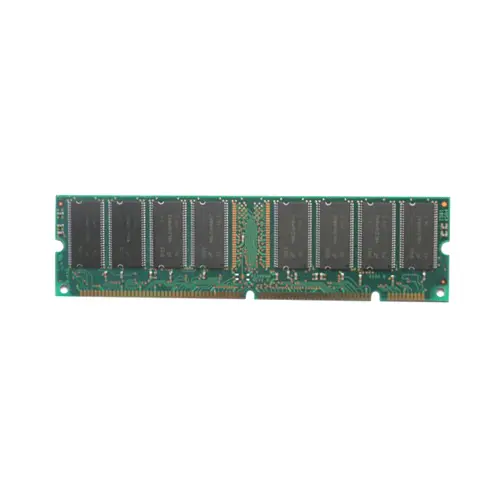
| Model | M390S6450BT1-C75 |
|---|---|
| Product Type | Memory Module |
| Compliance Standards | EU RoHS,FCC |
| Memory Capacity | 512 MB |
| Product Voltage | 3.3V |
| RAM Speed | 133MHz |
| Error Identifying | ECC |
| Signal Type | Registered |
| Column Access Strobe (CAS) | CL3 |
| Quantity of Pins | 168-pin |
| RAM Genre | RDIMM |
This is a legacy server-grade Registered ECC SDRAM module designed for vintage workstation and server platforms requiring high data integrity. Its 168-pin RDIMM form factor with registered signal buffering and ECC correction is best suited for early-generation virtualization hosts or memory-resident databases where stability and single-bit error resilience are critical, while the CL3 latency at 133 MHz ensures predictable, low-latency data access in synchronous architectures.
1. The half-gigabyte capacity creates a dedicated, interference-free memory space for bare-metal embedded server tasks, eliminating resource contention and ensuring predictable uptime for critical network control planes.
2. PC133-class throughput supplies a steady, bounded bandwidth ideally matched to real-time transactional processing, preventing jitter in synchronized industrial automation and telemetry servers.
3. ECC protection continuously corrects single-bit faults in the background, which is essential for safeguarding long-running database integrity in financial clearing or electronic medical record systems against silent data corruption.
4. Registered clock and command buffering stabilizes signal integrity across fully populated risers, allowing a multi-socket server platform to reliably scale memory channel utilization without electrical loading errors.
5. A CAS latency of just three cycles accelerates initial data access, reducing CPU idle stalls during frequent small-record queries in directory services or caching servers where every cycle of response time matters.
Targeting legacy server infrastructures, the M390S6450BT1-C75 is a 512MB Registered ECC SDRAM module built on the 168-pin, 3.3V standard. Its four defining characteristics directly address the relentless demands of enterprise computing where stability is not optional but mandatory.
The combination of ECC and Registered buffering forms the backbone of data integrity in multi-slot server boards. In a virtualization cluster running dozens of VMs on a single node, a single-bit error in unprotected memory can silently corrupt a hypervisor page, cascading into instantaneous guest crashes and hours of forensic downtime. ECC detects and corrects those errors in real time, while the register chip decouples the electrical load from the memory controller, enabling fully populated banks without signal degradation—crucial when maximizing RAM density for densely packed containers or virtual desktops.
For latency-sensitive memory databases like Redis or in-memory analytics engines, the CL3 column access strobe delivers deterministic, low-latency fetches. Even a two-cycle penalty multiplies across millions of queries per second, directly impacting transaction throughput. Moreover, the 3.3V operating voltage and industry-standard 168-pin form factor ensure seamless drop-in compatibility with aging yet mission-critical systems, from factory-floor control servers to legacy telco billing platforms, where replacing the entire infrastructure is not feasible. Here, every parity check and every buffered signal translates directly into uptime, accuracy, and a preserved investment.
The M390S6450BT1-C75 is a server-class 512MB PC133 Registered ECC SDRAM module built for legacy platforms. Capacity planning with such a small, error‑corrected DIMM must acknowledge extreme limits while maximizing module count and stability.
General Virtualization
A typical 4‑ to 8‑slot board fully populated with identical 512MB RDIMMs yields only 2–4GB, enough for a handful of lightweight containers or a single minimal VM. Install all modules in matched banks to preserve registered‑ECC interleaving and reliability.
In‑Memory Database
These workloads demand large RAM footprints, making this module impractical. If constrained to the platform, occupy every slot with the same part number to reach the ceiling (e.g., 16 slots for 8GB). This barely fits tiny test datasets or a small read cache; any production use should migrate to modern high‑capacity servers.
High‑Performance Computing (HPC)
CL3 latency is low, but 133MHz bandwidth chokes throughput. For a light compute node, install the smallest matched set—such as two DIMMs for 1GB—to lower bus load and retain ECC. HPC jobs needing more than a few hundred megabytes per core will immediately exhaust capacity, rendering this memory obsolete for serious workloads.
Rigorously tested server memory, compatible with Dell PowerEdge 2550, HP ProLiant DL380 G2, IBM xSeries 330.
Q: Can I mix this M390S6450BT1-C75 with other memory modules of different brands or speeds?
A: Mixing Registered ECC modules is not recommended. Different brands or speeds may cause timing conflicts and system instability. For reliable operation, install identical M390S6450BT1-C75 modules with the same density, speed, and organization.
Q: Is this memory compatible with my system?
A: This 168-pin PC133 Registered ECC SDRAM targets legacy server platforms, typically Intel 440GX/ServerWorks chipsets or equivalent AMD MP systems. Verify your server or motherboard QVL includes 512MB RDIMMs at 133MHz, 3.3V, CL3.
Q: What is the recommended DIMM population order for optimal performance?
A: Follow your server board’s manual. Generally, populate DIMM slots in pairs per bank, starting from the bank closest to the processor. Install identical modules in each bank to maintain 2-way interleaving and avoid bus loading issues.
Q: Does this module support overclocking or XMP profiles?
A: No. This is a JEDEC-standard server memory module without XMP or overclocking support. It operates strictly at 133MHz with CL3 timing to ensure stability in mission-critical, continuous-duty environments.
Q: What warranty and typical failure rate can I expect?
A: This module carries a 1-year warranty. As a mature, rigorously screened server component, it delivers an extremely low annualized failure rate (typically below 0.5%) when operated within specified voltage and temperature ranges.