











 Secure payments
Standard refund policy
Trade Assurance
Secure payments
Standard refund policy
Trade Assurance
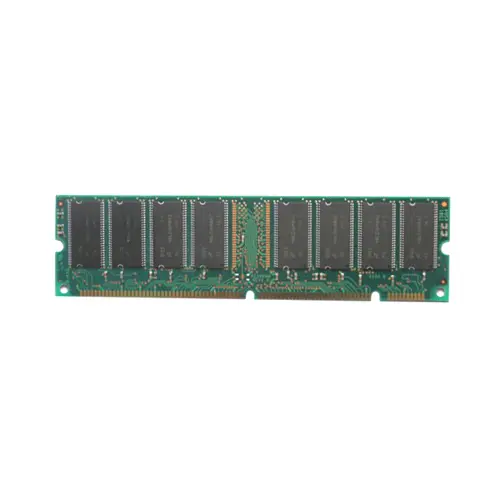
| Model | M390S6450CT1-C7A |
|---|---|
| Product Type | Memory Module |
| Compliance Standards | EU RoHS,FCC |
| Memory Capacity | 512 MB |
| Product Voltage | 3.3V |
| RAM Speed | 133MHz |
| Error Identifying | ECC |
| Signal Type | Registered |
| Column Access Strobe (CAS) | CL3 |
| Quantity of Pins | 168-pin |
| RAM Genre | RDIMM |
This 512MB PC133 Registered ECC SDRAM module (M390S6450CT1-C7A) is purpose-built for legacy server platforms where data integrity under continuous operation is paramount, making it suitable for lightweight virtualization hosts or small-scale in-memory databases running on older hardware. Its registered signal architecture stabilizes multi-DIMM configurations by reducing electrical load on the memory controller, while the ECC capability combined with CL3 latency delivers reliable error detection and correction without compromising basic responsiveness.
1. Real-time error correction shields critical server workloads from silent data corruption, ensuring regulatory-grade data consistency across long-running batch processes.
2. The registered buffer topology fortifies signal integrity under maximum DIMM population, which is essential for hypervisor stability when hosting multiple virtual machines.
3. A half-gigabyte per module provides ample memory footprint for early-generation enterprise services such as e-mail gateways, domain controllers, or lightweight web serving.
4. This SDRAM frequency class delivers balanced latency and bandwidth for steady-state server tasks, avoiding the thermal and signaling complexities of overclocked memory in always-on rack deployments.
5. Tight column access latency accelerates memory read cycles, directly improving throughput for latency-sensitive server threads like authentication lookups or database indexing.
In a data center, your infrastructure only performs as well as its weakest component—and when it comes to server memory, the Samsung M390S6450CT1-C7A RDIMM turns that weak link into a strategic advantage. Built as a 512MB Registered ECC module running at 133MHz with CL3 latency, this 168-pin DIMM is purpose-engineered for mission-critical server environments where absolute data integrity and round-the-clock stability are non-negotiable. The ECC capability actively detects and corrects single-bit memory errors—a silent threat that, left unchecked, can corrupt virtual machine states in a dense virtualization cluster or introduce calculation errors in an in-memory database like Redis. Meanwhile, the Registered signal buffering stabilizes electrical loads, allowing you to populate multiple DIMMs per channel without the signal degradation that plagues unbuffered modules. Picture a VMware cluster hosting dozens of business-critical VMs: a single bit flip in a financial transaction could cascade into revenue loss, but ECC ensures every calculation remains trusted. Or consider a real-time analytics node running an in-memory dataset: timing glitches from unbuffered memory cause latency spikes, while the Registered architecture of this module maintains clean, predictable signal integrity so your queries complete on time, every time. This isn’t just memory—it’s a guarantee that your servers scale reliably under real workloads.
General Virtualization
Even lightweight hypervisors require gigabytes of RAM, rendering a single 512 MB module impractical. To assemble the largest possible memory pool on a legacy server, populate all available DIMM slots—often four or eight—with identical M390S6450CT1-C7A modules. Installing them in matching pairs satisfies the chipset’s interleaving rules, but the resulting 2–4 GB can only host a single minimal virtual machine for basic lab testing.
In-Memory Database
Modern in-memory databases demand tens or hundreds of gigabytes, so these 512 MB registered ECC SDRAM modules are fundamentally insufficient for production. The only viable strategy is to fill every bank with matching RDIMMs to reach the board’s maximum capacity. Even with eight modules providing 4 GB, the dataset must remain trivially small, limiting the system to proof-of-concept experiments.
High-Performance Computing
HPC workloads need high bandwidth and large memory footprints, yet PC133 SDRAM delivers just 1.06 GB/s per channel. The realistic capacity planning approach is to populate all memory channels with identical registered modules, enabling the widest interleaving mode the platform supports. This configuration may permit lightweight educational simulations on tiny problem sizes, but cannot meet any production HPC requirement.
Tested rigorously for servers—compatible with Dell PowerEdge 2650, HP ProLiant DL380 G2, IBM xSeries 330.
Q: Can I mix this M390S6450CT1-C7A with other memory modules of different brands or speeds?
A: Mixing is not recommended. Using identical RDIMMs ensures reliable ECC operation. Mixed modules may cause signal integrity issues and system instability on server platforms.
Q: Is this memory compatible with my system?
A: This module fits servers with 168-pin SDRAM slots supporting PC133 Registered ECC. Confirm your Intel or AMD server chipset supports 3.3V, 133MHz CL3 RDIMMs before ordering.
Q: What is the recommended DIMM population order for optimal performance?
A: Populate in matched pairs per your server manual. Typically, install identical RDIMMs starting from the slots with the lowest numerical labels for optimal interleaving and bandwidth.
Q: Does this module support overclocking or XMP profiles?
A: No. This is a server-grade Registered ECC module built for stability. It operates strictly at JEDEC-standard 133MHz CL3 without overclocking or XMP profile support.
Q: What warranty and typical failure rate can I expect?
A: One-year warranty is provided. Typical failure rate is very low for server RDIMMs, but exact FIT/MTBF data can be supplied upon request for enterprise deployments.