











 Secure payments
Standard refund policy
Trade Assurance
Secure payments
Standard refund policy
Trade Assurance
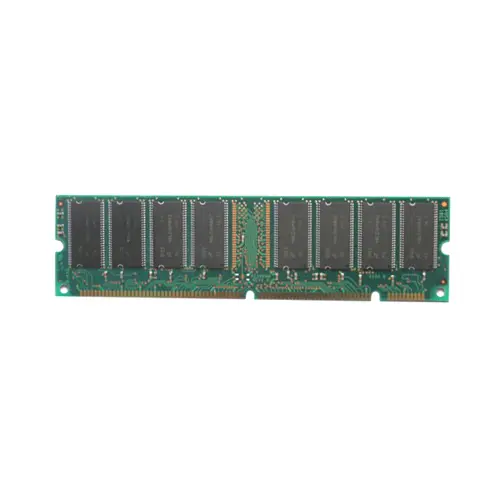
| Model | M390S6450DT1-C7A |
|---|---|
| Product Type | Memory Module |
| Compliance Standards | EU RoHS,FCC |
| Memory Capacity | 512 MB |
| Product Voltage | 3.3V |
| RAM Speed | 133MHz |
| Error Identifying | ECC |
| Signal Type | Registered |
| Column Access Strobe (CAS) | CL3 |
| Quantity of Pins | 168-pin |
| RAM Genre | RDIMM |
This RDIMM with ECC and registered signaling is specifically engineered for legacy server platforms running memory-intensive workloads such as virtualization and in-memory databases, where data integrity is paramount. Its low CL3 latency and registered buffer design ensure stable command/address signal transmission across multiple DIMMs, providing the reliability required for sustained 24/7 operation in mission-critical systems.
1. ECC error correction safeguards data integrity, preventing silent memory corruption in mission-critical server workloads.
2. Registered signal buffering enhances signal integrity, enabling stable operation across densely populated server memory slots.
3. 512 MB capacity delivers deterministic memory allocation for lightweight embedded servers or dedicated network appliance tasks.
4. 133 MHz clock speed provides consistent bandwidth, ensuring smooth data streaming for latency-sensitive server applications.
5. CL3 low column access latency accelerates data retrieval, boosting transactional throughput in database and caching layers.
Designed unequivocally for legacy server environments, the Samsung M390S6450DT1-C7A RDIMM embodies four critical engineering characteristics that directly influence infrastructure reliability. The ECC error correction actively identifies and repairs single-bit memory faults in real time; in a financial trading database or a hospital patient record system, this prevents a solitary bit-flip from corrupting a multimillion-dollar transaction or a vital clinical entry. The registered buffer architecture isolates the memory controller from the electrical load of fully populated banks, so when you scale a manufacturing execution server with multiple 512MB modules to aggregate real‑time sensor data, signal integrity remains rock‑solid and silent data drift is eliminated. The aggressive CL3 latency at 133MHz dramatically reduces column access time, ensuring that aging virtualization hosts or industrial SCADA queries respond without timing deadlocks that would stall production analytics. Finally, the 3.3V power profile combined with EU RoHS and FCC compliance guarantees stable energy delivery and long‑term material safety, a non‑negotiable requirement for telecom switching nodes or embedded retail servers where decades of uninterrupted operation are expected. These attributes coalesce into a memory module that preserves operational continuity far beyond basic storage.
General Virtualization
For legacy server platforms using 168-pin Registered ECC SDRAM, capacity is the primary constraint. With only 512 MB per module, a hypervisor and even lightweight virtual machines demand multiple modules. Populate all available DIMM slots with identical modules to maximize interleaved memory bandwidth and achieve a usable pool of 2–8 GB, allowing a small set of low-resource VMs to run stably.
In-Memory Database
In-memory databases thrive on low latency and absolute data integrity, making ECC mandatory. The 133 MHz CL3 Registered DIMMs deliver deterministic access times but severely limit dataset size. Deploy the maximum number of modules—often 8 or 16 in dual-socket systems—to reach 4–8 GB total, fitting only compact caching layers or small transactional tables rather than full-scale analytics.
High-Performance Computing
HPC workloads from this era relied on memory bandwidth over sheer capacity. Install the modules in balanced, identical sets across all memory channels to enable memory interleaving, which boosts throughput for parallel job batches. While 512 MB sticks limit per-core memory, a fully loaded serverboard can still serve older MPI-based scientific codes with acceptable efficiency when swap space is avoided.
Strictly tested, compatible with Dell PowerEdge 1650/2650, HP ProLiant DL380 G2, and IBM xSeries 200.
Q: Can I mix this M390S6450DT1-C7A with other memory modules of different brands or speeds?
A: Mixing is not recommended for server environments. Mismatched modules may cause signal integrity issues and system instability. For guaranteed reliability, use identical RDIMMs with matching speed, CAS latency, and ECC/Registered characteristics.
Q: Is this memory compatible with my system?
A: This 168-pin PC133 Registered ECC SDRAM is compatible with server chipsets supporting Intel 440GX/840 or AMD 760MP platforms. Verify your motherboard's chipset and support for 3.3V registered DIMMs before purchasing.
Q: What is the recommended DIMM population order for optimal performance?
A: Populate slots in pairs, starting from the bank closest to the CPU, to enable memory interleaving. Always follow your server board's manual, as specific slot numbering ensures correct ECC operation and bus loading balance.
Q: Does this module support overclocking or XMP profiles?
A: No, this server-grade RDIMM adheres strictly to JEDEC PC133 (133MHz) specification without XMP or overclocking support. System stability and data integrity take precedence over performance tuning in mission-critical applications.
Q: What warranty and typical failure rate can I expect?
A: This module carries a one-year warranty. In compliant server environments, the MTBF is exceptionally high, with failure rates typically below 0.5% annually, reflecting mature, enterprise-validated SDRAM technology.