











 Secure payments
Standard refund policy
Trade Assurance
Secure payments
Standard refund policy
Trade Assurance
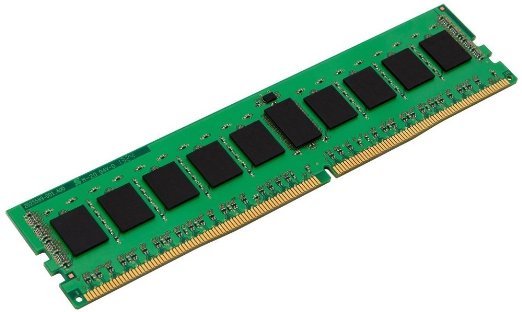
| Product Type | Memory Module |
|---|---|
| Compliance Standards | |
| Memory Capacity | 8 GB |
| Memory Technology | DDR4 |
| Product Voltage | 1.2 V |
| RAM Speed | 2133 MHz |
| RAM Standard | DDR4-2133/PC4-17000 |
| Error Identifying | ECC |
| Signal Type | Unbuffered |
| Column Access Strobe (CAS) | CL15 |
| Rank | Dual Rank x8 |
| Quantity of Pins | 288-pin |
| RAM Genre | UDIMM |
This 8GB DDR4-2133 UDIMM with ECC is best suited for entry-level servers and professional workstations running availability-sensitive workloads such as virtualization, file repositories, or light database instances. Its unbuffered dual-rank x8 configuration minimizes signal latency at CL15 while ECC error correction safeguards data integrity, making it a reliable choice for always-on environments that demand both performance and fault tolerance.
1. ECC memory detects and corrects single-bit errors, protecting critical data integrity in always-on server environments where even minor corruption can lead to downtime.
2. Unbuffered signal type eliminates the register chip to lower latency and power draw, suiting cost-conscious small business servers and NAS appliances that need straightforward reliability.
3. Dual rank organization interleaves access across internal banks, keeping the memory channel saturated for steady performance when hosting multiple virtual machines.
4. Low voltage operation cuts energy consumption and waste heat, enabling denser, cooler server chassis and reducing lifetime operational expenses for colocation deployments.
5. Mainstream DDR4 frequency provides ample bandwidth and broad platform compatibility for file serving, light virtualization, and entry-level enterprise workloads.
The Samsung M391A1G43DB0‑CPB, an 8GB DDR4 UDIMM with ECC and 288 pins, is engineered for entry‑level servers and workstations. Its four defining attributes—Error‑Correcting Code, unbuffered design, dual rank x8, and 1.2V operation—tackle the real pain points of always‑on, data‑sensitive environments. In a small business running a hypervisor with two virtual machines, ECC silently corrects single‑bit flips from background radiation, preventing silent corruption that could destabilize your accounting database and trigger costly downtime. The unbuffered layout keeps command‑to‑data latency minimal, so the host remains snappy even when multiple services contend for resources. On a dedicated NAS appliance, the dual rank configuration doubles bank interleaving, delivering higher sustained bandwidth that accelerates RAID parity checks and rebuilds while ECC safeguards file integrity from start to finish. When a financial analyst runs complex pivot tables inside a VM, that same rank interleaving eliminates data‑starved stalls. Meanwhile, the low 1.2V power envelope reduces thermal stress in tightly packed chassis, extending component lifespan and cutting your cooling overhead across years of 24/7 operation. This memory turns abstract specs into tangible reliability for workloads that cannot afford a single bit of error.
General Virtualization
For general virtualization hosts, populate at least four of these 8 GB ECC UDIMMs across available channels to achieve 32 GB total, ensuring memory bandwidth is balanced for moderate VM density. Favor symmetric DIMM population (e.g., one DIMM per channel) to avoid NUMA penalties on dual-socket boards, and leave headroom for a 20–30% memory overcommit without inducing ballooning or swapping.
In-Memory Database
In-memory databases demand capacity first; deploy a full set of identical modules—commonly eight 8 GB DIMMs for 64 GB on single-socket platforms—to hold entire datasets in RAM. Use dual-rank x8 modules like this one to maximize rank interleaving and sustain low latency under heavy OLTP workloads, and always configure identical DIMMs across all populated channels to prevent clocking to the slowest rank.
HPC
For HPC clusters, prioritize memory bandwidth per core; install one 8 GB ECC UDIMM per channel (six or eight modules depending on platform) to populate all memory channels and leverage the full DDR4-2133 throughput. Double the capacity per node only when working set exceeds 48 GB, otherwise keep the configuration lean to reduce power and thermal load in dense rack environments, while ECC guards against silent data corruption over long-running parallel jobs.
Rigorously tested, compatible with Dell PowerEdge R230, HPE ProLiant DL20 Gen9, Lenovo ThinkSystem ST250.
Q: Can I mix this M391A1G43DB0-CPB with other memory modules of different brands or speeds?
A: Mixing is not recommended. ECC UDIMM systems require identical specifications for stable operation. Mismatched speeds or vendors may degrade performance, cause parity errors, or prevent system boot.
Q: Is this memory compatible with my system?
A: It is compatible with server/workstation platforms supporting DDR4-2133 ECC Unbuffered DIMMs, such as Intel Xeon E3-1200 v5/v6 or select AMD Ryzen PRO series on certified mainboards.
Q: What is the recommended DIMM population order for optimal performance?
A: Populate identical modules per channel starting with the slot farthest from the CPU. For dual-channel servers, fill the blue slots first, ensuring symmetrical configurations across channels according to your board manual.
Q: Does this module support overclocking or XMP profiles?
A: No. This memory adheres strictly to JEDEC DDR4-2133 standards. ECC RDIMMs and UDIMMs prioritize data integrity and stability for 24/7 operation, thus overclocking is not supported or advised.
Q: What warranty and typical failure rate can I expect?
A: This module is backed by a one-year warranty. As a Samsung enterprise-grade ECC DIMM, it exhibits a very low annualized failure rate (AFR) under normal operating conditions, ensuring reliable long-term deployment.