











 Secure payments
Standard refund policy
Trade Assurance
Secure payments
Standard refund policy
Trade Assurance
| Product Type | Memory Module |
|---|---|
| Memory Capacity | 8 GB |
| Memory Technology | DDR4 |
| Product Voltage | 1.2V |
| RAM Speed | 2400MHz |
| RAM Standard | DDR4-2400/PC4-19200 |
| Error Identifying | ECC |
| Signal Type | Unbuffered |
| Column Access Strobe (CAS) | CL17 |
| Rank | Dual Rank x8 |
| Quantity of Pins | 288-pin |
| RAM Genre | UDIMM |
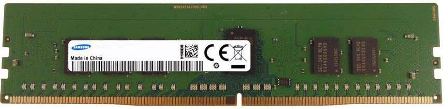
This UDIMM ECC DDR4-2400 module is best suited for single-socket servers and entry-level workstations handling integrity-sensitive workloads such as virtualization, ZFS storage, or light database operations. Its dual-rank x8 organization improves memory interleaving for higher effective throughput, while the unbuffered ECC design combines low CL17 latency with hardware-level error correction to maintain data reliability without the added latency of registered modules.
1. ECC protection silently corrects single-bit errors in real time, ensuring data integrity for always-on database services and financial transaction processing.
2. A compact capacity footprint comfortably hosts essential lightweight virtual machines and containerized microservices without wasting costly server resources.
3. Dual-rank organization keeps memory channels fully saturated, delivering predictable performance under heavy virtual machine consolidation and mixed-tenant workloads.
4. Elevated DDR4 data rates provide sufficient bandwidth headroom for concurrent request handling in web servers, caching layers, and entry-level storage appliances.
5. Unbuffered signal topology trims access latency and bill-of-materials cost, suiting small business servers that need uncompromising reliability without enterprise-grade complexity.
When you are running a virtualization host or an in-memory database on a small business server, silent memory errors are more than a nuisance—they can silently corrupt customer records or bring down critical virtual machines. This Samsung 8GB DDR4-2400 UDIMM (M391A1G43EB1-CRCQ0) is engineered to eliminate that risk. Its true ECC constantly detects and corrects single-bit data flips caused by cosmic radiation or electrical noise, delivering uncompromised data integrity for workloads like a Proxmox cluster hosting multiple VMs or a Redis instance processing transactional data at speed.
Beyond error correction, the module’s Dual Rank x8 architecture leverages rank interleaving, meaning the memory controller can issue commands to one rank while the other completes a cycle, effectively raising sustained bandwidth. For a database engine performing thousands of lookups per second, this translates directly into lower latency and higher throughput. The 1.2V low-voltage design also reduces power draw and thermal stress inside compact, always-on server chassis, cutting operational costs and extending component lifespan. Paired with its unbuffered footprint, this UDIMM is a purpose-built upgrade that maximizes platform compatibility and brings enterprise-grade reliability to entry-level servers, NAS appliances, and workstation tasks where every bit matters.
Based on the provided specifications—DDR4 2400MHz ECC Unbuffered UDIMM, 8GB capacity, dual-rank x8—this module is clearly server memory intended for entry-level servers and workstations that require data integrity without the cost of registered DIMMs.
General Virtualization
For light to moderate virtualization hosts, populate all available channels with two 8GB modules per channel (e.g., 4 x 8GB for dual-channel platforms) to reach 32GB total. This balanced configuration maximizes memory bandwidth while keeping ECC protection for multiple VMs. Avoid single-module setups, as they halve throughput and limit VM density.
In-Memory Database
In-memory databases like Redis or Memcached demand capacity above all. Use the maximum supported DIMM slots with 8GB modules—typically 4 or 8 sticks for 32GB or 64GB—to hold entire datasets in RAM. Prioritize symmetrical population across memory channels to maintain low latency, and consider the dual-rank advantage for slightly better bank-level parallelism.
High-Performance Computing (HPC)
HPC workloads benefit from consistent memory bandwidth. Populate all channels identically with one 8GB module per channel (e.g., 6 x 8GB for triple-channel or 8 x 8GB for octa-channel motherboards) to avoid performance penalties. The 2400MHz speed is sufficient for many compute-bound tasks, but balance core count to roughly 2–4GB per core to prevent swapping to storage.
Rigorously validated for ECC UDIMM servers/workstations: Dell Precision 3620, PowerEdge T30, HPE ML30 Gen10, etc.
Q: Can I mix this M391A1G43EB1-CRCQ0 with other memory modules of different brands or speeds?
A: Mixing is not recommended for server environments. For stability, populate all channels with identical ECC UDIMMs of the same brand, speed, rank, and CAS latency. Mismatched modules may cause system instability or disable ECC functionality.
Q: Is this memory compatible with my system?
A: This module is compatible with server motherboards supporting DDR4-2400 ECC Unbuffered UDIMMs. It fits platforms such as Intel Xeon E3-1200 v5/v6 or AMD Ryzen Pro series with 288-pin slots. Verify your server's QVL for confirmation.
Q: What is the recommended DIMM population order for optimal performance?
A: Refer to your server's manual. Generally, populate identical DIMMs in slots of the same color to enable dual-channel mode, starting with the slots farthest from the CPU. Even population across channels ensures balanced memory interleaving.
Q: Does this module support overclocking or XMP profiles?
A: No. This server-grade ECC UDIMM operates strictly at JEDEC-standard DDR4-2400 with 1.2V. It does not support XMP or overclocking, as reliability and data integrity are prioritized over performance tuning in server deployments.
Q: What warranty and typical failure rate can I expect?
A: This module includes a one-year warranty. It delivers enterprise-class reliability with a very low Annualized Failure Rate (AFR), thanks to rigorous testing and integrated ECC for on-the-fly data correction in mission-critical server environments.