











 Secure payments
Standard refund policy
Trade Assurance
Secure payments
Standard refund policy
Trade Assurance
| Model | M391A5143EB1-CPB |
|---|---|
| Product Type | Memory Module |
| Compliance Standards | EU RoHS,FCC |
| Memory Capacity | 4 GB |
| Memory Technology | DDR4 |
| Product Voltage | 1.2V |
| RAM Speed | 2133MHz |
| RAM Standard | DDR4-2133/PC4-17000 |
| Error Identifying | ECC |
| Signal Type | Unbuffered |
| Column Access Strobe (CAS) | CL15 |
| Rank | Single Rank x8 |
| Quantity of Pins | 288-pin |
| RAM Genre | UDIMM |
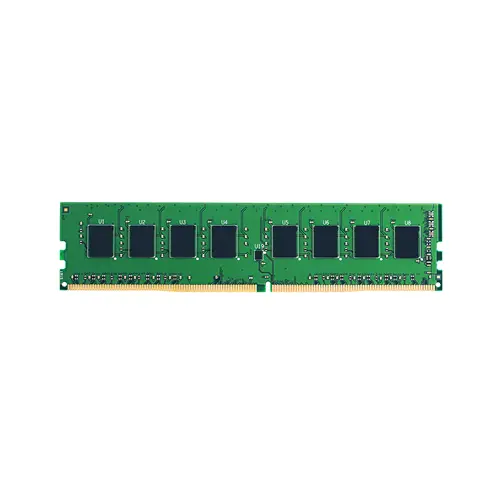
This ECC DDR4 UDIMM targets entry-level servers and workstations that demand data integrity, making it well-suited for file storage, light virtualization, or other critical productivity workloads where silent memory corruption is unacceptable. Its single-rank x8 architecture and unbuffered signal type promote broad platform compatibility and robust signal quality, while the integrated ECC corrects single-bit errors on the fly for continuous run-time reliability.
1. ECC error correction actively detects and fixes single-bit data corruption, which is essential for preserving financial transaction integrity and preventing silent data decay in long-running server workloads.
2. Unbuffered signal type eliminates the additional chip latency of registered memory, giving entry-level servers faster access to critical hot data for latency-sensitive caching tasks.
3. 4GB capacity provides a lean memory footprint ideal for dedicated lightweight services or containerized microservices, keeping cost per node minimal in scale-out deployments.
4. 2133MHz base frequency supplies stable and predictable bandwidth to match the throughput of entry-level server processors, ensuring consistent response times under moderate concurrent requests.
5. 1.2V ultra-low operating voltage reduces overall server power draw and waste heat, enabling denser rack configurations without exceeding cooling or energy budgets.
Samsung’s M391A5143EB1-CPB is a server- and workstation-class DDR4 UDIMM engineered to protect critical workloads where data accuracy cannot be compromised. Unlike desktop memory, this module is identified by its unbuffered ECC design, and its four defining traits work together to solve real reliability challenges. The built-in error‑correcting code actively detects and corrects single‑bit flips on the fly. For a small office running a virtualized file server and a lightweight customer database on a single host, a stray cosmic particle can silently corrupt a cached record; ECC prevents that bit error from cascading into transaction failures or backup silent corruption. Operating at a low 1.2V, the module significantly reduces thermal output inside a compact 1U chassis or an always‑on edge node, lowering cooling costs and extending system life. The 2133MHz JEDEC‑standard speed with CL15 timing provides predictable, stable bandwidth without overclocking risk, easily handling multiple lightweight VMs or a ZFS‑based NAS where checksums paired with ECC deliver end‑to‑end data integrity. Finally, the unbuffered architecture eliminates additional clocked registers, ensuring seamless compatibility and lower latency on Intel Xeon E and similar platforms that mandate UDIMM ECC. This directly translates into simpler deployment and more responsive real‑time services, giving IT admins a trusted foundation for applications that refuse to compromise between availability and data fidelity.
General Virtualization
For lightweight hypervisor hosts, deploy six to eight M391A5143EB1-CPB modules per server to achieve 24–32 GB of ECC-protected memory. This UDIMM’s unbuffered ECC design suits single-socket boards where moderate VM density is needed, balancing cost and data integrity. Enable memory interleaving in the BIOS to maximize throughput for concurrent guest OS execution.
In-Memory Database
In-memory databases demand capacity and reliability; populate all four channels of a single-socket platform with two modules each, totaling eight DIMMs (32 GB). The ECC capability detects and corrects single-bit errors, essential for transactional consistency. If dataset size exceeds this footprint, consider higher-capacity DIMMs, but for small-scale Redis or Memcached instances, eight-way matching x8 single-rank modules deliver deterministic latency thanks to uniform CAS 15 timings.
High-Performance Computing
HPC nodes benefit from balanced memory bandwidth. Install one M391A5143EB1-CPB per channel across four channels (four modules, 16 GB) to maximize per-core bandwidth in embarrassingly parallel workloads. The 2133 MT/s speed and single-rank x8 organization reduce bus loading, enabling stable operation when all DIMM slots are populated in dense compute clusters. Use identical modules across nodes to guarantee reproducible benchmark results and eliminate performance anomalies during MPI job scaling.
Rigorously tested server memory, compatible with Dell PowerEdge T30, T130, T330, HPE ML30 Gen9, and Lenovo ST50.
Q: Can I mix this M391A5143EB1-CPB with other memory modules of different brands or speeds?
A: Mixing is not recommended for server environments. Combining mismatched modules risks ECC errors and system instability. For reliable operation, always use identical modules with the same speed, rank, and timings.
Q: Is this memory compatible with my Intel Xeon E3 or AMD Ryzen PRO server?
A: This is a DDR4 ECC UDIMM designed for Intel Xeon E3, E-2100/2200, and AMD Ryzen PRO platforms. Ensure your motherboard explicitly supports unbuffered ECC memory for dependable server operation.
Q: What is the recommended DIMM population order for optimal performance?
A: Always follow your motherboard manual. Typically, populate DIMM_A1 first, then DIMM_B1 for dual-channel. Use matched pairs in each channel to maintain ECC integrity and achieve consistent memory bandwidth.
Q: Does this module support overclocking or XMP profiles?
A: No. As a server-grade ECC UDIMM, it strictly adheres to JEDEC DDR4-2133 standards. Overclocking or XMP is disabled to prioritize data integrity and long-term stability over peak speed.
Q: What warranty and typical failure rate can I expect?
A: It is covered by a 1-year warranty. When operated within JEDEC specifications, Samsung modules exhibit a very low annualized failure rate, delivering the reliability expected in mission-critical server deployments.