











 Secure payments
Standard refund policy
Trade Assurance
Secure payments
Standard refund policy
Trade Assurance
| Model | M391A5143EB1-CRC00 |
|---|---|
| Product Type | Memory Module |
| Compliance Standards | EU RoHS,FCC |
| Memory Capacity | 4 GB |
| Memory Technology | DDR4 |
| Product Voltage | 1.2V |
| RAM Speed | 2400MHz |
| RAM Standard | DDR4-2400/PC4-19200 |
| Error Identifying | ECC |
| Signal Type | Unbuffered |
| Column Access Strobe (CAS) | CL17 |
| Rank | Single Rank x8 |
| Quantity of Pins | 288-pin |
| RAM Genre | UDIMM |
This UDIMM module with ECC is tailored for entry-level servers, NAS appliances, and small workstations where data integrity is non-negotiable, leveraging unbuffered signaling and a single-rank x8 configuration for minimal electrical load and strong compatibility across Intel Xeon E and AMD Ryzen Pro platforms. With tight CL17 latency at 2400MHz and 1.2V operation, it delivers reliable error-corrected throughput ideal for memory-resident databases, light virtualization, and file services that benefit from stable, power-efficient performance.
1. ECC error correction actively detects and fixes single-bit memory errors, safeguarding critical server workloads from data corruption and unplanned downtime.
2. Unbuffered signal type reduces latency per access, which benefits latency-sensitive applications like lightweight virtualization and edge server deployments.
3. Single Rank x8 configuration presents a lighter electrical load on the memory controller, enhancing stability when populating multiple DIMMs in compact server builds.
4. 2400MHz speed and PC4-19200 bandwidth provide steady throughput for concurrent tasks, ensuring smooth operation in file serving and basic cloud workloads.
5. 1.2V low power consumption minimizes thermal output and operational cost, essential for small servers running 24/7 in constrained spaces.
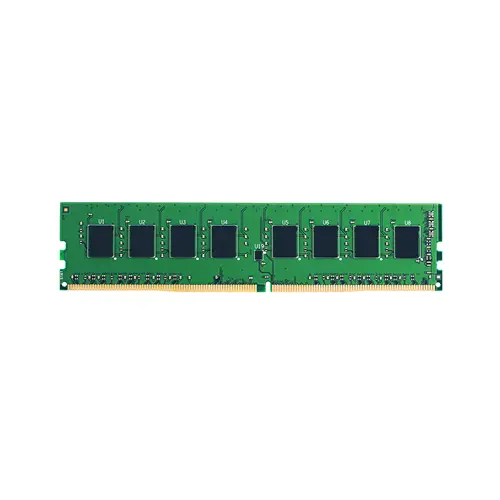
The M391A5143EB1-CRC00 is a DDR4 4GB UDIMM with ECC, easily identified by its unbuffered 288-pin form factor and error-correcting code—a definitive server memory module. This is not about raw capacity or flashy speed ratings; it is engineered for environments where a single bit flip can cascade into financial loss or application downtime. ECC means the module constantly scans for and corrects single-bit memory errors, a silent threat that occurs more frequently as server farms scale. In a virtualized cluster running multiple mission-critical VMs on a single host, an undetected memory corruption could instantly crash every tenant. ECC turns that unpredictable risk into a logged, corrected event, keeping your hypervisor stable and your customers online.
When you deploy an in-memory database engine like Redis or Memcached, every transaction lives in RAM. A random bit error in a customer’s shopping cart total or a financial ledger entry is unacceptable. This module’s DDR4-2400 speed and CL17 latency deliver the deterministic response required for caching, while the 1.2V low-voltage design directly reduces thermal load across dense server racks. Lower heat means lower fan speeds, which translates to meaningful OPEX savings in a colocation facility. The single-rank x8 organization also simplifies signal integrity when populating multiple slots, ensuring consistent boot and operation in file servers or lightweight database nodes where mixing ranks can cause compatibility headaches. Every design choice here serves a single purpose: eliminating doubts about data integrity while keeping operational costs predictable.
General Virtualization
This ECC UDIMM is ideal for small to mid-scale virtualization hosts running hypervisors like VMware ESXi or Proxmox. For light workloads (5–10 VMs), populate a single 4 GB module per channel to maintain memory bandwidth while keeping costs low. Scaling to 16–32 GB across four identical modules enables reliable multi-tenant consolidation with single-bit error correction.
In-Memory Database
Memory databases such as Redis or SAP HANA demand absolute data integrity and low latency. Deploy modules in matching pairs to maximize channel interleaving, starting with 32 GB (8×4 GB) for caching layers. For larger datasets, fill all available slots with identical 4 GB DIMMs to reach 64 GB, ensuring consistent CAS 17 timings and ECC protection against silent corruption.
High-Performance Computing (HPC)
HPC clusters often require balanced memory bandwidth per node. Use one module per memory channel to achieve optimal throughput with single-rank x8 configurations; for a dual-channel platform, install two 4 GB DIMMs. Scale density linearly—populate all channels with identical UDIMMs to avoid NUMA imbalances, and let ECC safeguard long-running simulation jobs against transient bit flips.
Validated through rigorous testing for servers like Dell PowerEdge T140, HPE ML30 Gen10, and Lenovo ST50.
Q: Can I mix this M391A5143EB1-CRC00 with other memory modules of different brands or speeds?
A: Mixing is not recommended. The ECC UDIMM requires matched specs to maintain error correction integrity. Different speeds or brands may force single-channel mode or cause instability, undermining server reliability.
Q: Is this memory compatible with my system?
A: It is designed for servers/workstations supporting DDR4 ECC Unbuffered DIMMs. Verified with Intel Xeon E-2100/E-2300 series and AMD Ryzen B550/X570 boards with ECC support. Confirm your board’s QVL for 4GB DDR4-2400 ECC UDIMM.
Q: What is the recommended DIMM population order for optimal performance?
A: Install identical modules in pairs within the same memory channel, typically slots A1 and B1 first. This enables dual-channel ECC operation, maximizing throughput and fault tolerance. Follow your motherboard’s manual.
Q: Does this module support overclocking or XMP profiles?
A: No. As a JEDEC-compliant server UDIMM, it operates only at DDR4-2400 with CL17 timings. Overclocking and XMP are unsupported to preserve ECC stability critical for 24/7 operation.
Q: What warranty and typical failure rate can I expect?
A: This module comes with a 1-year warranty. Built with Samsung original chips, its annualized failure rate is typically below 0.2% under proper operating conditions, ensuring long-term reliability.