











 Secure payments
Standard refund policy
Trade Assurance
Secure payments
Standard refund policy
Trade Assurance
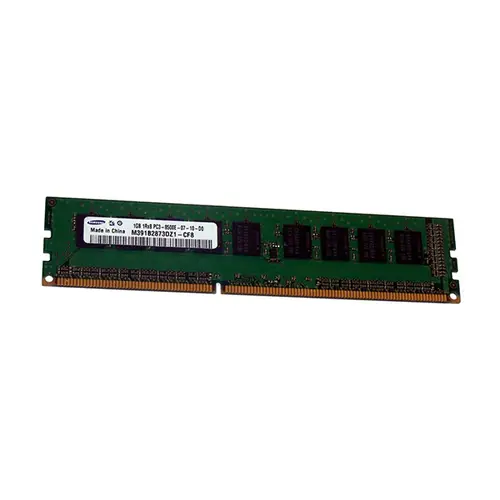
| Model | M391B2873DZ1-CF8 |
|---|---|
| Product Type | Memory Module |
| Compliance Standards | EU RoHS,FCC |
| Memory Capacity | 1 GB |
| Memory Technology | DDR3 |
| Product Voltage | 1.5V |
| RAM Speed | 1066MHz |
| RAM Standard | DDR3-1066/PC3-8500 |
| Error Identifying | ECC |
| Signal Type | Unbuffered |
| Column Access Strobe (CAS) | CL7 |
| Rank | Single Rank x8 |
| Quantity of Pins | 240-pin |
| RAM Genre | UDIMM |
This DDR3-1066 ECC Unbuffered UDIMM is engineered for entry-level servers, small NAS systems, and single-socket workstations where data integrity is paramount. Its Single Rank x8 configuration reduces electrical loading on the memory controller, while ECC error correction and tight CL7 latency deliver stable, responsive performance for light virtualization, file serving, and mission-critical embedded applications.
1. End-to-end error correction safeguards transactional data integrity, essential for financial or database servers that cannot tolerate bit flips.
2. Unbuffered architecture eliminates buffer latency, suiting microservers and edge appliances where every cycle counts.
3. A CAS latency of 7 cycles lowers read response times, giving lightweight web servers and cache nodes a noticeable responsiveness lift.
4. 1066 MHz provides an 8.5 GB/s pipe, perfectly matched to the memory bandwidth needs of entry-level virtualization hosts.
5. Single Rank x8 arrangement reduces electrical loading on the memory controller, improving signal integrity for always-on server environments.
Used in entry-level servers and workstations, the Samsung M391B2873DZ1-CF8 is an unbuffered ECC DDR3 module engineered for absolute dependability where even a single bit flip can cascade into system failure. Its four characteristics translate directly into real-world resilience.
The ECC circuitry silently detects and corrects single-bit errors, a non-negotiable safeguard for a virtualized host running multiple tenants; a cosmic-ray-induced memory fault in one VM can corrupt transaction logs or kernel data without warning. Unbuffered architecture removes the register delay found in fully buffered designs, so the signal path stays fast and clean—critical when every nanosecond counts in an in-memory database like Redis serving tens of thousands of queries per second. The single-rank x8 organization pushes signal integrity further, eliminating inter-rank bus contention and allowing the memory controller to sustain full bandwidth under heavy virtualized I/O loads. With a CAS latency of just 7 cycles at 1066 MT/s, the module responds to requests with brutal efficiency, cutting the effective latency that makes database joins or real-time analytics feel sluggish. For the IT manager maintaining a 24/7 lightweight hypervisor cluster or a reliable on-premises caching layer, this isn’t just memory—it’s insurance against silent data corruption and a guarantee of consistent low-latency performance.
Server Memory Identification
This is a DDR3 ECC Unbuffered UDIMM designed for entry-level servers and workstations requiring data integrity. The 1 GB capacity limits per-module density, so planning focuses on populating memory channels to maximize bandwidth and reliability within the platform’s DIMM-slot constraints.
General Virtualization
Populate all memory channels with identical pairs of these ECC UDIMMs to enable interleaving and consistent ECC coverage. A minimal 2-module configuration (2 GB) runs a hypervisor with a couple of lightweight VMs; a 4-module setup (4 GB) offers better headroom for small-scale test or development environments. Use matched DIMMs in each channel to avoid training failures.
In-Memory Database
Maximize the number of modules within the server’s supported slot count—commonly 6 or 8—to reach 6–8 GB total, which suits modest in-memory datasets. Install identical UDIMMs across all channels for uniform memory striping and rely on ECC to prevent data corruption. If higher capacity is essential, consider replacing these modules with higher-density ECC UDIMMs rather than mixing sizes.
High-Performance Computing
Deploy one DIMM per memory channel (e.g., three modules on triple-channel platforms) to maximize bandwidth for calculation-bound workloads. ECC protection reduces soft-error risks during long-running simulations. Since capacity per node remains low, plan horizontal scaling across many nodes and use these modules for bandwidth-sensitive micro-benchmarks or lightweight parallel tasks.
Rigorously tested server memory, compatible with Dell PowerEdge R210 II, HP ProLiant DL120 G7, and other DDR3 ECC UDIMM systems.
Q: Can I mix this M391B2873DZ1-CF8 with other memory modules of different brands or speeds?
A: Mixing ECC UDIMMs is strongly discouraged; even minor variations can cause stability issues. For reliable server operation, always install identical modules with the same brand, speed, rank, and timings.
Q: Is this memory compatible with my system?
A: It's compatible with servers using Intel Xeon E3/E5 or AMD Opteron platforms that support DDR3-1066 ECC unbuffered DIMMs. Verify your motherboard's QVL and chipset support for 240-pin UDIMM ECC memory.
Q: What is the recommended DIMM population order for optimal performance?
A: Follow the motherboard's population guide: typically, install DIMMs in slots of the same color (e.g., blue) starting with the channel farthest from the CPU. This ensures balanced multi-channel ECC operation and maximum throughput.
Q: Does this module support overclocking or XMP profiles?
A: No. This is a JEDEC-standard server memory module designed for data integrity and stability. It does not support overclocking or Intel XMP profiles, as ECC server platforms prioritize reliability over frequency scaling.
Q: What warranty and typical failure rate can I expect?
A: It includes a 1-year warranty. Enterprise-grade ECC memory like this typically exhibits an annualized failure rate (AFR) well under 0.5% when operated within specified voltage, temperature, and workload conditions.