











 Secure payments
Standard refund policy
Trade Assurance
Secure payments
Standard refund policy
Trade Assurance
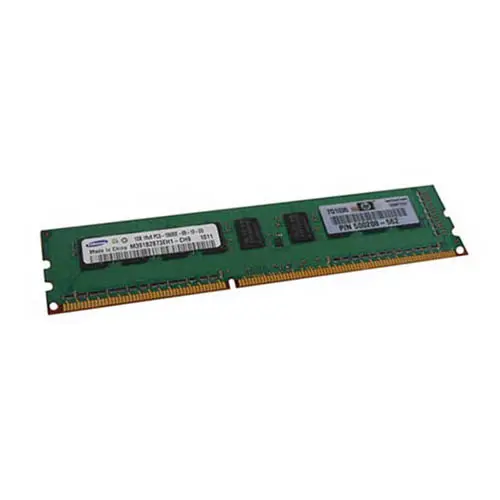
| Model | M391B2873EH1-CH9 |
|---|---|
| Product Type | Memory Module |
| Compliance Standards | EU RoHS,FCC |
| Memory Capacity | 1 GB |
| Memory Technology | DDR3 |
| Product Voltage | 1.5V |
| RAM Speed | 1333MHz |
| RAM Standard | DDR3-1333/PC3-10600 |
| Error Identifying | ECC |
| Signal Type | Unbuffered |
| Column Access Strobe (CAS) | CL9 |
| Rank | Single Rank x8 |
| Quantity of Pins | 240-pin |
| RAM Genre | UDIMM |
This DDR3 ECC UDIMM is best suited for entry-level servers or workstations using platforms like Intel Xeon E3 series, where data integrity is critical for file storage and light virtualization workloads. Its ECC error correction and single-rank x8 configuration ensure stable, low-latency operation at CL9, while the unbuffered design maintains compatibility and simplicity for cost-sensitive, always-on systems.
1. ECC protection actively corrects single-bit errors and detects multi-bit corruption, preserving data integrity in always-on file servers where silent bit flips could otherwise jeopardize archived records.
2. Unbuffered design strips out buffer latency, giving entry-level hosting environments quicker command-to-data turnaround crucial for lightweight web and DNS services.
3. 1333 MHz clock speed delivers a peak bandwidth appropriate for consistent request handling in legacy enterprise applications or small-scale virtualization nodes.
4. CL9 column access timing reduces stalls during random read bursts, improving responsiveness under database workloads that hammer small memory pages.
5. 1.5 V operating voltage aligns with standard DDR3 server rail specifications, simplifying electrical compatibility and thermal stability in dense, cost-optimized rack chassis.
Designed for entry-level servers and professional workstations, the Samsung M391B2873EH1-CH9 is a DDR3 Unbuffered ECC DIMM that brings enterprise-grade integrity into cost-sensitive environments. Its ECC circuitry actively detects and corrects single-bit memory errors in real time—errors that can silently corrupt financial records in a small business accounting server or flip a calculation in a scientific simulation. For a hypervisor host running multiple virtual machines, this means crash-free stability; for an always-on file server, it prevents the creeping data rot that leads to backup failures months later.
The unbuffered architecture eliminates the additional latency of a register chip, giving your CPU direct, low-latency access to memory. This translates into snappier response times for a Redis cache or a lightly loaded database server where every nanosecond counts during peak transaction bursts. Paired with a single-rank x8 organization, the module places minimal electrical load on the memory channel, ensuring wide compatibility with consumer-grade server chipsets and allowing you to populate all DIMM slots without sacrificing the rated 1333MHz speed. At a standard 1.5V, it also keeps thermals in check inside compact tower servers or cramped workstation cases during overnight rendering sessions. Whether you are virtualizing a lightweight dev cluster or building a ZFS-based NAS that must protect every bit, this module gives you the reliability of ECC without the complexity of registered memory.
General Virtualization
For lightweight hypervisors hosting multiple VMs, install modules in matched pairs to enable dual-channel mode, ensuring balanced memory bandwidth for concurrent workloads. For example, populate the server’s DIMM slots with six 1 GB sticks (totaling 6 GB) to allocate 2–3 GB per VM while keeping ECC protection active. Always consult the motherboard QVL and balance memory across CPU memory channels to avoid bottlenecks.
In-Memory Database
These workloads demand capacity far beyond what a single 1 GB stick can supply, so this module only suits very small caching instances or test environments. Combine as many identical ECC UDIMMs as the board supports—typically up to 32 GB across four slots—to maximize data held in RAM and reduce disk I/O. Use the same rank and CAS latency configuration throughout to maintain stability under sustained write-intensive loads.
High-Performance Computing
HPC clusters processing dense linear algebra or fluid dynamics simulations benefit from populating all memory channels evenly, even with modest capacity per node. Configure four or eight single-rank modules per node to deliver low latency and uniform access times, while the unbuffered ECC design minimizes memory controller loading for speed-sensitive parallel jobs. Ensure the CPU’s memory interleaving policy is set to optimize for bandwidth, and validate results with memory stress tests before deployment.
Server-grade memory rigorously tested, compatible with Dell PowerEdge T110 II, T20, HP MicroServer Gen8, Lenovo TS140.
Q: Can I mix this M391B2873EH1-CH9 with other memory modules of different brands or speeds?
A: Mixing is not recommended for ECC UDIMMs. All modules may default to the lowest speed, risking stability and jeopardizing error correction. For guaranteed reliability, use identical modules.
Q: Is this memory compatible with my Intel Xeon E3 or AMD Opteron server platform?
A: It fits server boards supporting DDR3 ECC unbuffered DIMMs, notably Intel Xeon E3-1200 series and equivalent AMD platforms. Verify your motherboard's QVL list for exact compatibility.
Q: What is the recommended DIMM population order for optimal performance?
A: Populate slots per your server board manual, typically filling channels starting from the slot farthest from the CPU. For dual-channel, install identical pairs in matching color slots first.
Q: Does this module support overclocking or XMP profiles?
A: No. This is a JEDEC-compliant server-grade ECC DIMM. It operates strictly at DDR3-1333 with CL9 timing and does not support overclocking or XMP profiles.
Q: What warranty and typical failure rate can I expect?
A: It includes a 1-year warranty. This Samsung server memory is built with high-grade components, delivering an extremely low annualized failure rate typical of enterprise-class modules.