











 Secure payments
Standard refund policy
Trade Assurance
Secure payments
Standard refund policy
Trade Assurance
| Model | M391B2873FH0-YH9 |
|---|---|
| Product Type | Memory Module |
| Compliance Standards | EU RoHS,FCC |
| Memory Capacity | 1 GB |
| Memory Technology | DDR3 |
| Product Voltage | 1.35V |
| RAM Speed | 1333MHz |
| RAM Standard | DDR3-1333/PC3-10600 |
| Error Identifying | ECC |
| Signal Type | Unbuffered |
| Column Access Strobe (CAS) | CL9 |
| Rank | Single Rank x8 |
| Quantity of Pins | 240-pin |
| RAM Genre | UDIMM |
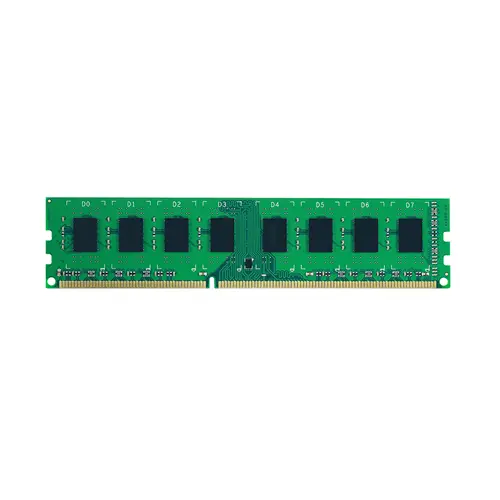
Designed as an unbuffered ECC UDIMM for entry-level servers and workstations, this 1GB DDR3-1333 module operates at a low 1.35V for improved energy efficiency. Its ECC and single-rank x8 configuration ensure data integrity and stable signal quality, making it ideal for lightweight virtualization, file serving, and always-on microserver workloads where reliability matters more than capacity.
1. ECC protection silently corrects single-bit errors, preserving data integrity for always-on entry server workloads where memory faults cannot be tolerated.
2. 1.35V low-voltage operation cuts power consumption and thermal output, helping small business servers reduce energy bills and maintain cooler rack environments.
3. 1333 MHz data rate provides a stable bandwidth foundation for light virtualization and file-sharing duties without introducing unnecessary latency.
4. Unbuffered UDIMM architecture lowers platform cost while delivering the reliability benefits of ECC, ideal for budget-conscious server builds and workstations.
5. Single Rank x8 organization minimizes electrical loading on the memory controller, improving signal integrity and ensuring broad compatibility across single-socket server boards.
The Samsung M391B2873FH0-YH9 is a server-grade DDR3 UDIMM engineered for reliability-driven workloads where data integrity and energy efficiency are non-negotiable. Its ECC (Error-Correcting Code) capability is the first critical safeguard: in a high-density virtualization cluster, a single undetected bit-flip caused by background radiation can silently corrupt a hypervisor’s memory space, crashing dozens of guest machines. ECC automatically corrects these single-bit errors in real time, directly reducing unplanned downtime and preserving transactional consistency. Equally vital is the module’s low-voltage 1.35V operation, which scales across racks of always-on servers—cutting thermal waste and cumulative power draw without sacrificing the stable 1333MHz clock speed. In an in-memory database like Redis or SAP HANA, the unbuffered architecture and single-rank x8 organization deliver deterministic, low-latency access, preventing the load-reduction buffer lag that would otherwise stall high-frequency query spikes. Combined with a tight CL9 latency, this ensures predictable response times under heavy concurrent reads, converting electrical specifications into tangible operational resilience for your data center.
The M391B2873FH0-YH9 is a 1GB DDR3-1333 ECC unbuffered DIMM for entry-level servers (1.35V low-power). Capacity planning focuses on channel population.
General Virtualization
Virtualization needs abundant RAM. With 1GB sticks, install matched pairs in all slots to enable dual-channel interleaving (e.g., 12 modules = 12GB). This suffices only for light test VMs; deploy higher-capacity DIMMs for production. Always use identical modules per channel to leverage ECC and prevent instability.
In-Memory Database
In-memory databases require large capacity. Fully populating 16 slots yields just 16GB, inadequate for production. Use these modules for dev/test environments where ECC adds integrity; treat them as a stepping stone to 8GB+ DIMMs. Populate symmetrically to maximize error correction efficiency.
HPC
HPC favors memory bandwidth. Install one module per channel to reduce loading and achieve balanced interleaving. A dual-socket server (4 channels/CPU) reaches 8–16GB. ECC ensures data integrity for long runs; compensate capacity by scaling nodes. The 1.35V operation also improves energy efficiency in dense clusters.
Rigorously tested for compatibility with servers like Dell PowerEdge R210 II and HP ProLiant MicroServer Gen8.
Q: Can I mix this M391B2873FH0-YH9 with other memory modules of different brands or speeds?
A: Mixing is not recommended for server environments. Using identical modules ensures consistent ECC functionality and prevents signal integrity issues that can cause system instability or data corruption under load.
Q: Is this memory compatible with my Intel Xeon or AMD Opteron server platform?
A: It is compatible with platforms supporting DDR3 ECC Unbuffered DIMMs. Please verify your motherboard accepts 240-pin UDIMM with 1.35V and confirms support for 1333MHz single-rank x8 modules.
Q: What is the recommended DIMM population order for optimal performance?
A: Always follow your server motherboard manual. Typically, populate identical DIMMs per channel starting from the furthest slot to balance memory interleaving and maintain effective ECC multi-bit error protection.
Q: Does this module support overclocking or XMP profiles?
A: No. This is a JEDEC-compliant server UDIMM built for stability and data integrity. It does not support overclocking or XMP profiles, prioritizing reliable 24/7 operation over performance tuning.
Q: What warranty and typical failure rate can I expect?
A: This module includes a one-year warranty. Designed with enterprise-grade components, it delivers a very low annualized failure rate, ideal for mission-critical servers requiring sustained uptime and data integrity.