











 Secure payments
Standard refund policy
Trade Assurance
Secure payments
Standard refund policy
Trade Assurance
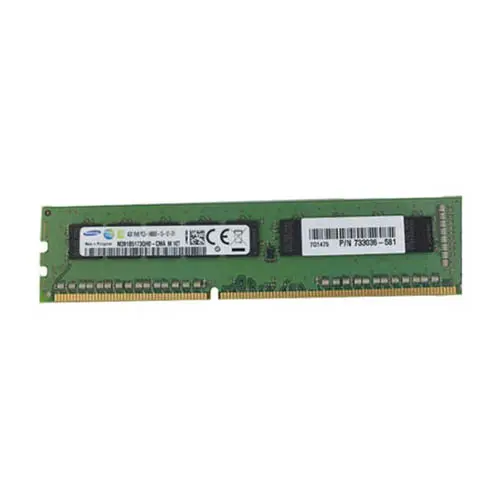
| Model | M391B5173QH0-CMA |
|---|---|
| Product Type | Memory Module |
| Compliance Standards | EU RoHS,FCC |
| Memory Capacity | 4 GB |
| Memory Technology | DDR3 |
| Product Voltage | 1.5V |
| RAM Speed | 1866MHz |
| RAM Standard | DDR3-1866/PC3-14900 |
| Error Identifying | ECC |
| Signal Type | Unbuffered |
| Column Access Strobe (CAS) | CL13 |
| Rank | Single Rank x8 |
| Quantity of Pins | 240-pin |
| RAM Genre | UDIMM |
Evaluated as a server and workstation memory module, this DDR3-1866 UDIMM with ECC is ideally suited for entry-level single-socket servers, NAS systems, and professional workstations where data integrity is critical. Its single-rank x8 organization and tight CL13 latency deliver a balanced combination of signal stability and responsive performance under memory-intensive, error-sensitive workloads such as file serving and light virtualization.
1. ECC protection actively corrects single-bit memory errors, preserving data integrity for financial transactions and critical database workloads in always-on server environments.
2. 1866MHz clock speed accelerates memory access, reducing latency for virtualization hosts that juggle numerous concurrent virtual machines.
3. Unbuffered signaling minimizes electrical load on the memory bus, ensuring reliable operation in dense microserver clusters where every watt and signal counts.
4. Single Rank x8 organization concentrates all DRAM chips onto one rank, lowering power draw and thermal stress inside compact 1U rack servers.
5. CL13 column access strobe latency delivers swift data retrieval, helping latency-sensitive applications like high-frequency trading platforms maintain deterministic response times.
Targeted at entry-level servers and single-socket workstations, the Samsung M391B5173QH0-CMA is a DDR3-1866 Unbuffered ECC UDIMM designed to safeguard critical workloads. For a small business running a 24/7 file server or a lightweight virtualization host, silent data corruption is a real and costly danger—a single-bit error caused by cosmic radiation can flip a financial entry in an accounting database without warning. The integrated Error-Correcting Code actively detects and corrects these errors in real time, ensuring your transactional data remains absolutely accurate and your business reputation intact. Meanwhile, the Unbuffered architecture eliminates the extra clock cycle introduced by registered modules, delivering lower access latency. This becomes a decisive advantage in a high-frequency financial analysis workstation where every nanosecond matters during algorithm execution. The 1866MHz clock speed paired with a CL13 latency provides responsive throughput, while the single-rank x8 configuration guarantees broad electrical compatibility with a wide range of single-processor server motherboards. This module means true data integrity and deterministic performance in environments where reliability is never optional.
Server Memory Identified
The module M391B5173QH0-CMA is a DDR3 ECC Unbuffered DIMM (UDIMM), typically used in entry-level single-socket servers and workstations. Its 4GB capacity, 1866MHz speed, and 1.5V operating voltage define the building block for the following capacity planning scenarios.
General Virtualization
Virtualized hosts prioritize memory quantity over extreme speed. Using this 4GB ECC UDIMM, populate all available DIMM slots (commonly four per channel) to reach 32GB or 64GB, balancing cost and VM density. Enable memory interleaving in the BIOS for moderate throughput; a 4x4GB configuration per CPU is a typical starting point for light to medium workloads.
In-Memory Database
In-memory databases require the largest possible capacity and data integrity. Fill every DIMM slot with these ECC modules to maximize total RAM—often 64GB or 128GB on single-socket platforms. Prioritize identical batches of 4GB sticks to ensure stability under constant full-load writes, and never mix unbuffered ECC with non-ECC memory.
High-Performance Computing (HPC)
HPC workloads benefit from balanced memory channels and high bandwidth. Install modules in multiples matching the CPU’s memory channels (typically four) for optimal interleaving, e.g., 4x4GB or 8x4GB. Keeping DIMMs identical, single-rank, and populating all channels minimizes latency and boosts sustained throughput for parallel computations.
Rigorously tested ECC UDIMM compatible with Dell R210 II, HP MicroServer Gen8, Lenovo TS140.
Q: Can I mix this M391B5173QH0-CMA with other memory modules of different brands or speeds?
A: Mixing is not recommended for server environments. ECC UDIMMs require identical ranks, timings, and organization to maintain stability. Even slight mismatches risk parity errors and system crashes.
Q: Is this memory compatible with my system?
A: It is designed for servers/workstations supporting DDR3 ECC Unbuffered DIMMs, such as Intel Xeon E3/E5 v2/v3 platforms or AMD Opteron 3000 series. Verify your motherboard and CPU explicitly support ECC UDIMMs.
Q: What is the recommended DIMM population order for optimal performance?
A: Follow your server board’s manual. Typically, populate identical DIMMs in the farthest channel slots from the CPU first, then symmetric slots to enable dual-channel interleaving and balanced memory access.
Q: Does this module support overclocking or XMP profiles?
A: No. As enterprise server memory, it operates strictly at JEDEC standard DDR3-1866 CL13 (1.5V) without XMP or overclocking support. Stability and data integrity take priority over frequency tuning in server environments.
Q: What warranty and typical failure rate can I expect?
A: Backed by a 1-year warranty. Built with Samsung’s enterprise-grade DRAM and rigorous testing, this module demonstrates an extremely low annualized failure rate (AFR) typical for server UDIMM ECC products, well below 0.1% under nominal conditions.