











 Secure payments
Standard refund policy
Trade Assurance
Secure payments
Standard refund policy
Trade Assurance
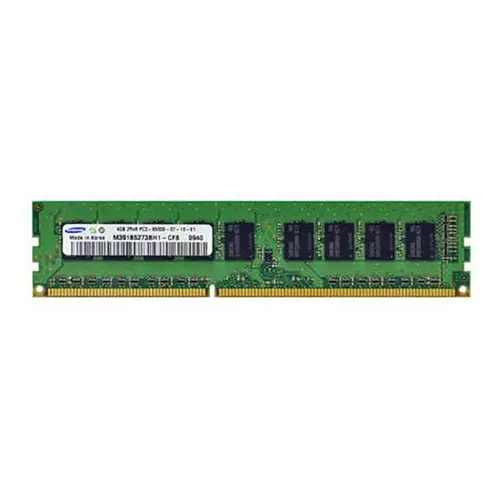
| Model | M391B5273BH1-CF8 |
|---|---|
| Product Type | Memory Module |
| Compliance Standards | EU RoHS,FCC |
| Memory Capacity | 4 GB |
| Memory Technology | DDR3 |
| Product Voltage | 1.5V |
| RAM Speed | 1066MHz |
| RAM Standard | DDR3-1066/PC3-8500 |
| Error Identifying | ECC |
| Signal Type | Unbuffered |
| Column Access Strobe (CAS) | CL7 |
| Rank | Dual Rank x8 |
| Quantity of Pins | 240-pin |
| RAM Genre | UDIMM |
This unbuffered ECC DDR3 module is designed for entry-level servers and workstations that demand data integrity for light virtualization, file serving, or memory-dependent applications. Its dual-rank x8 organization and low CL7 latency enhance bandwidth efficiency and responsiveness, while ECC error correction ensures reliable 24/7 operation in mission-critical environments.
1. Error-correcting code protection silently detects and fixes single-bit memory errors, preserving data integrity for critical financial or virtualization host workloads that cannot tolerate silent corruption.
2. Dual Rank x8 organization feeds each memory channel with interleaved access patterns, sustaining higher bandwidth efficiency when multiple virtual machines contend for shared resources.
3. DDR3-1066 transfer rate provides a cost-optimized throughput ceiling for entry-level server roles, comfortably handling file, print, or lightweight application serving without overshooting energy budgets.
4. CAS 7 column access latency shortens the wait between a data request and its delivery, directly improving database query responsiveness on lightly loaded departmental servers.
5. Standard 1.5-volt signaling aligns with legacy server board designs and rack power limitations, maintaining stable thermal margins inside airflow-constrained chassis during continuous operation.
The Samsung M391B5273BH1-CF8 is an unbuffered ECC DDR3 UDIMM designed for entry-level servers and workstations where data integrity directly impacts business continuity. In a small-business file server or a network-attached storage appliance, the ECC function is non-negotiable: it actively detects and corrects single-bit memory errors caused by background radiation, preventing silent data corruption that could irreversibly damage financial records or customer files. For a lightly virtualized environment running a pair of guest machines, this module’s dual-rank x8 organization enables memory interleaving that lowers access latency and improves bandwidth, so a hypervisor can service concurrent I/O requests from multiple VMs without stuttering. The same dual-rank advantage proves valuable when hosting an in-memory database like Redis for real-time inventory lookups, where every nanosecond of CAS 7 latency and the predictable signal integrity of a 240-pin UDIMM translates into faster transactions and a smoother user experience. Because the module operates at the standard 1.5V with unbuffered signaling, it generates less heat than registered alternatives, which helps maintain long-term reliability inside compact server chassis with limited airflow—turning a basic hardware refresh into a safeguard for mission-critical uptime.
General Virtualization
For general virtualization hosts using this Samsung 4GB DDR3-1066 ECC unbuffered DIMM, populate all available memory channels in balanced configurations (e.g., four identical modules for dual-channel or triple-channel architectures) to maximize memory bandwidth while leveraging ECC for service stability. Aim for a minimum of 16 GB (4x4GB) to comfortably run 4–6 light VMs; scale to 32 GB using eight modules on dual-socket boards where UDIMM support permits.
In-Memory Database
In-memory databases demand both capacity and data integrity—ECC is mandatory, making this module a safe, low-cost building block. Use as many identical modules as the platform’s UDIMM slots allow (often 4 or 6 DIMMs per socket) to reach 16–24 GB, enough for small Redis or Memcached instances. For better performance, select matched kits and configure memory interleaving; note that the 1066 MT/s speed may become a bottleneck for larger, throughput-heavy caches, so prioritize capacity over latency.
High-Performance Computing (HPC)
HPC clusters using UDIMM ECC memory often run dense, parallel jobs where error resilience is critical. Equip each node with the maximum supported UDIMM count—typically 4×4GB for dual-channel platforms or 6×4GB for triple-channel Xeon E3 systems—to deliver 16–24 GB per node. Although 1066 MT/s limits peak bandwidth, dual-rank x8 modules improve bank-level parallelism; pair with CPUs offering large L3 caches to offset the lower transfer rate and maintain acceptable floating-point throughput in memory-bound workloads.
Tested rigorously for compatibility with servers like Dell PowerEdge R210 II, HP ProLiant DL120 G7, and Lenovo ThinkServer TS130.
Q: Can I mix this M391B5273BH1-CF8 with other memory modules of different brands or speeds?
A: Mixing is not recommended. Unmatched DIMMs may cause instability or disable ECC functionality. For reliable enterprise operation, install identical Samsung M391B5273BH1-CF8 modules with the same rank and timing.
Q: Is this memory compatible with my server or workstation using Intel Xeon or AMD Opteron platforms?
A: It is compatible with systems supporting DDR3 ECC Unbuffered UDIMMs. Verify your motherboard specifically supports 4GB Dual Rank x8 PC3-8500 modules at 1.5V before purchase.
Q: What is the recommended DIMM population order for optimal performance in a server board?
A: Refer to your motherboard manual. Typically, install matching pairs starting from the slots farthest from the CPU per channel to enable dual-channel interleaved ECC mode for maximum throughput.
Q: Does this module support overclocking or XMP profiles for higher memory speeds?
A: No. This is a JEDEC-compliant server memory designed for 1066MHz operation. It does not support overclocking or XMP, as stability and data integrity are critical in server environments.
Q: Can this DDR3 ECC UDIMM be used in a standard desktop PC motherboard?
A: Only if your desktop motherboard and CPU explicitly support ECC Unbuffered memory. Most consumer platforms do not; using it on incompatible boards will result in no POST or disabled ECC.