











 Secure payments
Standard refund policy
Trade Assurance
Secure payments
Standard refund policy
Trade Assurance
| Model | M391B5273CH0-CH9 |
|---|---|
| Product Type | Memory Module |
| Compliance Standards | EU RoHS,FCC |
| Memory Capacity | 4 GB |
| Memory Technology | DDR3 |
| Product Voltage | 1.5V |
| RAM Speed | 1333MHz |
| RAM Standard | DDR3-1333/PC3-10600 |
| Error Identifying | ECC |
| Signal Type | Unbuffered |
| Column Access Strobe (CAS) | CL9 |
| Rank | Dual Rank x8 |
| Quantity of Pins | 240-pin |
| RAM Genre | UDIMM |
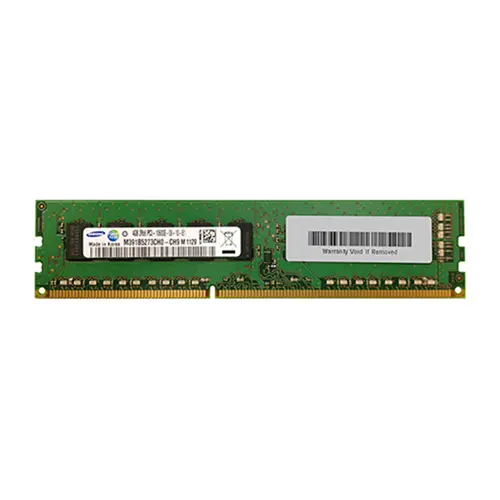
Targeted at entry-level servers and workstations requiring data integrity, this DDR3-1333 ECC UDIMM leverages unbuffered signal type for lower latency and dual-rank x8 organization to improve memory interleaving efficiency. Its error-correcting code (ECC) capability ensures critical data reliability for always-on applications such as small business servers and scientific computing workloads.
1. ECC error correction silently detects and fixes single-bit data faults, safeguarding transaction accuracy in a 24/7 file server or domain controller.
2. Unbuffered architecture cuts signal latency, giving lightweight on-premises applications snappier response without adding registered clock overhead.
3. Dual rank x8 organization balances bank-level parallelism while keeping electrical loading manageable, sustaining steady throughput during simultaneous lightweight VM operations.
4. Four-gigabyte module granularity enables cost-conscious right-sizing for dedicated web hosting or network appliance workloads that need stable memory but not maximum density.
5. 1333 MHz operation with CL9 timings supplies consistent bandwidth on legacy server boards, helping maintain smooth database lookups under sustained moderate concurrency.
The Samsung M391B5273CH0-CH9 is a DDR3 Unbuffered ECC UDIMM built specifically for entry-level servers and workstations, where data integrity and dependable performance directly impact your operations. The on-die ECC engine silently detects and corrects single-bit errors that naturally occur due to background radiation, meaning your virtualized cluster won’t suffer unexplained VM crashes or file corruption in a 24/7 hosted environment. Its dual-rank x8 construction enables rank interleaving, letting the memory controller access one rank while the other completes a refresh cycle; for an in-memory database like Redis or a heavily queried MySQL instance, this translates to lower access latency and smoother transaction throughput during peak loads. The unbuffered architecture avoids the extra clock cycle that registered modules introduce, so you get straightforward plug-and-play compatibility across a wide range of Intel and AMD server platforms along with slightly faster signal response, which helps keep critical services snappy. At 1333MHz with a CAS latency of 9, the module strikes a mature balance between speed and rock‑solid stability, preventing timing-related hangs when your virtualization host is juggling two dozen containers. In short, this cost‑effective module gives your infrastructure the error‑free reliability and consistent speed it needs without compromising your budget.
General Virtualization
For light to moderate VM density, populate six to eight identical M391B5273CH0-CH9 4 GB modules across triple‑channel or dual‑channel memory controllers, yielding 24–32 GB of ECC‑protected capacity. Keep one DIMM per channel when latency‑sensitive VMs dominate, or add a second DIMM per channel to prioritize total memory over peak bandwidth. Always enable memory interleaving in the BIOS and budget for a 15–20 % spare capacity headroom to absorb failover and ballooning.
In-Memory Database
In‑memory workloads demand capacity over sheer frequency, so fill all available DIMM slots with these 4 GB UDIMMs to reach the platform’s maximum—typically 32 GB on a single‑socket Xeon E3 or similar. Use dual‑rank DIMMs in a dual‑channel symmetric layout to sustain the highest sustainable throughput under heavy key‑value store loads. Monitor corrected single‑bit error rates via IPMI; replace any module that exceeds 10 corrected errors per day to avoid silent data corruption.
High-Performance Computing
HPC nodes that leverage DDR3‑1333 UDIMMs often belong to cost‑optimized cluster segments. Deploy eight matching modules (32 GB total) per node in a balanced dual‑channel configuration to maximize memory bandwidth for memory‑bound MPI jobs. Lower latency CL9 and dual‑rank design help maintain stream triad bandwidth near 21 GB/s per channel. For scale‑out mini‑clusters, stocking identical Samsung M391B5273CH0‑CH9 DIMMs guarantees uniform power draw and thermal behavior across hundreds of nodes, simplifying capacity forecasting.
Rigorously tested, this server ECC UDIMM is compatible with Dell PowerEdge T110 II, R210 II, HP MicroServer Gen8.
Q: Can I mix this M391B5273CH0-CH9 with other memory modules of different brands or speeds?
A: Not advised. This ECC UDIMM will downclock to the slowest module. Mixing ECC and non-ECC disables error correction. For mission‑critical stability, install identical modules with matching rank and organization.
Q: Is this memory compatible with my system?
A: It fits servers or workstations using DDR3 ECC UDIMMs, such as Intel Xeon E3‑1200 v1/v2, E5‑1600/2600 v1/v2 on C202/C204/C602 chipsets, or AMD Opteron platforms that support 240‑pin unbuffered ECC memory.
Q: What is the recommended DIMM population order for optimal performance?
A: Consult your motherboard manual. Typically, populate the slots farthest from the CPU per channel first, using matched modules. For dual‑rank x8 modules like this, fill identical channels in pairs to maintain interleaving and ECC integrity.
Q: Does this module support overclocking or XMP profiles?
A: No. This JEDEC‑compliant server UDIMM targets reliable 1333MHz operation at CL9 with ECC. Overclocking and XMP are not supported; platform stability and data integrity are the priorities.
Q: What warranty and typical failure rate can I expect?
A: Covered by a 1‑year warranty. Built to Samsung’s rigorous standards, this module exhibits an annualized failure rate below 0.5% under normal server operating conditions, ensuring proven enterprise‑grade reliability.