











 Secure payments
Standard refund policy
Trade Assurance
Secure payments
Standard refund policy
Trade Assurance
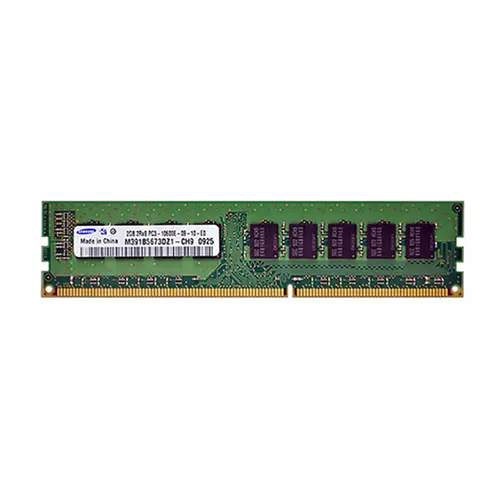
| Model | M391B5673DZ1-CH9 |
|---|---|
| Product Type | Memory Module |
| Compliance Standards | EU RoHS,FCC |
| Memory Capacity | 2 GB |
| Memory Technology | DDR3 |
| Product Voltage | 1.5V |
| RAM Speed | 1333MHz |
| RAM Standard | DDR3-1333/PC3-10600 |
| Error Identifying | ECC |
| Signal Type | Unbuffered |
| Column Access Strobe (CAS) | CL9 |
| Rank | Dual Rank x8 |
| Quantity of Pins | 240-pin |
| RAM Genre | UDIMM |
Designed as an ECC Unbuffered DDR3 UDIMM, this module is ideal for entry-level servers and micro-servers running virtualization or light database workloads where data integrity is paramount. Its dual-rank x8 organization and CL9 latency provide a balanced combination of memory interleaving efficiency and reliable error correction, ensuring stable operation in 24/7 environments.
1. ECC protection silently corrects single-bit memory errors, preventing data corruption in always-on servers that handle financial transactions or database operations.
2. Unbuffered UDIMM signal topology trims module latency, giving entry-level server builds a cost-effective path to dependable operation under steady workloads.
3. Dual Rank x8 organization interleaves memory banks to sustain balanced throughput, keeping virtual machines responsive during moderate consolidation.
4. The 1333 mega-transfer rate feeds typical enterprise tasks like web serving and file sharing with sufficient bandwidth while simplifying thermal management.
5. A compact 2-gigabyte capacity suits dedicated appliance servers or embedded systems where a small, stable memory footprint is prioritized over maximum density.
The Samsung M391B5673DZ1-CH9 is a 2GB DDR3-1333 ECC Unbuffered DIMM, purpose-built for entry-level servers and professional workstations where data integrity and responsive performance directly impact your business. Its four defining characteristics solve real operational pain points. First, Error Correcting Code (ECC) detects and corrects single-bit memory errors on the fly, eliminating silent data corruption that can crash a virtualized host or poison a financial transaction log. In a multi-tenant virtualization cluster, this means uninterrupted VM uptime and zero risk of corrupted database states—your Redis or MySQL instances stay accurate and available 24/7. Second, the Unbuffered architecture forgoes a register chip, delivering lower latency compared to registered alternatives. For a video editor scrubbing through 4K timelines, every nanosecond matters; unbuffered direct access reduces lag between your commands and the CPU, keeping the creative flow snappy. Third, the Dual Rank x8 organization enables rank interleaving, which overlaps memory accesses to boost bandwidth under heavy concurrency. When your virtualized server farm runs dozens of lightweight containers, dual ranks sustain smooth throughput instead of choking on simultaneous I/O requests. Finally, CL9 latency at 1333MHz keeps column access strobe delays tight, meaning heavy random-access workloads like 3D rendering or in-memory analytics fetch data without unnecessary wait states. This module translates into tangible outcomes: your virtual machines stay reliable, your renders finish without artifacts, and your critical applications avoid costly downtime caused by bit flips—protection a generic desktop memory simply cannot offer.
General Virtualization
For a basic hypervisor host, ECC UDIMMs ensure data integrity during guest consolidation. Given the small 2 GB module size, populate all available DIMM slots to reach at least 16–32 GB total. A balanced configuration pairs four or eight identical M391B5673DZ1 modules per memory channel to maximize interleaving and sustain stable multi-VM operation.
In-Memory Database
Capacity is the primary constraint for in-memory datasets, so this 2 GB DIMM is only suitable for lightweight caching or test instances. Deploy six to eight modules in a dual-socket, triple-channel setup to achieve 12–16 GB of fully buffered ECC RAM. Use all identical ranks to maintain consistent latency and prevent data corruption under continuous write pressure.
High-Performance Computing (HPC)
HPC workloads demand peak memory bandwidth rather than sheer volume. Install one DIMM per channel across all four channels of a single-socket server, yielding 8 GB total with quad-channel interleaving. The dual-rank x8 organization of this module already optimizes bank-level parallelism, and the ECC capability protects long-running simulations against silent bit errors.
Strictly tested server memory; compatible with Dell PowerEdge R210 II, T110 II, HP ProLiant ML110 G7.
Q: Can I mix this M391B5673DZ1-CH9 with other memory modules of different brands or speeds?
A: Mixing ECC UDIMMs of different brands or speeds is strongly discouraged. Inconsistent timing parameters or signal integrity can trigger ECC errors and compromise server stability.
Q: Is this memory compatible with my system? (Server platforms: Intel Xeon E3 series with C200 chipset, or AMD AM3+ boards that support ECC UDIMM)
A: This DDR3-1333 ECC UDIMM is validated for Intel Xeon E3-1200 series and C202/C204/C206 chipsets, as well as select AMD platforms. Verify your motherboard supports unbuffered ECC DDR3 modules.
Q: What is the recommended DIMM population order for optimal performance?
A: Install the dual-rank module in the primary DIMM slot of each channel (usually slot A1 or 1). For dual-channel, populate the farthest slots from the CPU first. Always consult your server board manual.
Q: Does this module support overclocking or XMP profiles?
A: No. This server-grade ECC UDIMM adheres strictly to JEDEC DDR3-1333 CL9 specifications and does not include XMP profiles. Overclocking is unsupported and may jeopardize data integrity.
Q: What warranty and typical failure rate can I expect?
A: It includes a 1-year warranty. Produced through rigorous binning and burn-in tests, it demonstrates a typical annualized failure rate (AFR) below 0.5% under standard operating conditions.