











 Secure payments
Standard refund policy
Trade Assurance
Secure payments
Standard refund policy
Trade Assurance
| Model | M391B5673EH1-CH9 |
|---|---|
| Product Type | Memory Module |
| Compliance Standards | EU RoHS,FCC |
| Memory Capacity | 2 GB |
| Memory Technology | DDR3 |
| Product Voltage | 1.5V |
| RAM Speed | 1333MHz |
| RAM Standard | DDR3-1333/PC3-10600 |
| Error Identifying | ECC |
| Signal Type | Unbuffered |
| Column Access Strobe (CAS) | CL9 |
| Rank | Dual Rank x8 |
| Quantity of Pins | 240-pin |
| RAM Genre | UDIMM |
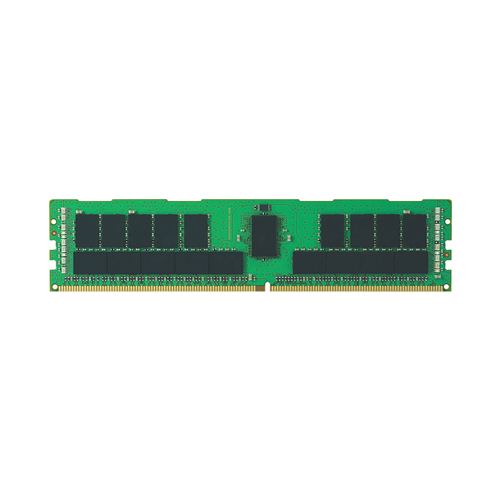
Designed for entry-level servers and workstations that require data integrity without registered memory, this 2GB DDR3-1333 UDIMM features unbuffered ECC to actively correct single-bit errors in memory-sensitive tasks like virtualization or light database workloads. Its dual-rank x8 organization at CL9 latency maximizes signal stability and throughput on 240-pin platforms, ensuring reliable, low-cost protection against data corruption.
1. On-chip ECC protection continuously detects and corrects single-bit errors, preserving data integrity for mission-critical server databases and financial transactions.
2. Standard JEDEC voltage ensures consistent power delivery across all DIMM slots, strengthening long-term stability in always-on server environments.
3. Unbuffered UDIMM design eliminates register delays, delivering lower access latency for latency-sensitive edge computing and small-scale virtualized workloads.
4. Dual-rank organization exploits internal bank interleaving to maximize channel utilization, keeping throughput smooth when multiple services contend for memory.
5. Proven DDR3 architecture offers dependable backwards compatibility and energy-efficient operation, allowing cost-effective refresh cycles for legacy server farms.
Targeted for entry-level servers and workstations, the Samsung M391B5673EH1-CH9 is a 2 GB DDR3 UDIMM engineered for unwavering reliability in always-on environments. Its four defining attributes directly address the pain points of IT administrators who cannot tolerate silent data corruption or unplanned downtime.
First, integrated ECC detects and corrects single-bit memory errors on the fly. In a remote edge server running a lightweight hypervisor to host a firewall and a web proxy, a cosmic-ray-induced bit flip could crash the entire network stack; ECC ensures continuous, error-free operation without expensive service visits. Second, the unbuffered architecture eliminates the register chip latency found in RDIMMs, delivering a cleaner signal path that benefits single-socket platforms like a mid-range network-attached storage device, where fast, predictable response is critical for multiple simultaneous file transfers. Third, the dual-rank x8 organization enables rank interleaving, allowing the memory controller to initiate a read on one rank while the other is finishing a write. This concurrency significantly lifts effective bandwidth for memory-intensive benchmarks or a small in-memory database handling hundreds of queries per second. Finally, the DDR3-1333 speed with CL9 latency strikes a deliberate balance between rapid data access and stable, 1.5 V power consumption, reducing thermal stress inside a compact 1U chassis and prolonging component lifespan. For professionals extending the life cycle of single-socket servers, this module transforms aging hardware into a trustable, responsive foundation for critical workloads.
Capacity Planning for DDR3-1333 ECC UDIMM (2GB Module)
This module is a server-class DDR3 2GB ECC Unbuffered DIMM operating at 1.5V. It is suited for entry-level servers and small-scale memory configurations where data integrity is critical. For modern workloads, capacity per module is limited, so plan channel population and module counts carefully to meet minimum requirements.
General Virtualization
For light virtualization on a single-socket platform, populate all channels with identical 2GB modules to maximize interleaving. A six-channel board with six modules provides 12GB—enough for 3–4 small VMs. Avoid mixing ranks; dual-rank x8 modules already offer good bandwidth, so populate one DIMM per channel.
In-Memory Database
In-memory databases demand both capacity and low latency. With 2GB UDIMMs, you can install eight modules (16GB) on a dual-socket server with four channels each. This only suits tiny caching layers. Prioritize identical, ECC-matched sticks across all channels to prevent correction overhead, but recognize that 2GB parts severely constrain dataset size.
High-Performance Computing
HPC workloads need maximum memory bandwidth. Fully populate all memory channels—e.g., 12 modules (24GB) in a triple-channel Nehalem era server. Use the same dual-rank, CL9 modules in every slot to maintain symmetric access. This configuration works for memory-bound parallel codes where capacity needs are modest, but modern HPC will quickly outgrow this footprint.
This Samsung DDR3 ECC UDIMM is validated for Dell R210 II, T110 II, HP MicroServer Gen8 after strict testing.
Q: Can I mix this M391B5673EH1-CH9 with other memory modules of different brands or speeds?
A: Mixing is not recommended for server environments. Unmatched DIMMs may cause signal integrity issues and disable ECC protection, leading to instability. Always use identical modules for validated reliability.
Q: Is this memory compatible with my system?
A: This DDR3 ECC UDIMM is designed for entry-level servers and workstations. It supports Intel Xeon E3-1200 v2/v3 and AMD AM3+ platforms with 240-pin sockets. Verify your board specifically supports unbuffered ECC memory.
Q: What is the recommended DIMM population order for optimal performance?
A: Install identical modules in the farthest white slots from the CPU per channel first. Populate one DIMM per channel to maintain dual-channel symmetry. Consult your server board manual for specific slot coloring.
Q: Does this module support overclocking or XMP profiles?
A: No. This module adheres strictly to JEDEC DDR3-1333 standards without XMP support. Overclocking is not possible; it is engineered for 24/7 rock-solid stability in mission-critical server workloads.
Q: What warranty and typical failure rate can I expect?
A: This module is covered by a 1-year warranty. It exhibits an extremely low annualized failure rate (AFR), typically under 1%, when operated within specified voltage and thermal limits.