











 Secure payments
Standard refund policy
Trade Assurance
Secure payments
Standard refund policy
Trade Assurance
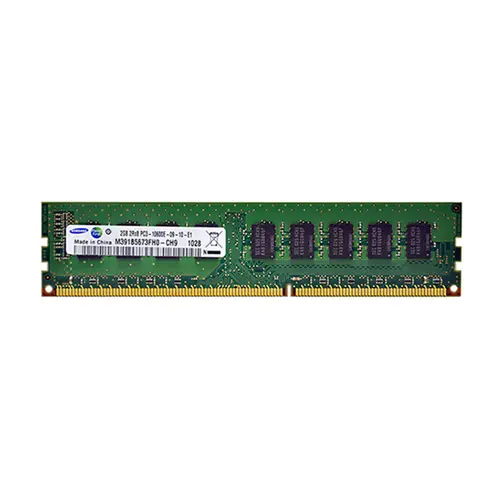
| Model | M391B5673FH0-CH9 |
|---|---|
| Product Type | Memory Module |
| Compliance Standards | EU RoHS,FCC |
| Memory Capacity | 2 GB |
| Memory Technology | DDR3 |
| Product Voltage | 1.5V |
| RAM Speed | 1333MHz |
| RAM Standard | DDR3-1333/PC3-10600 |
| Error Identifying | ECC |
| Signal Type | Unbuffered |
| Column Access Strobe (CAS) | CL9 |
| Rank | Dual Rank x8 |
| Quantity of Pins | 240-pin |
| RAM Genre | UDIMM |
Geared for entry-level servers and workstations, this Samsung 2GB DDR3-1333 UDIMM with ECC ensures data integrity in lightweight virtualization, file serving, and persistent memory applications where cost-effective reliability is critical. Its unbuffered dual-rank x8 organization at CL9 reduces electrical loading and interleaves access across ranks to improve bandwidth efficiency, while the 1.5V operation and column-level error correction safeguard against single-bit errors without compromising signal stability on short-trace platforms.
1. ECC error correction actively prevents single-bit data corruption, ensuring transactional accuracy for financial databases and always-on virtualized workloads.
2. The unbuffered UDIMM design eliminates register latency, giving entry-level servers and network appliances a slight edge in request-response efficiency.
3. Dual rank x8 organization enables rank interleaving, which sustains higher effective bandwidth to keep lightweight VMs and web caches responsive under concurrency.
4. A 1333 MHz clock delivers steady, reliable throughput for hosting containerized services without pushing power and cooling budgets beyond tight chassis limits.
5. CL9 column access latency keeps memory fetch overhead low, reducing query wait time in latency-sensitive microservices and small database instances.
When you're running a virtualized cluster or an in-memory database, every single bit matters. The M391B5673FH0-CH9 is a server-grade UDIMM engineered to eliminate that silent threat—single-bit errors caused by cosmic radiation or electrical noise. Its integrated ECC (Error-Correcting Code) detects and corrects these flips in real time, preventing silent data corruption that could crash a hypervisor or poison a financial transaction. In a dense virtualization host, where multiple VMs share physical resources, this isn't a luxury; it’s the difference between reliable uptime and unexplained, intermittent failures.
The 1.5V DDR3 operation and dual-rank x8 organization address two more practical realities: thermal efficiency and capacity bandwidth. With lower voltage, your rack’s cooling load stays manageable even as memory channels fill up. The dual-rank design boosts interleaving performance, giving the memory controller more open pages to access simultaneously—critical when your Redis instance is hammering read operations or when a bare-metal database engine needs consistent low-latency access. This 1333MHz, CL9 module is unbuffered, meaning it slots directly into cost-sensitive single-socket servers and workstations without the added latency of a register chip, making it an ideal drop-in upgrade for legacy platforms that still demand absolute data integrity at a budget-conscious price. For the sysadmin monitoring database query times or the IT manager safeguarding business-critical applications, this memory translates directly into fewer silent errors, predictable performance, and a longer, more stable lifecycle for your infrastructure.
Server Memory Capacity Planning for M391B5673FH0-CH9
This is a server‑grade DDR3‑1333 ECC Unbuffered DIMM (UDIMM) with a 2 GB capacity per module, typically used in entry‑level single‑socket servers, microservers, and workstations. Because of the small individual capacity, planning must rely on populating multiple identical modules to meet workload demands while maintaining ECC protection and multi‑channel performance.
General Virtualization
For a lightweight hypervisor running 3–5 undemanding VMs, install six identical 2 GB modules (12 GB total) across all memory channels. Use one DIMM per channel to preserve full ECC and channel interleaving; avoid mixing densities. This configuration gives headroom for host services and guest operating systems without risking memory oversubscription.
In‑Memory Database
Production in‑memory databases are impractical with 2 GB DIMMs, but for Redis or Memcached test/dev instances, populate every available slot (e.g., 6×2 GB = 12 GB) and operate in symmetric channel mode for maximum throughput. Configure strict instance memory limits and enable disk‑backed persistence to guard against capacity exhaustion; always monitor eviction rates.
High‑Performance Computing
On a dual‑ or triple‑channel platform, deploy balanced sets (e.g., 4 or 6 identical modules) to maximize memory bandwidth. This arrangement sustains better throughput for MPI‑based light simulations or code compilation. Keep problem sizes aligned with the limited total RAM, and offload larger datasets to nodes equipped with higher‑density Registered DIMMs.
Rigorously tested server memory, compatible with Dell PowerEdge R210 II, HP ProLiant MicroServer Gen8, and more.
Q: Can I mix this M391B5673FH0-CH9 with other memory modules of different brands or speeds?
A: Mixing modules is not recommended in server environments due to potential instability. For reliable ECC operation, populate all channels with identical M391B5673FH0-CH9 modules matching the same speed, rank, and voltage.
Q: Is this memory compatible with my system?
A: It is compatible with server boards supporting DDR3 ECC Unbuffered DIMMs, such as those using Intel C202/C204/C206 chipsets or AMD equivalent platforms. Verify your system supports 240-pin DDR3-1333 UDIMM with ECC.
Q: What is the recommended DIMM population order for optimal performance?
A: Install identical DIMMs in pairs within the same memory channel (typically slots 1 & 3 or 2 & 4) to enable dual-channel mode. Start with slots furthest from the CPU for best signal integrity.
Q: Does this module support overclocking or XMP profiles?
A: No. This module adheres to JEDEC DDR3-1333 standards and does not support overclocking or XMP. It is engineered for stable, error-corrected operation in servers where data integrity is critical.
Q: What warranty and typical failure rate can I expect?
A: This module includes a one-year limited warranty. Engineered for 24/7 server operation, it has an extremely low annualized failure rate (AFR), typically below 0.1% under specified conditions.