











 Secure payments
Standard refund policy
Trade Assurance
Secure payments
Standard refund policy
Trade Assurance
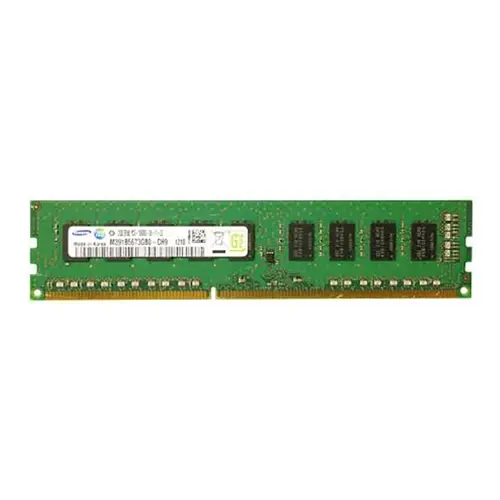
| Model | M391B5673GB0-CH9 |
|---|---|
| Product Type | Memory Module |
| Compliance Standards | EU RoHS,FCC |
| Memory Capacity | 2 GB |
| Memory Technology | DDR3 |
| Product Voltage | 1.5V |
| RAM Speed | 1333MHz |
| RAM Standard | DDR3-1333/PC3-10600 |
| Error Identifying | ECC |
| Signal Type | Unbuffered |
| Column Access Strobe (CAS) | CL9 |
| Rank | Dual Rank x8 |
| Quantity of Pins | 240-pin |
| RAM Genre | UDIMM |
Designed for entry-level servers and workstations, this Samsung DDR3-1333 UDIMM with ECC ensures data integrity for critical applications like file hosting and light virtualization. Its dual-rank x8 organization and unbuffered signal path optimize memory density and latency, delivering reliable performance at CL9 timings.
1. ECC protection silently corrects single-bit errors, safeguarding long-running virtualization workloads against in-memory data corruption.
2. The 2GB capacity is purpose-fit for lightweight dedicated server appliances, keeping OS overhead minimal while maximizing node density in micro-server fleets.
3. 1333MHz operation delivers a steady 10.6 GB/s bandwidth, capably handling concurrent requests in entry-level web hosting and caching roles.
4. Standard 1.5V operation ensures broad compatibility with legacy server boards and delivers predictable thermals for reliable 24/7 duty cycles.
5. Dual Rank x8 organization leverages rank interleaving to boost effective throughput, reducing latency under mixed-workload conditions common in unified communications servers.
This Samsung M391B5673GB0-CH9 is a server-grade DDR3 UDIMM with ECC, purpose-built for entry-level servers, NAS systems, and workstations where data reliability cannot be compromised on a budget. Its unbuffered design skips the register chip found in RDIMMs, cutting latency for applications that demand snappy response—think a small office running a lightweight virtualized domain controller or a SQL Express database, where every microsecond counts during transaction commits. The integrated ECC engine corrects single-bit errors in real time, protecting against silent data corruption that could wreck a financial log or a RAID integrity check during a routine backup. Dual-rank x8 organization interleaves two independent sets of memory banks, boosting bandwidth utilization; when a file server simultaneously handles multiple client read requests and a background backup job, the resulting parallelism keeps throughput smooth rather than bogging down. Running at 1333MHz with a tight CL9 latency at 1.5V, the module hits the sweet spot between speed and thermal stability inside the cramped, always-on chassis of a network storage appliance or a point-of-sale server. Together, these characteristics deliver uncompromised uptime and transactional accuracy exactly where small businesses feel real pain: corrupted records, sluggish multitasking, and unplanned reboots.
Server Memory Type Identified:
This is a DDR3-1333 ECC Unbuffered UDIMM (240-pin, 2 GB, Dual Rank x8). Such modules are typical for entry-level servers and small-business platforms that require data integrity but do not support Registered DIMMs. Capacity planning must account for the modest 2 GB per module density and the Dual Rank organization, which can limit the number of DIMMs per channel at full speed.
General Virtualization
In virtualized environments, memory capacity is the primary constraint. With only 2 GB per UDIMM, virtual host density is severely limited. Populate all available DIMM slots with identical modules to reach at least 32 GB (16 modules) on dual-socket systems that support four channels per CPU, prioritizing balanced memory across channels for consistent VM performance. Avoid mixing unmatched ranks or speeds, as ECC Unbuffered configurations require strict homogeneity for reliable error correction.
In-Memory Database
In-memory databases demand large, contiguous memory space and ultra-low latency. Given the 2 GB module size, achieving a meaningful dataset size (e.g., 64 GB) requires populating 32 DIMM slots, which is rarely possible on UDIMM platforms. Use the maximum number of identical 2 GB modules in a balanced multi-channel setup, ideally one DIMM per channel to maintain 1333 MHz with dual-rank UDIMMs. For any realistic deployment, consider capacity constraints: a dual-rank x8 configuration at two DIMMs per channel will likely downclock to 1066 MHz, harming transactional throughput, so limit population to one DIMM per channel and accept the capacity ceiling.
High-Performance Computing
HPC workloads benefit from high memory bandwidth rather than massive capacity per node. Install three identical 2 GB UDIMMs per populated memory channel (for triple-channel architectures) or four per channel (quad-channel), ensuring perfectly balanced groups of six or eight modules to achieve peak dual-rank interleaving. With ECC Unbuffered DIMMs, using more than one dual-rank module per channel forces the memory controller to drop to 1066 MHz; therefore, limit to a single 2 GB DIMM per channel if 1333 MHz frequency is critical for bandwidth-sensitive HPC codes, resulting in a lean 8–12 GB per node configuration that favors speed over capacity.
Rigorously tested server memory. Compatible with Dell PowerEdge R710, HP ProLiant DL380 G7, and more.
Q: Can I mix this M391B5673GB0-CH9 with other memory modules of different brands or speeds?
A: Mixing modules is not recommended for server environments. Different brands or speeds may cause instability or boot failure. For guaranteed reliability, always use identical M391B5673GB0-CH9 modules with the same rank, CAS, and JEDEC profile.
Q: Is this memory compatible with my system?
A: This DDR3 ECC Unbuffered UDIMM is designed for Intel and AMD server/workstation platforms that support unbuffered ECC memory. Verify your motherboard supports 240-pin DDR3-1333 ECC UDIMMs by checking the qualified vendor list (QVL).
Q: What is the recommended DIMM population order for optimal performance?
A: Follow your server’s manual. Typically, populate slots that enable dual-channel mode first, often matching colors or numbered sequences per channel. For this dual-rank module, balanced loading across channels is critical for optimal signal integrity.
Q: Does this module support overclocking or XMP profiles?
A: No. This is a server‑grade memory module strictly adhering to JEDEC DDR3-1333 standards. It does not support overclocking or XMP profiles, as mission‑critical stability and ECC data protection take priority over performance tuning.
Q: What warranty and typical failure rate can I expect?
A: This module comes with a 1‑year warranty. Built with high‑grade components for enterprise use, it exhibits an annualized failure rate (AFR) typically below 0.5%, ensuring robust long‑term operation in 24/7 environments.