











 Secure payments
Standard refund policy
Trade Assurance
Secure payments
Standard refund policy
Trade Assurance
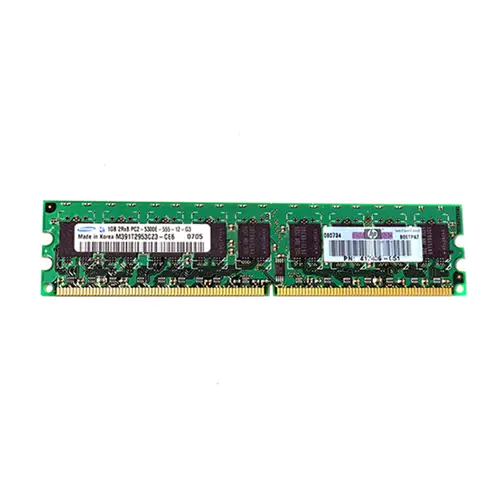
| Model | M391T2953CZ3-CE6 |
|---|---|
| Product Type | Memory Module |
| Compliance Standards | EU RoHS,FCC |
| Memory Capacity | 1 GB |
| Memory Technology | DDR2 |
| Product Voltage | 1.8V |
| RAM Speed | 667MHz |
| RAM Standard | DDR2-667/PC2-5300 |
| Error Identifying | ECC |
| Signal Type | Unbuffered |
| Column Access Strobe (CAS) | CL5 |
| Rank | Dual Rank x8 |
| Quantity of Pins | 240-pin |
| RAM Genre | UDIMM |
This UDIMM with ECC is tailored for legacy server and workstation platforms where data integrity is critical, such as small business file servers or embedded industrial controllers. Its dual-rank x8 organization and CL5 latency deliver stable 667 MT/s throughput, while ECC protects against single-bit errors to ensure reliability in always-on environments.
1. ECC protection silently corrects single-bit memory errors, preserving the integrity of financial transactions and long-running virtualization workloads in always-on server environments.
2. Unbuffered signal architecture removes register latency, delivering marginally quicker access that benefits latency-sensitive microservices on entry-level server nodes.
3. Dual Rank organization enables rank interleaving, maximizing bandwidth utilization when multiple virtual machines access memory simultaneously on consolidated hosts.
4. The entry capacity provides a sufficient footprint for lightweight dedicated server functions such as DNS, firewall, or embedded management controllers.
5. Its moderate frequency grade ensures stable, power-efficient operation within thermally constrained and densely populated rack chassis.
As a server-grade DDR2 memory module, the M391T2953CZ3-CE6 is an Unbuffered ECC DIMM designed for legacy entry-level servers and long-deployment workstations where absolute uptime and data fidelity still matter. In a small-business file server or a Linux-based DNS appliance, its ECC engine is the silent safeguard that corrects single-bit memory errors in real time—preventing cosmic-ray-induced bit flips from silently corrupting financial records or configuration databases. Over years of continuous operation, that protection means the difference between a forgotten background repair and a catastrophic silent data loss that no backup can reverse. The dual-rank x8 organization further complements this reliability: by interleaving access across two internal ranks, the module sustains higher effective bandwidth under concurrent requests, letting a legacy database engine or a lightweight virtualized web server juggle more connections without page allocation stalls. Being an Unbuffered UDIMM, it eliminates the extra latency of a register chip—a critical advantage in latency-sensitive embedded controllers or industrial imaging systems that rely on deterministic memory response. With a standard 1.8V power profile and compliance with EU RoHS, this module also drops safely into aging but mission-critical machines where replacing the entire platform is not an option, offering a precise, non-disruptive upgrade that keeps critical, low-power infrastructure humming through another maintenance cycle.
Server Memory Classification
Based on the specifications — DDR2, ECC, Unbuffered, 240-pin UDIMM — this module is server memory for entry-level servers and workstations requiring data integrity.
General Virtualization
Virtualized environments demand stable capacity for multiple VMs. Populate all memory channels symmetrically with identical 1 GB modules; a minimum of four modules (4 GB) in a dual‑channel board enables ECC and interleaving. For higher VM density, install eight modules (8 GB) across two banks.
In‑Memory Database
In‑memory databases require maximum reliable capacity and low latency. Fill every available DIMM slot with matched, same‑batch 1 GB ECC UDIMMs — eight or more modules — to eliminate paging and leverage full ECC protection. Uniform dual‑rank x8 modules ensure consistent rank interleaving for predictable real‑time performance.
High‑Performance Computing
HPC workloads benefit from aggregate memory bandwidth. Install one identical module per channel (e.g., four modules in a quad‑channel server) to achieve balanced channel interleaving. For larger problem sets, use two modules per channel (eight modules total) while keeping all modules identical; the dual‑rank organization already aids rank‑interleaving, maximizing DDR2‑667 throughput under compute‑intensive tasks.
Strictly tested server memory, compatible with Dell PowerEdge 860, HP ProLiant ML110 G5, and more.
Q: Can I mix this M391T2953CZ3-CE6 with other memory modules of different brands or speeds?
A: Mixing is not recommended for server environments. ECC UDIMMs require identical speed, rank, and timings to maintain signal integrity. Disparate modules may cause instability or disable ECC functionality, risking data integrity.
Q: Is this memory compatible with my system?
A: It is compatible with Intel 5000-series or equivalent AMD server platforms using DDR2-667 ECC UDIMMs. Verify your motherboard supports 1.8V, 240-pin PC2-5300 Unbuffered ECC memory.
Q: What is the recommended DIMM population order for optimal performance?
A: Populate identical modules in matched sets per channel, starting with the farthest slots from the CPU. For dual-rank configurations, fill one channel at a time to enable interleaving and maximize throughput.
Q: Does this module support overclocking or XMP profiles?
A: No. This is a server-grade ECC UDIMM locked to JEDEC DDR2-667 specifications. Overclocking is unsupported and strictly discouraged, as it can compromise error correction and system stability.
Q: What warranty and typical failure rate can I expect?
A: It carries a one-year warranty. Annualized failure rate for this reliable server module is typically below 0.5% under proper thermal and operating conditions, ensuring excellent long-term dependability.