











 Secure payments
Standard refund policy
Trade Assurance
Secure payments
Standard refund policy
Trade Assurance
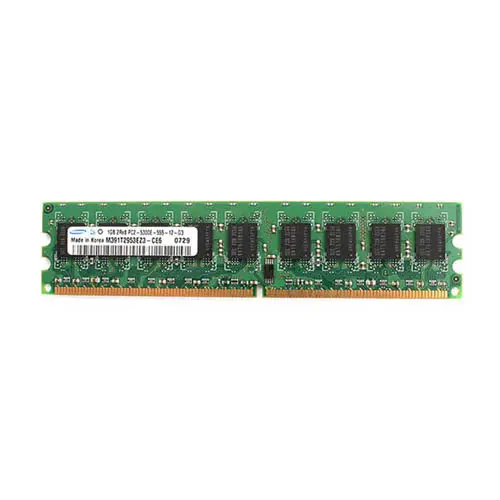
| Model | M391T2953EZ3-CE6 |
|---|---|
| Product Type | Memory Module |
| Compliance Standards | EU RoHS,FCC |
| Memory Capacity | 1 GB |
| Memory Technology | DDR2 |
| Product Voltage | 1.8V |
| RAM Speed | 667MHz |
| RAM Standard | DDR2-667/PC2-5300 |
| Error Identifying | ECC |
| Signal Type | Unbuffered |
| Column Access Strobe (CAS) | CL5 |
| Rank | Dual Rank x8 |
| Quantity of Pins | 240-pin |
| RAM Genre | UDIMM |
This 1GB DDR2-667 UDIMM with ECC is specifically built for entry-level servers and workstations where data integrity is critical, offering single-bit error correction to prevent silent data corruption in always-on environments. Its dual-rank x8 organization and CL5 latency provide a balance of signal stability and compatible performance for legacy Socket AM2/F platforms or similar systems requiring unbuffered memory with reliable error detection.
1. ECC memory detects and corrects single-bit errors in real time, preventing silent data corruption that could jeopardize financial records or customer databases in a small business server.
2. Unbuffered signal design eliminates the register chip delay, giving entry-level server CPUs faster access to each memory word for latency-sensitive lightweight workloads.
3. UDIMM form factor delivers unbuffered ECC protection without the cost of registered memory, offering a pragmatic reliability upgrade for budget-constrained server builds.
4. Dual Rank x8 organization interleaves two internal rank accesses per channel, keeping the memory bus saturated to improve throughput during concurrent virtual machine operations.
5. One gigabyte of dedicated server memory is ideally matched for stable, stripped-down appliance roles such as firewall, DNS, or lightweight embedded controller duties where error-free uptime matters far more than capacity.
The M391T2953EZ3-CE6 is a 1GB DDR2-667 UDIMM built for small-business servers and entry-level workstations where data integrity and consistent responsiveness define operational uptime. Its four defining characteristics directly address the real-world demands of legacy virtualization hosts and in-memory databases.
First, ECC error correction silently detects and corrects single-bit memory errors. In a 24/7 virtualized cluster running multiple lightweight VMs, a cosmic-ray-induced bit flip in unprotected memory can corrupt a hypervisor state and force a host restart. ECC prevents that cascade, preserving service continuity when you cannot afford unexplained crashes. Second, the unbuffered architecture eliminates the register chip latency found in RDIMMs, so every read and write command hits the DRAM cells with minimal delay. For a Redis or Memcached instance serving transaction lookups, lower access latency translates directly into faster query responses and more consistent tail latencies under load. Third, the dual-rank x8 organization enables rank interleaving, allowing the memory controller to pipeline commands across two internal ranks on the same module. This boosts sustained bandwidth during large in-memory table scans or when multiple VMs compete for memory throughput. Fourth, a CAS latency of CL5 at 667MHz keeps initial access time tight, complementing the unbuffered design. Together, these traits make the module a resilient, low-overhead building block for cost-sensitive server environments that prioritize reliability and real-time data handling over raw capacity.
General Virtualization
For light virtualization on legacy servers, install four identical M391T2953EZ3-CE6 modules (4 GB total) in a balanced dual‑channel configuration. This ensures ECC protection and symmetrical interleaving, critical for hypervisor stability. Avoid mixed capacities to prevent performance penalties and uncorrected error risks.
In‑Memory Database
In‑memory databases demand maximum capacity and absolute data integrity. Populate all available DIMM slots with these 1 GB ECC UDIMMs to reach the highest supported memory—typically 8 GB on older platforms. The dual‑rank design and unbuffered ECC provide a modest latency advantage while safeguarding in‑flight data against single‑bit errors.
High‑Performance Computing (HPC)
Achieve peak memory bandwidth by filling every memory channel identically; a minimum of four modules (two per channel) is recommended for dual‑channel systems to enable full interleaving. Strictly adhere to matched pairs across channels, leveraging the module’s dual‑rank x8 organization. This layout minimizes access latency in parallel workloads and fortifies the cluster node with ECC resilience under sustained compute loads.
Rigorously tested, this DDR2 ECC UDIMM is compatible with servers like Dell PowerEdge 840, 860, T105, HP ProLiant ML110 G5.
Q: Can I mix this M391T2953EZ3-CE6 with other memory modules of different brands or speeds?
A: Mixing different brands or speeds with ECC UDIMMs is not recommended. It may cause instability or disable ECC. For reliable server operation, always use identical modules.
Q: Is this memory compatible with my system?
A: This module is compatible with servers and workstations supporting DDR2-667 ECC Unbuffered DIMMs. Please verify your Intel or AMD platform explicitly requires 240-pin, 1.8V ECC UDIMMs.
Q: What is the recommended DIMM population order for optimal performance?
A: For dual-channel servers, populate identical DIMMs in symmetrical slots (e.g., slots 1 and 3) per the motherboard manual. Start with the farthest channel from the processor for balanced signal integrity.
Q: Does this module support overclocking or XMP profiles?
A: No. This is a server-grade ECC UDIMM strictly adhering to JEDEC DDR2-667 standards. Overclocking and XMP are not supported to ensure 24/7 data integrity and stability.
Q: What warranty and typical failure rate can I expect?
A: This module carries a one-year warranty. Manufactured with rigorous testing, its typical annualized failure rate (AFR) is well under 1%, delivering high reliability for mission-critical environments.