











 Secure payments
Standard refund policy
Trade Assurance
Secure payments
Standard refund policy
Trade Assurance
| Model | M391T5663QZ3-CE6 |
|---|---|
| Product Type | Memory Module |
| Compliance Standards | EU RoHS,FCC |
| Memory Capacity | 2 GB |
| Memory Technology | DDR2 |
| Product Voltage | 1.8V |
| RAM Speed | 667MHz |
| RAM Standard | DDR2-667/PC2-5300 |
| Error Identifying | ECC |
| Signal Type | Unbuffered |
| Column Access Strobe (CAS) | CL5 |
| Rank | Dual Rank x8 |
| Quantity of Pins | 240-pin |
| RAM Genre | UDIMM |
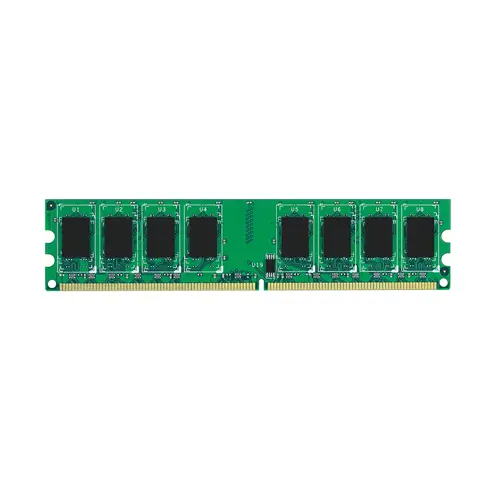
This DDR2-667 UDIMM with ECC is tailored for entry-level legacy servers and workstations where data integrity is critical for applications like lightweight virtualization or archival databases. Its unbuffered signal topology combined with dual-rank x8 organization and CL5 latency ensures reliable single-bit error correction and stable module-level access, maintaining steady throughput under continuous memory-sensitive workloads.
1. ECC protection automatically corrects single-bit errors, preventing silent data corruption in critical server workloads like financial transactions or database queries.
2. Dual Rank x8 organization interleaves memory accesses across two internal ranks, sustaining higher throughput under concurrent virtualized environments.
3. Unbuffered signal type eliminates register delays, lowering latency for response-sensitive applications such as caching layers or real-time monitoring.
4. CL5 column access strobe latency reduces memory fetch delays, translating into snappier throughput for high-concurrency server tasks.
5. 2 GB capacity packs enough headroom to run lightweight hypervisors and essential services without swapping, keeping entry-level server nodes stable and responsive.
Designed for legacy server platforms, the M391T5663QZ3-CE6 is a DDR2-667 UDIMM with ECC, and its four defining characteristics translate directly into tangible reliability for mission-critical systems that cannot afford unexpected downtown. When you maintain an aging ERP database or a lightweight virtualization host that runs essential internal services, the ECC feature is your first line of defense: it detects and corrects single-bit memory errors on the fly, preventing silent data corruption that could cascade into a miswritten financial record or a crashed hypervisor. The unbuffered architecture, combined with a dual-rank x8 organization, allows the memory controller to interleave access across internal banks, delivering noticeably smoother read/write throughput under the constant, random-access load of a database management system. With a 1.8V operating voltage—low for its era—this module reduces thermal stress inside dense 1U or 2U chassis where airflow is already constrained, helping to sustain long-term stability. Finally, the standard 240-pin UDIMM form factor ensures drop-in compatibility with a wide range of servers and workstations from that generation, making it a straightforward, risk-free upgrade to extend productive life. What this means for you is fewer memory-related tickets, preserved data accuracy, and a cost-effective path to keep your legacy infrastructure performing reliably while you plan the next hardware cycle.
General Virtualization
This is a DDR2 ECC Unbuffered DIMM, primarily suited for entry-level servers or workstations that require data integrity. For a basic hypervisor host, install the maximum supported capacity—typically 16–32GB across all slots—using 2GB modules in matched pairs to enable dual-channel interleaving and maintain virtual machine density without overcommitting memory.
In-Memory Database
In-memory databases demand absolute reliability and low latency. Populate all available channels with identical 2GB UDIMMs, reaching at least 16GB total. ECC is non-negotiable here to prevent silent data corruption, and a balanced configuration across memory channels maximizes throughput for cache-heavy workloads like Redis or Memcached.
High-Performance Computing (HPC)
HPC clusters using older DDR2 platforms benefit from uniform memory configurations. Fill each node with 8–16 modules (16–32GB total) to supply sufficient bandwidth for MPI-based parallel tasks. Dual-rank x8 modules offer moderate rank interleaving, but capacity limits restrict this platform to smaller problem sets or light compute-node duty.
Rigorously tested DDR2 ECC UDIMM, compatible with Dell PowerEdge 840/860/T300 and HP ProLiant ML110 G5.
Q: Can I mix this M391T5663QZ3-CE6 with other memory modules of different brands or speeds?
A: Mixing is technically possible, but not recommended for server environments. Mismatched speeds or brands may force the system to the lowest common denominator, risking stability. For guaranteed reliability, use identical modules.
Q: Is this memory compatible with my Intel Xeon or AMD Opteron server platform?
A: It is compatible with server boards supporting DDR2-667 ECC Unbuffered DIMMs. Verify your platform specifically accepts 240-pin PC2-5300 UDIMM with x8 organization. Common on Intel 3000/5000 series and select AMD Opteron configurations.
Q: What is the recommended DIMM population order for optimal performance?
A: Populate identical modules in matched slots per your motherboard manual, typically starting with the slots furthest from the CPU. For dual-rank x8 UDIMMs, fill one channel completely before moving to the next to maintain balanced interleaving.
Q: Does this module support overclocking or XMP profiles?
A: No. This is an industry-standard ECC server module operating at JEDEC-standard DDR2-667 with fixed CL5 timings. It does not include XMP or support overclocking, as stability and data integrity are paramount in server applications.
Q: What warranty and typical failure rate can I expect?
A: This memory includes a one-year warranty. Typical annualized failure rate (AFR) for such enterprise-grade ECC UDIMMs is well below 0.5% under normal operating conditions, assuming proper cooling and no electrical overstress.