











 Secure payments
Standard refund policy
Trade Assurance
Secure payments
Standard refund policy
Trade Assurance
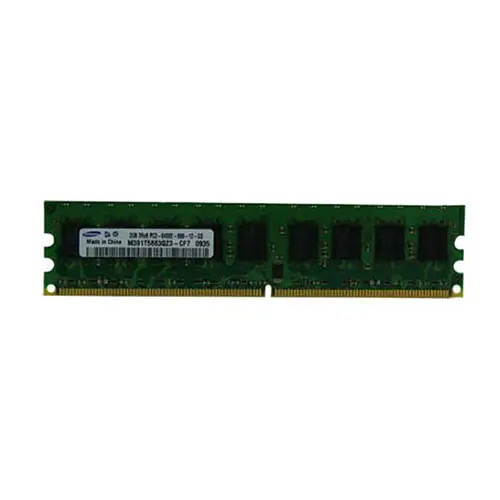
| Model | M391T5663QZ3-CF7 |
|---|---|
| Product Type | Memory Module |
| Compliance Standards | EU RoHS,FCC |
| Memory Capacity | 2 GB |
| Memory Technology | DDR2 |
| Product Voltage | 1.8V |
| RAM Speed | 800MHz |
| RAM Standard | DDR2-800/PC2-6400 |
| Error Identifying | ECC |
| Signal Type | Unbuffered |
| Column Access Strobe (CAS) | CL6 |
| Rank | Dual Rank x8 |
| Quantity of Pins | 240-pin |
| RAM Genre | UDIMM |
This DDR2-800 Unbuffered ECC UDIMM is best suited for legacy small business servers and entry-level workstations where data integrity is critical for light virtualization or archival database roles. Its CL6 latency and dual-rank x8 organization provide stable, error-corrected performance and improved compatibility with older chipsets compared to single-rank modules.
1. ECC error detection and correction silently intercepts single-bit memory faults, preserving data integrity for mission-critical server applications that require non-stop uptime.
2. Dual Rank x8 organization interleaves memory banks to sustain high command throughput, preventing bandwidth starvation during multi-client file or web serving workloads.
3. Unbuffered signal topology strips away register delays, delivering the low access latency that latency-sensitive entry-level server tasks such as caching or light virtualization demand.
4. 800MHz clock speed provides a stable 6.4 GB/s channel bandwidth, comfortably handling concurrent small-scale database queries and back-office operations without I/O bottlenecks.
5. CL6 column access latency shortens the wait between request and retrieval, directly accelerating transaction processing and keeping CPU pipelines efficiently utilized in always-on service environments.
Targeting entry-level servers and workstations, the Samsung M391T5663QZ3-CF7 is a 2GB DDR2-800 UDIMM with a feature set that directly addresses the reliability and throughput demands of always-on business applications. This module’s four key characteristics translate into tangible uptime and performance where it matters most.
First, ECC error correction continuously detects and corrects single-bit memory errors, a critical defense against silent data corruption. In a virtualized cluster running multiple VMs on a single host, a flipped bit in the hypervisor’s memory space can crash every guest or quietly corrupt a financial transaction log. ECC turns that risk into a non-issue, preserving data integrity with no administrative overhead.
Second, the unbuffered architecture combined with ECC gives you the ideal balance for cost-conscious reliability. Without the added latency of a register chip, this UDIMM responds faster than registered alternatives, making it especially effective for memory-resident databases like Redis or a local financial caching layer where sub-millisecond lookup speeds are non-negotiable and every data record must remain absolutely accurate.
Third, the dual-rank x8 organization employs interleaving to boost effective bandwidth. While one rank is refreshing or preparing data, the other actively services read requests, minimizing idle cycles on the memory bus. This directly benefits virtualized workloads where numerous small block operations from multiple guest machines create highly random access patterns.
Finally, the 1.8V operating voltage and 800MHz clock with CL6 timings deliver a proven sweet spot of energy efficiency and predictable performance in dense server deployments, helping keep thermal loads manageable in limited 1U chassis while maintaining consistent throughput during backup windows or nightly batch processes.
Based on its ECC Unbuffered DDR2 specification, the Samsung M391T5663QZ3-CF7 is a 2 GB server-grade memory module intended for legacy servers and entry-level workstations. The following capacity planning guidance addresses typical workloads using this ECC UDIMM.
General Virtualization
Populate a minimum of four identical modules across both memory channels to enable dual-channel interleaving and maximise throughput. This 8 GB configuration can host a handful of light virtual machines for lab use, but production deployments are severely capacity-constrained and typically require a platform upgrade.
In-Memory Database
Capacity is the critical factor. Install the maximum number of identical 2 GB DIMMs your server supports—often 8 modules for 16 GB total—and configure symmetrical pairs for dual-channel operation. Even fully populated, only small test datasets fit entirely in memory; treat this as a proof-of-concept environment rather than a production datastore.
High-Performance Computing (HPC)
Bandwidth-sensitive HPC workloads demand balanced channel population. Use matched pairs of these CL6 modules in every channel, typically four DIMMs for an 8 GB dual-channel configuration, to supply consistent memory bandwidth per core. This suits legacy cluster nodes running lightweight MPI tasks, though the small per-node capacity severely restricts problem sizes and modern codes.
Tested and compatible with Dell PowerEdge 860, HP ProLiant DL140 G3, and IBM System x3200 M2.
Q: Can I mix this M391T5663QZ3-CF7 with other memory modules of different brands or speeds?
A: Mixing is not recommended for server environments. The ECC Unbuffered DIMMs require identical specifications to maintain signal integrity and prevent memory errors. Different brands or speeds may cause instability or ECC failures.
Q: Is this memory compatible with my system?
A: It is compatible with server and workstation platforms supporting DDR2 ECC Unbuffered DIMMs, such as select Intel 3000/5000 series chipsets or AMD Opteron platforms with 240-pin slots. Verify your board's memory QVL for ECC support.
Q: What is the recommended DIMM population order for optimal performance?
A: Populate identical modules per channel, starting with the slot farthest from the CPU. For dual-rank DIMMs, fill all channels symmetrically to enable dual-channel interleaving and maximize bandwidth. Consult the server's manual.
Q: Does this module support overclocking or XMP profiles?
A: No. This is a server-grade ECC UDIMM operating at standard JEDEC profiles. Overclocking is not supported as it compromises error correction reliability and system stability, which are critical for server workloads.
Q: What warranty and typical failure rate can I expect?
A: This module carries a 1-year warranty. Server ECC memory undergoes rigorous screening, resulting in a very low annualized failure rate, typically under 0.2% under normal operating conditions.