











 Secure payments
Standard refund policy
Trade Assurance
Secure payments
Standard refund policy
Trade Assurance
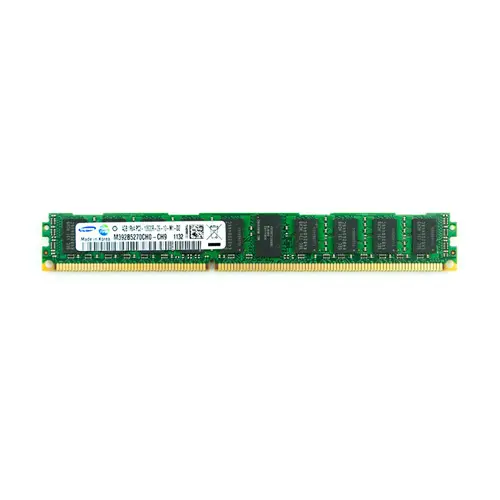
| Model | M392B5270CH0-CH9 |
|---|---|
| Product Type | Memory Module |
| Compliance Standards | EU RoHS,FCC |
| Memory Capacity | 4 GB |
| Memory Technology | DDR3 |
| Product Voltage | 1.5V |
| RAM Speed | 1333MHz |
| RAM Standard | DDR3-1333/PC3-10600 |
| Error Identifying | ECC |
| Signal Type | Registered |
| Column Access Strobe (CAS) | CL9 |
| Rank | Single Rank x4 |
| Quantity of Pins | 240-pin |
| RAM Genre | VLP RDIMM |
This Samsung 4GB DDR3-1333 VLP RDIMM is engineered specifically for space-constrained 1U/2U rack servers and blade systems, where the very-low-profile form factor maximizes airflow while Registered ECC memory ensures single-bit error correction and multi-bit error detection for mission-critical workloads like virtualization and in-memory databases. Its single-rank x4 configuration with CL9 latency delivers predictable electrical loading and stable signal integrity on dense memory channels, making it an optimal choice for platforms requiring consistent reliability under sustained memory pressure.
1. ECC automatically corrects single-bit memory errors, preserving transactional data integrity and preventing costly silent corruption in always-on virtualized environments.
2. Registered signal buffering re-drives address and command lines, enabling large DIMM populations to run stably under the high-density demands of consolidated server workloads.
3. VLP RDIMM form factor minimizes module height to improve airflow in tightly packed 1U and blade chassis, directly reducing fan power and enhancing long-term thermal reliability.
4. Single Rank x4 organization narrows the per-chip data path, strengthening the error correction granularity needed for advanced Chipkill-like data protection across memory channels.
5. 1333MHz operating speed yields a consistent 10.6 GB/s of peak bandwidth per channel, sustaining smooth data throughput for moderate multi-threaded enterprise applications.
The M392B5270CH0-CH9 is a server-class DDR3 VLP RDIMM, engineered for mission‑critical data center environments. In a heavily consolidated virtualization cluster, its ECC capability is non‑negotiable—it actively corrects single‑bit errors caused by background radiation, preventing silent data corruption that could crash multiple virtual machines or corrupt transactional records overnight. The registered buffer redrives command and address signals, so you can fully populate all memory channels without signal degradation; this stability is vital when you need a large, reliable memory footprint for an in‑memory database like Redis or SAP HANA, where every query hits system DRAM. The very‑low‑profile form factor further solves the mechanical puzzle inside dense 1U rack servers and blade chassis, preserving critical airflow and preventing thermal throttling that would otherwise erode performance. With a single‑rank x4 organization running at 1333MHz and true CL9 latency, it delivers predictable, repeatable bandwidth—fundamental for latency‑bound caching tiers where milliseconds directly impact revenue. For your infrastructure, this memory means fewer uncorrected faults, cooler operation, and the confidence to scale capacity without sacrificing uptime.
General Virtualization
For a virtualized host running multiple VMs, populate at least six to eight identical M392B5270CH0-CH9 modules to reach 24–32 GB of registered ECC memory. This ensures enough headroom for hypervisor overhead and guest memory allocation while maintaining single-rank signal integrity on multi-socket servers.
In-Memory Database
For latency-sensitive in-memory databases, use one module per memory channel to maximize bandwidth and minimize electrical loading. Start with six modules (24 GB) on a dual-processor platform and scale by adding identical RDIMMs in balanced sets to preserve lockstep ECC protection under heavy write loads.
High-Performance Computing
In HPC clusters, populate all channels with these VLP RDIMMs to lower airflow obstruction and improve cooling density. A configuration of twelve 4 GB modules (48 GB per node) delivers a favorable balance of capacity, RAS, and thermal efficiency for memory-bandwidth-bound workloads while keeping power profiles predictable.
Rigorously tested server memory for Dell R610/R710, HP DL360/DL380 G7, IBM x3550 M3.
Q: Can I mix this M392B5270CH0-CH9 with other memory modules of different brands or speeds?
A: Mixing is not recommended for server environments. Different brands, speeds, or ranks can cause stability issues. For reliable operation, install identical Samsung VLP RDIMMs with the same part number and specifications.
Q: Is this memory compatible with my system?
A: It requires an Intel Xeon E5 or AMD Opteron platform with a C602/C204 or equivalent chipset supporting registered ECC DDR3 DIMMs. Verify your server board explicitly supports 4GB single-rank x4 VLP RDIMMs.
Q: What is the recommended DIMM population order for optimal performance?
A: Populate identical DIMMs per channel starting with the slots farthest from the CPU. Typically, blue slots are populated first. Always consult the specific motherboard or server system manual for explicit population guidelines.
Q: Does this module support overclocking or XMP profiles?
A: No. This is a server-grade Registered ECC DIMM designed for stability at standard JEDEC timings (DDR3-1333 CL9). Overclocking and XMP are not supported, as they compromise data integrity in mission-critical applications.
Q: What warranty and typical failure rate can I expect?
A: This Samsung module comes with a 1-year warranty. It meets strict industrial quality standards with a very low annualized failure rate (AFR) under normal server operating conditions, ensuring long-term reliability.