











 Secure payments
Standard refund policy
Trade Assurance
Secure payments
Standard refund policy
Trade Assurance
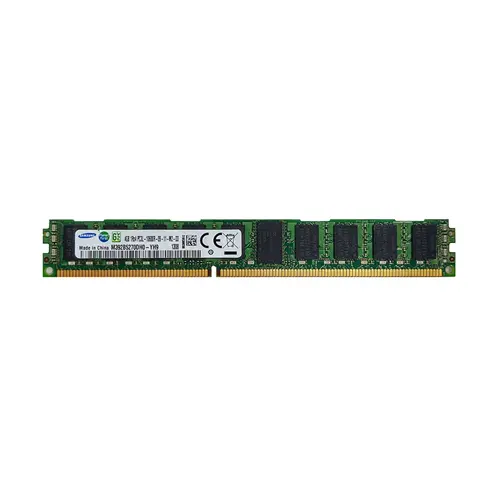
| Model | M392B5270DH0-YH9 |
|---|---|
| Product Type | Memory Module |
| Compliance Standards | CE,WEEE,RoHS |
| Memory Capacity | 4 GB |
| Memory Technology | DDR3 |
| Product Voltage | 1.35V |
| RAM Speed | 1333MHz |
| RAM Standard | DDR3-1333/PC3-10600 |
| Error Identifying | ECC |
| Signal Type | Registered |
| Column Access Strobe (CAS) | CL9 |
| Rank | Single Rank x4 |
| Quantity of Pins | 240-pin |
| RAM Genre | VLP RDIMM |
This VLP DDR3-1333 registered ECC module is purpose-built for dense server and virtualization environments where data integrity and power efficiency are critical. Its single-rank x4 configuration with 1.35V operation minimizes electrical loading and thermal footprint, making it ideal for memory-centric workloads like in-memory databases and high-density cloud computing platforms.
1. Registered signal buffering stabilizes command and address buses under heavy load, enabling reliable operation across fully populated server memory channels for critical virtualization clusters.
2. ECC protection actively corrects single-bit and detects multi-bit errors in real time, preventing silent data corruption in transactional databases and financial workloads.
3. VLP form factor minimizes module height to optimize airflow in dense rack and blade servers, directly lowering fan power and extending component lifespan in thermally constrained environments.
4. Low-voltage operation reduces overall power draw per DIMM, shrinking the energy footprint of hyperscale deployments without sacrificing baseline server reliability.
5. Single Rank x4 organization leverages narrow x4 DRAM devices to enhance error correction granularity, reinforcing data resilience under continuous mission-critical operation.
The Samsung M392B5270DH0-YH9 is a server-grade DDR3 VLP RDIMM, and its feature set is purpose-built to eliminate the risks that keep data center managers awake at night. First, the Error Correcting Code (ECC) actively detects and corrects single-bit memory errors—silent data corruption that can crash a virtual machine or poison financial transaction logs. In virtualized clusters running dozens of VMs on a single node, one uncorrected bit flip can cascade into multi-tenant outages, making ECC a non-negotiable line of defense. Second, the Registered signal type buffers address and command signals, stabilizing electrical loads when you populate all 24 DIMM slots in a dual-socket system. This directly translates to confidently scaling to 384GB or more for RAM-hungry in-memory databases like Redis or memcached, where a single unstable DIMM degrades query latency across the entire dataset. The low 1.35V operating voltage drives down energy consumption per DIMM—compounding into significant OPEX savings across a fleet of thousands—and reduces thermal stress to extend service life. Finally, the Very Low Profile form factor shines in dense 1U rack servers or blade enclosures, allowing airflow clearance where standard-height modules would block cooling and force thermal throttling, protecting your throughput during peak load.
This 4GB DDR3-1333 ECC Registered VLP RDIMM is a server module, built for 1.35V low-power operation and very-low-profile form factor. Below are capacity planning guidelines for three typical server workloads.
General Virtualization
Deploy six to twelve modules (24–48GB) per dual-socket host, placing at least one DIMM per memory channel. This density supports 20–40 general-purpose VMs, while the uniform single-rank x4 design guarantees balanced channel interleaving. Using identical part numbers avoids BIOS-level performance penalties.
In-Memory Database
Maximize capacity by fully populating all slots—up to 24 DIMMs (96GB) per node. ECC protection and registered buffering uphold data integrity when every rank is engaged. Enable memory mirroring or sparing if supported, and distribute DIMMs equally across sockets to maintain consistent, low-latency access to hot datasets.
High-Performance Computing
Install eight to twelve 4GB VLP RDIMMs (32–48GB) per compute node; the 1.35V ultra-low profile reduces power draw and improves airflow in dense clusters. Populate one DIMM per channel to maximize bandwidth, and rely on the CL9 latency and single-rank x4 organization for predictable access during parallel floating-point operations. This keeps memory per core adequate for HPL and CFD workloads.
Rigorously tested server RAM, compatible with Dell PowerEdge R720, HPE ProLiant DL380p Gen8, Lenovo ThinkServer RD630, and more.
Q: Can I mix this M392B5270DH0-YH9 with other memory modules of different brands or speeds?
A: Mixing different brands or speeds is not recommended for registered server memory. It can compromise signal integrity, cause ECC errors, and lead to unexpected system instability in mission-critical environments.
Q: Is this memory compatible with my system?
A: It is compatible with select Intel Xeon and AMD Opteron platforms supporting DDR3-1333 Registered ECC RDIMMs. Please consult your server or motherboard Qualified Vendor List (QVL) for exact model validation.
Q: What is the recommended DIMM population order for optimal performance?
A: Always follow the slot numbering in your server manual. Typically, populate identical DIMMs per channel starting from the farthest slot from the CPU to enable balanced memory interleaving and advanced RAS features.
Q: Does this module support overclocking or XMP profiles?
A: No. This is a JEDEC-compliant 1.35V DDR3-1333 Registered ECC module built for 24/7 reliability. It does not support overclocking, XMP, or any non-standard frequency profiles.
Q: What warranty and typical failure rate can I expect?
A: This module carries a one-year warranty. Engineered with ECC and tight screening, it delivers enterprise-class reliability with a very low annualized failure rate (AFR), ideal for demanding server deployments.