











 Secure payments
Standard refund policy
Trade Assurance
Secure payments
Standard refund policy
Trade Assurance
| Model | M392B5273CH0-CF8 |
|---|---|
| Product Type | Memory Module |
| Compliance Standards | EU RoHS,FCC |
| Memory Capacity | 4 GB |
| Memory Technology | DDR3 |
| Product Voltage | 1.5V |
| RAM Speed | 1066MHz |
| RAM Standard | DDR3-1066/PC3-8500 |
| Error Identifying | ECC |
| Signal Type | Registered |
| Column Access Strobe (CAS) | CL7 |
| Rank | Dual Rank x8 |
| Quantity of Pins | 240-pin |
| RAM Genre | VLP RDIMM |
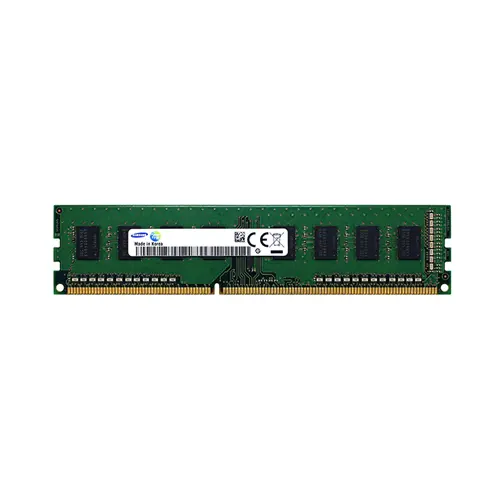
Engineered for legacy server platforms, this Samsung 4GB DDR3-1066 VLP RDIMM (M392B5273CH0-CF8) delivers reliable performance in virtualized environments and memory-intensive database applications through its registered signal architecture and ECC error correction, ensuring data integrity under continuous operation. Its dual-rank x8 organization combined with a low CAS latency of CL7 optimizes command scheduling and memory bandwidth, while the very low-profile form factor enhances airflow in dense 1U/2U rack deployments.
1. Error-correcting code protection silently corrects single-bit memory errors, preserving data integrity for mission-critical server applications where even a flipped bit can disrupt financial or virtualization workloads.
2. Registered buffering stabilizes the command and address signals across fully populated memory channels, allowing consistent operation in large-scale server deployments that demand extensive RAM capacity.
3. Very low profile form factor slashes the vertical height of the module, unlocking essential airflow clearance and cooling efficiency inside dense rack-mount and blade server enclosures.
4. Dual Rank x8 organization interleaves access across internal memory banks, boosting sustained bandwidth to keep virtualized environments responsive under aggressive consolidation ratios.
5. A seven-cycle column access strobe latency sharpens memory responsiveness, reducing read delays for latency-sensitive server tasks such as database lookups and real-time analytics.
The Samsung M392B5273CH0-CF8 is a DDR3-1066 VLP RDIMM engineered for unwavering server reliability. Its ECC protection actively corrects single-bit errors, ensuring data integrity in virtualized environments where a silent bit-flip can crash hypervisors or corrupt financial transactions. The Registered buffer minimizes electrical load, letting you fill every DIMM slot to scale memory for dense VM farms without stability compromises.
For in-memory databases and caching engines like Redis, the Dual Rank x8 design interleaves data paths for higher bandwidth, while the CL7 latency accelerates response times under heavy queries. The Very Low Profile form factor preserves critical airflow in 1U servers and blades, preventing thermal throttling and extending service life. From safeguarding virtual machine uptime to accelerating database throughput, this module turns technical features into tangible business continuity.
General Virtualization
For general virtualization with DDR3 Registered DIMMs, capacity is paramount to host multiple VMs. Populate all available memory channels with these 4 GB VLP RDIMMs to maximize total RAM—aim for at least 96–128 GB on dual-socket platforms—while respecting the per-channel rank limits to avoid clock speed drops. Use balanced configurations (equal modules per channel) to sustain stable 1066 MHz operation under mixed workloads.
In-Memory Database
In-memory databases demand both capacity and data integrity, making ECC Registered memory essential. Deploy the maximum number of identical 4 GB dual-rank modules in as many channels as the platform supports, favouring a fully-populated configuration (e.g., 192 GB or more) to hold large datasets entirely in RAM. Keep CL7 low latency and 1.5 V stability; avoid mixing with non-ECC UDIMMs to prevent server faults.
High-Performance Computing (HPC)
HPC workloads prioritize memory bandwidth over sheer capacity, but these DDR3-1066 modules limit peak throughput. Configure memory in a perfectly balanced layout—one module per channel per socket—to achieve the widest aggregated bandwidth, and then scale capacity by adding a second identical 4 GB module per channel only if datasets exceed the per-node working set. For modern HPC, however, consider migrating to DDR4 platforms where bandwidth demands are higher.
Rigorously server-tested. Compatible with Dell PowerEdge R720, HPE DL380p Gen8, Lenovo ThinkServer RD630, and similar ECC RDIMM systems.
Q: Can I mix this M392B5273CH0-CF8 with other memory modules of different brands or speeds?
A: For server stability, mixing RDIMMs of different brands or speeds is strongly discouraged. Mismatched modules can cause signal integrity issues and system errors. Always use identical, validated modules.
Q: Is this memory compatible with my system?
A: This DDR3 Registered ECC module is compatible with Intel Xeon E5-2600 v1/v2 and AMD Opteron 6300 series platforms. Verify that your motherboard supports 240-pin DDR3-1066 RDIMMs and meets voltage specifications.
Q: What is the recommended DIMM population order for optimal performance?
A: Follow your server motherboard's population guidelines. Generally, populate identical DIMMs in the first slot of each memory channel to enable balanced configurations and maximize throughput in channel interleaving or lockstep modes.
Q: Does this module support overclocking or XMP profiles?
A: No. This Samsung RDIMM is strictly JEDEC-compliant for DDR3-1066 operation. Server-class memory prioritizes data integrity and reliability over overclocking; XMP or manual overclocking is not supported.
Q: What warranty and typical failure rate can I expect?
A: We provide a one-year warranty. The module maintains a very low annualized failure rate, built with RoHS-compliant components and rigorously tested for 24/7 enterprise workloads.