











 Secure payments
Standard refund policy
Trade Assurance
Secure payments
Standard refund policy
Trade Assurance
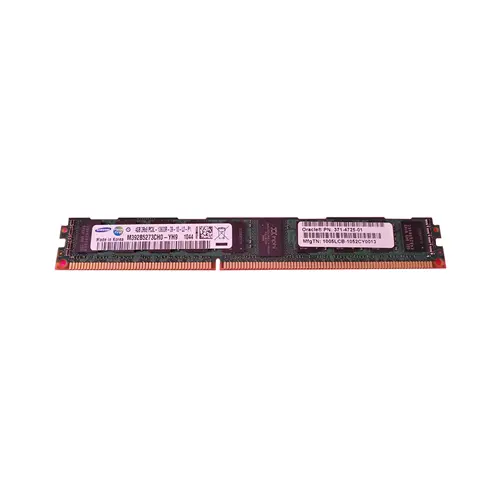
| Model | M392B5273CH0-YH9 |
|---|---|
| Product Type | Memory Module |
| Compliance Standards | EU RoHS,FCC |
| Memory Capacity | 4 GB |
| Memory Technology | DDR3 |
| Product Voltage | 1.35V |
| RAM Speed | 1333MHz |
| RAM Standard | DDR3-1333/PC3-10600 |
| Error Identifying | ECC |
| Signal Type | Registered |
| Column Access Strobe (CAS) | CL9 |
| Rank | Dual Rank x8 |
| Quantity of Pins | 240-pin |
| RAM Genre | VLP RDIMM |
Designed for server platforms, this Samsung DDR3-1333 VLP RDIMM with ECC and registered signaling ensures data integrity in memory-intensive workloads like virtualization and in-memory databases. Its dual-rank x8 configuration and low 1.35V operating voltage deliver a balance of capacity, signal stability, and energy efficiency in dense rack deployments.
1. ECC detection and correction silently eliminates single-bit memory errors, preserving transactional integrity in database servers and preventing costly downtime in financial processing.
2. Registered signal buffering stabilizes command and address buses, allowing dense memory populations necessary for large-scale virtualization without signal degradation.
3. Very Low Profile design fits ultra-slim blade server chassis, improving thermal airflow and enabling maximum DIMM counts for memory-hungry cloud infrastructure.
4. Dual Rank x8 organization keeps memory channels saturated through rank interleaving, delivering consistent bandwidth under heavy simultaneous tenant workloads.
5. 1.35V low-voltage operation cuts power draw and heat output, directly lowering energy bills and cooling demands in always-on enterprise deployments.
The M392B5273CH0-YH9 is a VLP registered DDR3 server memory module, purpose‑built for data‑center workloads where downtime is simply not an option. Its ECC technology actively corrects single‑bit errors, which means that in a virtualized cluster running dozens of VMs, a cosmic‑ray‑induced bit flip in a memory cell will not silently corrupt a hypervisor page table or a customer database transaction—your platform stays accurate and online. The registered signal buffer re‑drives address and command lines, allowing you to populate all 24 DIMM slots per server without signal degradation; for an in‑memory database like Redis or SAP HANA, that translates directly into terabytes of stable capacity that sustain sub‑millisecond latency even under heavy simultaneous reads and writes. The dual‑rank x8 organization interleaves accesses across two internal banks, boosting bandwidth for consolidation workloads. Meanwhile, the 1.35V low‑voltage operation cuts power draw by up to 20 percent compared to standard 1.5V modules, meaning a fully‑loaded rack generates less heat, reduces cooling costs, and extends system lifespan. Finally, the VLP form factor fits neatly into 1U and blade chassis where every millimeter counts, letting you densify computing power without airflow obstruction. These four characteristics together deliver uncompromised data integrity, massive scalable capacity, energy efficiency, and dense form‑factor compatibility—exactly what a modern virtualized or database‑centric data center demands.
General Virtualization
For virtualized workloads, populate at least one 4GB VLP RDIMM per memory channel to maintain balanced memory bandwidth across CPUs. In a typical dual‑socket server with triple‑channel architecture, installing 12 identical modules provides 48GB of registered ECC memory—sufficient for light‑to‑medium VM density. The 1.35V low‑voltage design also lowers power and cooling overhead in always‑on hosts.
In‑Memory Database
Maximize usable capacity by filling all available DIMM slots, since 4GB modules demand higher counts to reach cache‑friendly sizes. Dual‑rank x8 DIMMs deliver a slight latency advantage under heavy concurrent access, though populating every slot may force a modest speed drop to 1066MHz. Strictly use identical registered ECC parts to avoid stability risks in transactional in‑memory stores.
High‑Performance Computing
Achieve peak memory throughput by installing modules symmetrically across memory channels—ideally one 4GB RDIMM per channel in each processor’s bank. This yields 24GB–32GB per socket on common 2‑socket HPC nodes, which suits bandwidth‑sensitive simulations. The very‑low‑profile form factor improves airflow and allows denser node packaging, while 1.35V operation trims total cluster energy costs without sacrificing ECC reliability.
Rigorously tested server memory, compatible with Dell PowerEdge R720, HPE DL380p Gen8, IBM x3650 M4.
Q: Can I mix this M392B5273CH0-YH9 with other memory modules of different brands or speeds?
A: Mixing is not recommended for server environments. Registered ECC modules require identical ranks, timings, and organization to maintain signal integrity and system stability.
Q: Is this memory compatible with my Intel Xeon E5 or AMD Opteron server platform?
A: This DDR3-1333 PC3-10600 VLP RDIMM is compatible with most Intel Xeon E5-2600/E5-2400 series and equivalent AMD platforms that support 240-pin 1.35V registered ECC memory. Verify your motherboard's qualified vendor list.
Q: What is the recommended DIMM population order for optimal performance?
A: Follow your server board’s manual, typically populating identical DIMMs per memory channel. For dual-processor systems, balance DIMMs across both memory controllers to enable full memory interleaving.
Q: Does this module support overclocking or XMP profiles?
A: No. This is a JEDEC-compliant registered server DIMM. Overclocking and XMP are not supported; it operates strictly at its rated 1333MHz with CL9 timings to ensure data center reliability.
Q: What warranty and typical failure rate can I expect?
A: It includes a 1-year warranty. The part adheres to rigorous EU RoHS and JEDEC standards, exhibiting an extremely low annualized failure rate typical of enterprise-grade Samsung memory.