











 Secure payments
Standard refund policy
Trade Assurance
Secure payments
Standard refund policy
Trade Assurance
| Model | M392B5273DH0-CH9 |
|---|---|
| Product Type | Memory Module |
| Compliance Standards | CE,WEEE,RoHS |
| Memory Capacity | 4 GB |
| Memory Technology | DDR3 |
| Product Voltage | 1.5V |
| RAM Speed | 1333MHz |
| RAM Standard | DDR3-1333/PC3-10600 |
| Error Identifying | ECC |
| Signal Type | Registered |
| Column Access Strobe (CAS) | CL9 |
| Rank | Dual Rank x8 |
| Quantity of Pins | 240-pin |
| RAM Genre | VLP RDIMM |
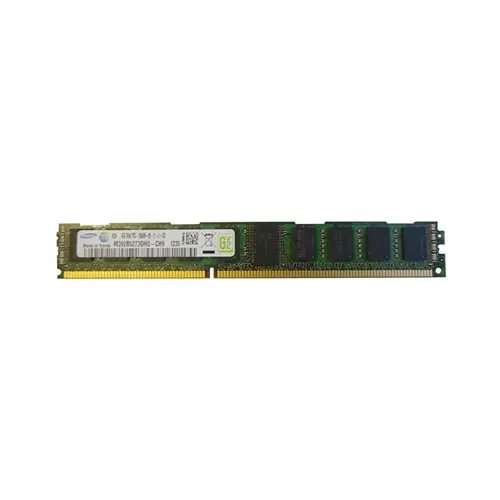
This Samsung M392B5273DH0-CH9 is a DDR3-1333 VLP RDIMM purpose-built for server platforms, where its registered signal type ensures stable operation across high-density memory configurations and ECC support provides critical data integrity for workloads like virtualization and in-memory databases. The dual-rank x8 organization and CAS 9 latency offer a practical balance of capacity and responsiveness, while the very low-profile form factor improves airflow in dense 1U/2U rack servers and blade enclosures.
1. Integrated ECC actively corrects single-bit errors in real time, safeguarding transactional integrity inside business-critical database and virtualization hosts.
2. The registered buffer offloads the memory controller to support higher-capacity DIMM populations, preserving signal stability across fully loaded server channels.
3. A very-low-profile PCB reduces module height for ultra-dense server sleds and blade chassis, directly improving airflow and lowering thermal strain in scale-out deployments.
4. Dual-rank x8 organization interleaves commands across internal banks, sustaining memory bandwidth saturation even under heavy multi-tenant VM workloads.
5. PC3-10600 throughput delivers 10.6 GB/s per channel, preventing memory bottlenecks for in-memory caching and high-concurrency web-tier applications.
When you are running a virtualized cluster hosting dozens of mission-critical VMs, or an in-memory database where every microsecond counts, the memory you choose either protects your uptime or invites silent data corruption. The Samsung M392B5273DH0-CH9 is a server-grade DDR3 VLP RDIMM engineered specifically for these exacting environments, and its four key characteristics directly answer the real-world pain points of IT architects and system administrators.
First, the ECC technology continuously detects and corrects single-bit errors, a vital safeguard against cosmic-ray-induced bit flips that can corrupt a financial transaction or crash a hypervisor node. Second, the registered signal type buffers the command and address lines, allowing a single server board to support massive memory populations without electrical loading instability—this means you can confidently scale to 192 GB or more for large VM farms. Third, the dual-rank x8 organization increases bank-level parallelism, delivering measurably higher sustained throughput for database caching and analytics workloads where rank interleaving hides refresh latency. Finally, the very-low-profile form factor is critical in dense 1U and blade servers where every millimeter of clearance matters for airflow and thermal headroom. In a clustered database environment, this VLP design prevents heat throttling during sustained loads, and in a virtualized environment, ECC and registered buffering together ensure that a memory fault never silently propagates across dozens of guest machines. This module is not just a specification sheet—it is the difference between a stable, high-density infrastructure and a cascading failure waiting to happen.
General Virtualization
For virtualized hosts, populate all memory channels symmetrically to maximize bandwidth and support multiple VMs. Using these 4GB ECC Registered DIMMs, a typical dual-socket server with three channels per CPU benefits from at least six identical modules—one per channel—to avoid bottlenecks. Since capacity demands scale with VM density, plan to fully populate all slots with dual-rank modules up to the board’s limit, ensuring stable memory overcommit and fault tolerance.
In-Memory Database
In-memory databases require absolute data integrity and large, contiguous memory pools. ECC Registered DIMMs are mandatory; these 4GB dual-rank modules provide a balance of capacity and signal integrity. To achieve the 128GB+ footprints common for real-time analytics, populate all available DIMM slots, adhering to population order per channel. Prioritise capacity over raw speed, but ensure uniform module configuration to maintain lockstep memory mode where supported.
High Performance Computing
HPC workloads thrive on memory bandwidth and reliability during long-running jobs. Install these RDIMMs in balanced channel configurations—typically one or two modules per channel—to fully utilise the server’s interleaved memory architecture. While 1333MHz is modest, populating three channels per socket with these low-profile dual-rank DIMMs sustains necessary throughput for dense node clusters. Scale capacity by adding complete sets of modules per socket, never mixing ranks or speeds, to preserve predictable compute performance.
Server-grade DDR3 Registered ECC memory, rigorously tested. Compatible with Dell PowerEdge R720, HP DL380p Gen8, IBM x3650 M4.
Q: Can I mix this M392B5273DH0-CH9 with other memory modules of different brands or speeds?
A: Mixing different brands or speeds is not recommended for Registered ECC memory. It can cause signal integrity issues and system instability. For optimal reliability, use identical M392B5273DH0-CH9 modules across all channels.
Q: Is this memory compatible with my server?
A: This M392B5273DH0-CH9 is a DDR3 Registered ECC VLP RDIMM, compatible with select Intel Xeon E5/E7 and AMD Opteron 6300/4300 platforms. Please verify your server motherboard's Qualified Vendor List for specific support.
Q: What is the recommended DIMM population order for optimal performance?
A: For dual-socket servers, populate memory channels symmetrically per CPU. Always fill the first DIMM slot (blue connector) in each channel before the second. Follow the platform-specific memory population guide for balanced NUMA configurations.
Q: Does this module support overclocking or XMP profiles?
A: No. This is a JEDEC-compliant server module running at DDR3-1333 CL9 with 1.5V. It does not support overclocking, XMP, or voltage modification, as operating outside specifications can compromise data integrity and ECC protection.
Q: What warranty and typical failure rate can I expect?
A: This M392B5273DH0-CH9 module is covered by a 1-year warranty. As an enterprise Registered RDIMM, it demonstrates an extremely low Annualized Failure Rate, typical of rigorously screened server-grade components.