











 Secure payments
Standard refund policy
Trade Assurance
Secure payments
Standard refund policy
Trade Assurance
| Model | M392B5273DH0-CMA |
|---|---|
| Product Type | Memory Module |
| Compliance Standards | EU RoHS,FCC |
| Memory Capacity | 4 GB |
| Memory Technology | DDR3 |
| Product Voltage | 1.5V |
| RAM Speed | 1866MHz |
| RAM Standard | DDR3-1866/PC3-14900 |
| Error Identifying | ECC |
| Signal Type | Registered |
| Column Access Strobe (CAS) | CL13 |
| Rank | Dual Rank x8 |
| Quantity of Pins | 240-pin |
| RAM Genre | VLP RDIMM |
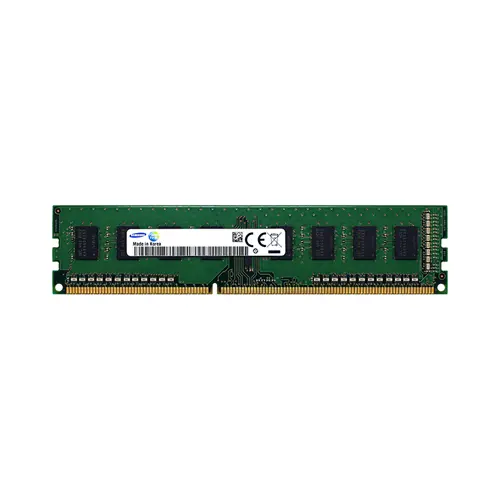
The Samsung M392B5273DH0-CMA is a 4 GB DDR3-1866 VLP RDIMM engineered for enterprise server platforms, delivering the registered signal buffering and ECC error correction essential for virtualized environments, in-memory databases, and mission-critical workloads that demand uncompromising data integrity. Its dual-rank x8 configuration with low CL13 latency enhances memory interleaving and response times, while the very low‑profile form factor allows dense DIMM population in compact 1U/2U rack servers, ensuring stable operation under sustained load.
1. ECC: End-to-end error correction safeguards transactional integrity in virtualized database servers, eliminating single-bit memory faults that silently corrupt critical business data.
2. Registered: The registered buffer stabilizes signal paths across densely populated memory banks, enabling reliable operation during peak VM consolidation and large-memory analytics.
3. VLP RDIMM: Very low profile construction maximizes cooling clearance in slim 1U/2U chassis, sustaining full-speed operation without thermal throttling under continuous compute loads.
4. Dual Rank x8: Dual rank interleaving saturates each memory channel with parallel access streams, significantly boosting throughput for in-memory caching and heavy multi-tenant workloads.
5. 1866MHz / PC3-14900: The 1866MHz clock drives 14.9GB/s peak bandwidth per channel, slashing response times for latency-sensitive enterprise applications like real-time transaction processing.
The M392B5273DH0-CMA is a DDR3-1866 Very Low Profile Registered DIMM engineered for mission-critical server environments. Its ECC circuitry is your first line of defense against silent data corruption: in a 24/7 virtualized cluster hosting dozens of VMs, a single bit flip in memory can crash an entire hypervisor or silently corrupt a financial transaction. ECC detects and corrects these errors in real time, preserving uptime and data trustworthiness. The registered signal architecture buffers command and address lines, allowing you to populate all 24 DIMM slots per server without compromising signal integrity — essential when scaling an in-memory database like SAP HANA or Redis, where every gigabyte counts and instability under full load is unacceptable. With its dual-rank x8 organization and 1866 MHz speed at CL13, this module enables rank interleaving that boosts effective bandwidth; a database engine can overlap read/write commands across ranks, reducing latency spikes during peak OLTP workloads. Finally, the VLP form factor solves a real-world density challenge: in 1U rack servers and blade enclosures, standard-height DIMMs obstruct airflow and limit thermal headroom. This low-profile design slides into tight spaces, letting you maximize capacity without sacrificing cooling efficiency — a quiet but decisive advantage when every rack unit must deliver predictable performance.
General Virtualization
For modest virtualization hosts, populate at least six identical 4 GB modules per CPU to enable balanced memory interleaving across all memory channels. Deploy modules in multiples of three to maintain triple‑channel symmetry on legacy Nehalem/Westmere platforms, or fill all channels on modern servers to avoid bandwidth bottlenecks and ensure reliable live migration.
In‑Memory Database
In‑memory databases demand capacity far beyond a single 4 GB DIMM, so plan for fully populated ranks with the largest supported count—often 12 or 24 modules per node—to reach 48–96 GB configurations. Registered ECC and dual‑rank x8 design guarantee signal integrity and data protection under heavy transactional loads, making these modules safe building blocks for Redis or SAP HANA pilot environments.
High‑Performance Computing
HPC clusters rely on memory bandwidth as much as capacity; balance modules evenly across all memory channels, ideally one DIMM per channel for maximum frequency headroom. The 1866 MT/s speed and CL13 latency suit compute‑bound workloads when tuned with correct DIMM population order, while VLP form factor helps maintain airflow in dense 1U compute sleds. Use identical Samsung M392B5273DH0‑CMA modules to eliminate timing mismatches that degrade floating‑point throughput.
Server-grade validated: rigorously tested with Dell R720, HP DL380p Gen8, IBM x3650 M4, and more.
Q: Can I mix this M392B5273DH0-CMA with other memory modules of different brands or speeds?
A: Mixing is not recommended for server workloads. Mismatched RDIMMs may cause stability issues or force lower speed. For guaranteed reliability, use identical modules with same rank and CAS latency.
Q: Is this memory compatible with my Intel Xeon E5 or AMD Opteron server platform?
A: This DDR3-1866 Registered ECC module is designed for dual-socket servers using Intel C600 or AMD SR56x0/SP5100 chipsets. Confirm if your board supports VLP RDIMM and 1866MHz speed.
Q: What is the recommended DIMM population order for optimal performance?
A: Install in sets of identical modules per memory channel, starting with blue slots for CPU1. Follow the platform’s population guide, typically filling all channels symmetrically to enable interleaving and maximize bandwidth.
Q: Does this module support overclocking or XMP profiles?
A: No. This is a JEDEC-compliant server RDIMM with CL13 at 1.5V. It does not support XMP or overclocking; it is validated for stable, 24/7 operation at rated 1866MHz in enterprise environments.
Q: What warranty and typical failure rate can I expect?
A: This module includes a 1-year warranty. As a Samsung server-grade RDIMM, it exhibits a very low annualized failure rate (typically below 0.1%) when operated within specified environmental conditions.