











 Secure payments
Standard refund policy
Trade Assurance
Secure payments
Standard refund policy
Trade Assurance
| Product Type | Memory Module |
|---|---|
| Memory Capacity | 8 GB |
| Memory Technology | DDR4 |
| Product Voltage | 1.2 V |
| RAM Speed | 2400 MHz |
| RAM Standard | DDR4-2400/PC4-19200 |
| Error Identifying | ECC |
| Signal Type | Registered |
| Column Access Strobe (CAS) | CL17 |
| Rank | Single Rank x4 |
| Quantity of Pins | 288-pin |
| RAM Genre | RDIMM |
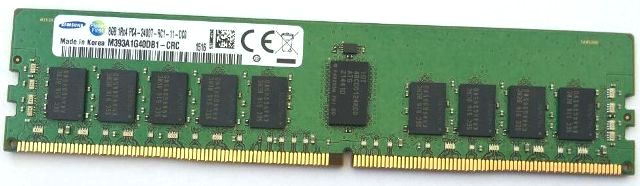
Designed for server environments, this Samsung M393A1G40DB1-CRC 8GB DDR4-2400 RDIMM with ECC and registered signaling ensures data integrity and system stability under heavy loads, making it ideal for virtualization, in-memory databases, and mission-critical enterprise workloads. Its single-rank x4 organization and CL17 latency optimize signal integrity and reduce electrical loading on the memory bus, allowing higher memory density per channel without sacrificing reliability.
1. ECC error correction silently detects and fixes single-bit memory faults, preserving transactional integrity for financial databases and preventing hypervisor crashes in always-on enterprise environments.
2. Registered signal buffering isolates the command and address bus from excessive electrical loading, allowing fully populated server boards to deliver unshakable stability under maximum memory capacity.
3. An 8GB module supplies right-sized headroom for dedicated caching servers or lightweight container hosts, optimizing TCO in dense scale-out infrastructure without over-provisioning.
4. 2400 MT/s throughput accelerates large dataset transfers, reducing query latency for concurrent business intelligence dashboards and in-memory analytics engines.
5. Single Rank x4 organization combines minimal bus load with x4 device width, enabling Chipkill-like advanced ECC that keeps mission-critical nodes online even if an entire DRAM chip fails.
The Samsung M393A1G40DB1-CRC is an 8 GB DDR4 RDIMM purpose‑built for enterprise servers, where its four core characteristics directly prevent the most painful real‑world failures. ECC error correction actively hunts and repairs single‑bit flips caused by background radiation, so a virtualized cluster running critical databases will not suffer silent data corruption that could crash dozens of VMs or mangle a financial transaction. The registered clock driver buffers address and command signals, allowing a hypervisor host to populate all channels with dense memory without signal degradation—this means you can confidently scale up to multi‑terabyte in‑memory footprints that consolidation demands. Under the heat spreader, a single‑rank x4 organization strikes the ideal balance between bank‑group parallelism and low electrical load, keeping latency tight even under the concurrent, random access patterns of Redis or SAP HANA. Finally, the 1.2 V DRAM core slashes power draw per DIMM; across a 96‑module server farm, the accumulated savings in cooling and energy directly reduce total cost of ownership while the stable 2400 MT/s throughput keeps virtual machines and real‑time analytics responding instantly.
Memory Type Identification: Server Memory (RDIMM ECC)
This is an 8GB DDR4-2400 Registered ECC DIMM, suited for enterprise servers requiring data integrity and stability.
General Virtualization
Start with a balanced population of at least four modules per server to enable quad-channel memory interleaving. For a mid-sized hypervisor hosting 20–30 VMs, configure 8 × 8GB (64GB total) to allow headroom for memory overcommit. As consolidation increases, scale by adding identical 8GB RDIMMs in matching ranks to avoid performance penalties.
In-Memory Database
Capacity is king, but speed and data protection matter. Given the 8GB base module size, populate all available channels with at least one DIMM per channel to maximize bandwidth for real-time analytics. A typical Redis or Memcached node benefits from 16 × 8GB (128GB) fully populated, ensuring ECC guards against silent corruption. For larger datasets, consider higher-capacity modules, but this 8GB unit can serve as a cost-effective building block.
High-Performance Computing (HPC)
HPC workloads crave memory bandwidth and low latency. Populate all memory channels symmetrically—e.g., 12 × 8GB (96GB) across a dual-socket server with six channels per CPU—to sustain parallel I/O. The CL17 latency and registered signal type stabilize large node clusters during MPI jobs. This capacity works well for compute-bound tasks, but pair it with identical RDIMMs to maintain uniform timing and rank interleaving.
Rigorously validated for servers; compatible with Dell PowerEdge R740, HPE ProLiant DL380 Gen10, Lenovo ThinkSystem SR650, and more.
Q: Can I mix this M393A1G40DB1-CRC with other memory modules of different brands or speeds?
A: Mixing registered DIMMs of different brands or speeds is not recommended. Mismatched modules may cause instability or prevent boot. For reliable server operation, always use identical, validated RDIMMs.
Q: Is this memory compatible with my system?
A: This DDR4-2400 ECC Registered DIMM is compatible with servers using Intel Xeon E5-2600 v4 or Scalable platforms, and select AMD EPYC systems. Verify your motherboard's QVL for RDIMM support.
Q: What is the recommended DIMM population order for optimal performance?
A: Follow the server board's memory population guidelines, typically filling slots per channel with identical DIMMs. Balance across memory channels and CPU sockets to maximize bandwidth and enable interleaving.
Q: Does this module support overclocking or XMP profiles?
A: No. This server RDIMM operates exclusively at JEDEC standard DDR4-2400 with CL17. It does not support XMP or overclocking, as enterprise reliability and error correction take priority over speed flexibility.
Q: What warranty and typical failure rate can I expect?
A: This module comes with a 1-year warranty. Enterprise DDR4 RDIMMs have very low annualized failure rates, typically under 0.5%, ensuring stable, long-term deployment in mission-critical servers.