











 Secure payments
Standard refund policy
Trade Assurance
Secure payments
Standard refund policy
Trade Assurance
| Product Type | Memory Module |
|---|---|
| Memory Capacity | 8 GB |
| Memory Technology | DDR4 |
| Product Voltage | 1.2 V |
| RAM Speed | 2400 MHz |
| RAM Standard | DDR4-2400/PC4-19200 |
| Error Identifying | ECC |
| Signal Type | Registered |
| Column Access Strobe (CAS) | CL17 |
| Rank | Dual Rank x8 |
| Quantity of Pins | 288-pin |
| RAM Genre | RDIMM |
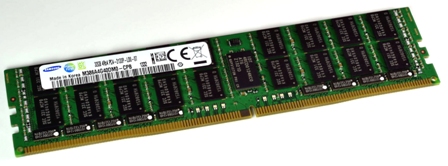
This is a server-class DDR4-2400 Registered ECC memory module (RDIMM) purpose‑built for virtualization clusters, in‑memory databases, and other mission‑critical enterprise workloads where data integrity takes absolute priority. Its dual‑rank x8 organization and registered signaling deliver robust signal integrity and increased bandwidth efficiency across fully‑populated memory channels, while ECC actively corrects single‑bit errors to prevent silent data corruption in 24/7 operation.
1. Registered signal type ensures robust command and address integrity across fully buffered memory channels, enabling large-scale server deployments to sustain uptime under heavy memory loading.
2. ECC protection provides real-time single-bit error correction, safeguarding transactional databases and in-memory caches against silent data corruption.
3. Dual Rank x8 organization maximizes per-channel bandwidth utilization, allowing dense virtualization hosts to maintain smooth guest responsiveness during peak consolidation workloads.
4. The 1.2V operating voltage reduces overall server power draw and thermal stress, directly lowering data center cooling costs in densely packed rack configurations.
5. An 8-gigabyte capacity per module offers a cost-effective building block for entry-level application servers, balancing memory density with budget in scale-out infrastructure.
As a Registered DDR4 DIMM with ECC, the Samsung M393A1G43EB1-CRC is engineered specifically for mission-critical server environments where reliability is non-negotiable. In a virtualized cluster hosting dozens of VMs, a seemingly minor memory bit-flip can silently corrupt data inside a running application or even crash the hypervisor, resulting in unexpected downtime. The module’s integrated ECC actively detects and corrects single-bit errors in real time, effectively shutting down this risk and preserving the data integrity your virtual infrastructure depends on. The registered buffer plays an equally vital role by ensuring clean, stable command and address signals when all memory channels are fully populated, which means you can confidently scale to large memory capacities for dense virtualization without destabilizing the system. Its dual-rank x8 organization further enables rank interleaving, allowing the memory controller to access one rank while the other precharges—this directly boosts throughput for latency-sensitive, in-memory databases like Redis or real-time analytics engines that cannot tolerate slow retrieval. Operating at a low 1.2V and 2400MT/s, this module also helps data centers contain power and cooling costs while meeting strict SLA targets around the clock.
General Virtualization
For a dual-socket server, populate all memory channels evenly to maximize throughput. Using 8 GB RDIMMs, aim for 128–256 GB total by installing sixteen 8 GB modules (two per channel in an 8-channel platform). This balanced configuration ensures sufficient capacity for hosting multiple VMs while maintaining the performance benefits of ECC and registered memory.
In-Memory Database
In-memory databases demand large capacity and high reliability. Deploy twenty-four 8 GB RDIMMs across all available DIMM slots (e.g., three per channel) to reach 192 GB or more, creating a single, resilient memory pool. ECC protection and the registered signal type safeguard data integrity during intensive, constant read/write operations typical of Redis or SAP HANA workloads.
High-Performance Computing
HPC clusters prioritize memory bandwidth alongside capacity. Equip each node with a symmetrical configuration—ideally one 8 GB RDIMM per channel across all eight channels—yielding 64 GB at maximum bandwidth. In bandwidth-constrained workloads, this lean setup reduces latency and avoids performance penalties from populating more than one DIMM per channel, while dual-rank x8 modules still deliver strong throughput for parallel calculations.
Server memory validated for Dell PowerEdge R750, HPE ProLiant DL380 Gen10, Lenovo ThinkSystem SR650. Rigorously tested.
Q: Can I mix this M393A1G43EB1-CRC with other memory modules of different brands or speeds?
A: Mixing Registered DIMMs of different brands or speeds is not recommended in servers. The system will clock all modules to the slowest speed and may cause stability issues or POST failures.
Q: Is this memory compatible with my system?
A: This DDR4-2400 ECC RDIMM is designed for Intel Xeon E5-2600 v4 and select AMD EPYC platforms. Verify your server's Qualified Vendor List (QVL) for validated mainboard compatibility before ordering.
Q: What is the recommended DIMM population order for optimal performance?
A: Populate identical DIMMs in matching channels according to your server manual, typically starting with the white or blue slots per channel. Balance capacity across memory controllers for symmetric memory architectures and full bandwidth.
Q: Does this module support overclocking or XMP profiles?
A: No. This is an industry-standard server Registered DIMM operating at JEDEC-specified timings. Overclocking and XMP profiles are not supported, as server platforms prioritize data integrity and stability over manual tuning.
Q: What warranty and typical failure rate can I expect?
A: This Samsung module carries a 1-year warranty. Actual AFR is typically well below 0.5% per year in controlled server environments. Premature failure is rare when thermal and voltage specifications are maintained.