











 Secure payments
Standard refund policy
Trade Assurance
Secure payments
Standard refund policy
Trade Assurance
| Product Type | Memory Module |
|---|---|
| Memory Capacity | 8 GB |
| Memory Technology | DDR4 |
| Product Voltage | 1.2 V |
| RAM Speed | 2666 MHz |
| RAM Standard | DDR4-2666/PC4-21300 |
| Error Identifying | ECC |
| Signal Type | Registered |
| Column Access Strobe (CAS) | CL19 |
| Rank | Dual Rank x8 |
| Quantity of Pins | 288-pin |
| RAM Genre | RDIMM |
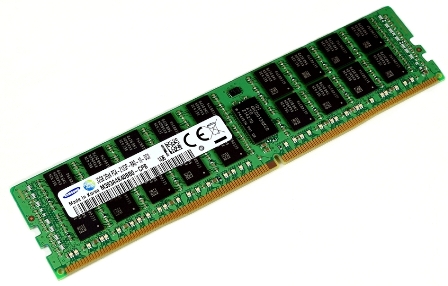
Optimized for server platforms such as virtualization hosts and in-memory databases, this Samsung M393A1G43EB1-CTD 8GB DDR4-2666 RDIMM leverages ECC and registered signal technology to ensure critical data integrity and system stability under heavy load. Its dual-rank x8 configuration at CL19 enhances memory bandwidth utilization, making it an efficient choice for dense multi-DIMM deployments where reliable, error-free operation is paramount.
1. ECC error correction silently detects and corrects single-bit data errors, ensuring transaction integrity for financial databases and virtualized environments where even a single flipped bit can compromise an entire workload.
2. Registered signal buffering stabilizes command and address lines under heavy channel loading, enabling a single server to scale to massive memory capacities without sacrificing signal integrity.
3. Dual Rank x8 organization uses rank interleaving to overlap back‑end access cycles, effectively boosting sustained bandwidth for consolidated VMs under mixed load.
4. 2666 MT/s data rate provides the raw throughput needed to feed modern multi‑core server CPUs, minimizing data starvation in memory‑hungry analytics and caching applications.
5. 1.2V low‑voltage operation directly cuts power draw per DIMM, lowering data center cooling costs and improving TCO for large‑scale server deployments.
Based on the RDIMM classification, this is server-grade memory. For IT architects managing virtualized clusters and real-time database platforms, the Samsung M393A1G43EB1-CTD directly addresses four critical operational demands. Its ECC engine is your frontline defense against silent data corruption: within a dense VMware farm, a single uncorrected bit flip can cascade through nested virtual machines and invalidate transactional records without warning. ECC detection and correction eliminate that liability, preserving financial and operational accuracy. The Registered buffer stabilizes command and address lines even when all 24 slots of a blade server are populated, which is essential when you need maximum memory capacity to host hundreds of containers without signal degradation. Meanwhile, the dual-rank x8 organization enables bank interleaving that meaningfully accelerates in-memory workloads. In a Redis or SAP HANA instance processing thousands of queries per second, the controller can parallelize access across ranks, slashing latency under high concurrency. The 2666 MT/s throughput and 1.2V efficiency then sustain that performance without inflating thermal budgets, keeping your data center both fast and stable.
General Virtualization
This 8 GB DDR4-2666 ECC Registered DIMM is suitable for modest virtualized environments. Deploy six to eight identical modules per dual-socket server to achieve 48–64 GB, which comfortably hosts a dozen lightweight VMs while maintaining memory interleaving. Populate symmetrical memory channels and balance DIMMs across processors to avoid NUMA bottlenecks and ensure reliable RAS coverage.
In-Memory Database
In-memory databases thrive on capacity and fault tolerance; use this module as a building block in larger populations. Aim for at least 128 GB total by installing sixteen 8 GB RDIMMs across all channels, enabling full memory bandwidth for high-throughput datasets. Pair with a second identical kit to reach 256 GB, avoiding mixed ranks on the same channel to preserve latency-sensitive transaction performance.
High-Performance Computing
HPC workloads demand maximum bandwidth and predictable latency. Configure eight matching Dual Rank x8 RDIMMs per socket (one DIMM per channel) to saturate the memory controller while keeping CL19 latency uniform. For capacity-bound simulations, scale to two DIMMs per channel, but validate thermal headroom and lower speed if the platform down-clocks; uniform population is critical to maintain job consistency across nodes.
Engineered and rigorously tested for compatibility with Dell PowerEdge R740, HPE ProLiant DL380 Gen10, Lenovo SR650, and Supermicro X11 servers.
Q: Can I mix this M393A1G43EB1-CTD with other memory modules of different brands or speeds?
A: Mixing modules is not recommended for registered server memory. Different brands or speeds can cause instability and invalidate support. For guaranteed reliability, populate identical M393A1G43EB1-CTD modules from the same batch.
Q: Is this memory compatible with my server system?
A: This RDIMM is compatible with servers using Intel Xeon Scalable or AMD EPYC platforms that support DDR4-2666 ECC Registered memory. Please consult your motherboard qualified vendor list (QVL) to confirm full compatibility.
Q: What is the recommended DIMM population order for optimal performance?
A: Optimal population follows your server board guidelines. Generally, fill identical DIMMs per channel starting from the furthest slot. For dual-socket systems, balance capacity evenly across both processors to maintain uniform memory interleaving.
Q: Does this module support overclocking or XMP profiles?
A: No. This is an enterprise-grade ECC Registered DIMM running at JEDEC standard DDR4-2666 (PC4-21300). It does not support XMP or overclocking; strict compliance to base frequency and timings ensures data integrity in server workloads.
Q: What warranty and typical failure rate can I expect?
A: Covered by a one-year warranty. Server-grade RDIMMs exhibit extremely low failure rates, typically with an MTBF exceeding millions of hours when operated within specifications, backed by rigorous manufacturer testing.