











 Secure payments
Standard refund policy
Trade Assurance
Secure payments
Standard refund policy
Trade Assurance
| Model | M393A1K43BB0-CRC0Q |
|---|---|
| Product Type | Memory Module |
| Compliance Standards | CE,WEEE,RoHS |
| Memory Capacity | 8 GB |
| Memory Technology | DDR4 |
| Product Voltage | 1.2V |
| RAM Speed | 2400MHz |
| RAM Standard | DDR4-2400/PC4-19200 |
| Error Identifying | ECC |
| Signal Type | Registered |
| Column Access Strobe (CAS) | CL17 |
| Rank | Single Rank x8 |
| Quantity of Pins | 288-pin |
| RAM Genre | RDIMM |
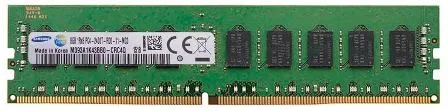
This Samsung 8GB DDR4-2400 RDIMM delivers registered ECC memory with a single-rank x8 organization that ensures robust signal integrity and data reliability for server platforms. It is ideally suited for virtualization and in-memory database workloads where stable 1.2 V operation and CL17 latency keep mission-critical applications responsive under sustained load.
1. Registered signal type buffers the command and address buses, stabilizing signal integrity across fully populated server memory channels and enabling large-scale memory configurations without compromising reliability.
2. ECC protection continuously detects and corrects single-bit errors and flags multi-bit faults, preventing silent data corruption in financial transactions and virtualized databases.
3. 8GB module capacity offers a granular, power-efficient building block for hyper-converged infrastructure, allowing fine-tuned memory allocation per virtual machine.
4. DDR4-2400 speed sustains 19.2GB/s peak bandwidth per channel, reducing latency in memory-hungry workloads such as in-memory analytics and high-traffic web serving.
5. Single Rank x8 organization presents a lighter electrical load to the memory controller, lowering access latency and improving request completion rates under heavy virtualization consolidation.
When you rely on a server to run hypervisor clusters hosting dozens of virtual machines, a single undetected bit-flip in memory can silently corrupt databases or crash critical workloads. This is where the Samsung M393A1K43BB0-CRC0Q RDIMM transforms uptime from hope into certainty. Its Error‑Correcting Code (ECC) constantly scrubs single‑bit errors—an absolute necessity for financial transaction logs or in‑memory databases like Redis, where data fidelity is non‑negotiable. Meanwhile, the Registered signal‑buffer design electrically isolates the command‑address bus, allowing you to populate all channels with maximum DIMMs without signal‑integrity issues. For a virtualization host, that means you can scale to 256 GB or more and keep every VM stable under full orchestration. The DDR4‑2400 speed, organized as single‑rank x8 with a 1.2 V supply, delivers consistent bandwidth while keeping thermals remarkably low. In a dense server rack, lower power per DIMM adds up: less fan noise, reduced cooling cost, and headroom for future expansion. These features do not just tick specification boxes—they directly prevent silent data corruption, sustain memory‑heavy analytics, and give IT teams the confidence to consolidate multi‑tenant applications onto fewer physical servers without compromise.
General Virtualization
Balance capacity and memory bandwidth by deploying at least sixteen modules (128 GB total) evenly across all memory channels of a dual‑socket server. Populate one DIMM per channel to avoid bottlenecks, maintain stable 2400 MHz operation, and comfortably host dozens of lightweight VMs without excessive NUMA latencies.
In-Memory Database
Maximize capacity using twenty‑four to thirty‑two modules (192–256 GB), filling every available DIMM slot in a symmetric 2‑DPC layout. This feeds demanding in‑memory datasets entirely into RAM while registered ECC guards data integrity. Match all modules identically per channel to sustain reliable, low‑latency performance under constant heavy utilization.
High-Performance Computing
Prioritize bandwidth and latency by installing exactly one DIMM per channel across all populated channels—typically sixteen modules for 128 GB. Running at the full DDR4‑2400 speed without rank‑switching penalties delivers predictable, balanced throughput for simulation, modeling, and parallel computational kernels.
Rigorously tested, compatible with Dell PowerEdge R760, HPE ProLiant DL380 Gen10, Lenovo ThinkSystem SR650.
Q: Can I mix this M393A1K43BB0-CRC0Q with other memory modules of different brands or speeds?
A: We do not recommend mixing brands, speeds, or ranks in server platforms. Mixed Registered DIMMs often cause stability issues, training failures, or degraded performance. For 24/7 reliability, populate with identical Samsung M393A1K43BB0-CRC0Q modules only.
Q: Is this memory compatible with my system?
A: This DDR4-2400 ECC Registered DIMM is designed for servers using Intel Xeon E5-2600 v4/Scalable or AMD EPYC 7000 series platforms. Verify your motherboard or server OEM's QVL list for M393A1K43BB0-CRC0Q to confirm full compatibility.
Q: What is the recommended DIMM population order for optimal performance?
A: Populate identical RDIMMs starting from the farthest slot from the CPU per channel, balancing channels equally. Always follow your server board's memory population guide to achieve optimal interleaved performance and avoid NUMA imbalances.
Q: Does this module support overclocking or XMP profiles?
A: No. As an enterprise Registered ECC module, it conforms strictly to the JEDEC DDR4-2400 standard. It does not support overclocking or XMP profiles, prioritizing data integrity and error correction over adjustable speed.
Q: What warranty and typical failure rate can I expect?
A: This Samsung module includes a 1-year warranty. Server DRAM of this class typically exhibits an annualized failure rate (AFR) well below 0.5% when operated within specified voltage and thermal limits in compliant platforms.