











 Secure payments
Standard refund policy
Trade Assurance
Secure payments
Standard refund policy
Trade Assurance
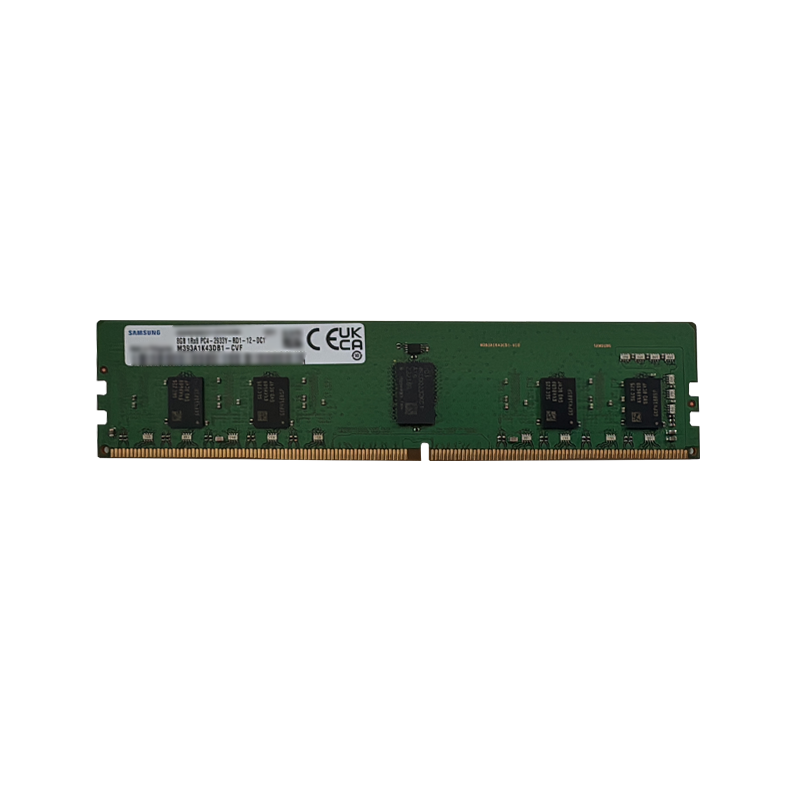
| Product Type | Memory Module |
|---|---|
| Memory Capacity | 8 GB |
| Memory Technology | DDR4 |
| Product Voltage | 1.2 V |
| RAM Speed | 2933 MHz |
| RAM Standard | DDR4-2933/PC4-23400 |
| Error Identifying | ECC |
| Signal Type | Registered |
| Column Access Strobe (CAS) | CL21 |
| Rank | Single Rank x8 |
| Quantity of Pins | 288-pin |
| RAM Genre | RDIMM |
This RDIMM module is engineered for server platforms, specifically optimized for virtualization and memory-intensive databases where registered signal stability and ECC data integrity are non-negotiable. The single-rank x8 configuration at DDR4-2933 with CL21 timing minimizes bus loading and maximizes memory controller headroom, ensuring reliable throughput under heavy concurrent workloads.
1. ECC protection silently corrects single-bit memory errors, preserving data integrity in mission-critical databases and preventing unexpected application crashes.
2. Registered signal buffering stabilizes command and address lines, allowing dense memory configurations without signal degradation in large-scale virtualization hosts.
3. Single Rank x8 organization reduces electrical loading on the memory bus, enabling stable high-frequency operation across fully populated server memory slots.
4. 2933 MT/s throughput accelerates data-intensive tasks such as real-time analytics, shrinking query completion times in multi-node clusters.
5. 1.2V low-power operation reduces thermal output in densely packed racks, lowering data center cooling costs and improving long-term reliability.
The M393A1K43DB1-CVF 8GB DDR4-2933 RDIMM with ECC targets server environments where four features are critical. First, ECC silently corrects single-bit errors, preventing silent data corruption that could crash a hypervisor or corrupt financial transactions in a virtualized cluster. Second, the registered clock driver stabilizes signal integrity across densely populated memory channels, letting you scale to 512 GB or beyond for in-memory databases like SAP HANA without sporadic errors. Third, 23.4 GB/s of bandwidth from 2933 MT/s feeds data-starved applications; in a Redis cache serving millions of queries, this throughput eliminates bottlenecks and keeps response times low. Fourth, the single-rank x8 design reduces electrical load, enabling faster command rates and tighter latencies even when every slot is full—essential for mixed workloads where dozens of VMs and database instances contend for memory. Together, these characteristics deliver the stability and speed that modern virtualization farms and real-time analytics platforms demand.
Server Memory Type Identified: DDR4-2933 Registered ECC RDIMM (8GB, single-rank x8, 1.2V)
General Virtualization
For a typical hypervisor hosting mixed-role VMs, aim for balanced capacity and memory bandwidth. Populate six to eight identical 8GB RDIMMs per CPU socket, distributing them evenly across all available memory channels to maximize interleaving. This provides 48–64 GB per socket, a cost-effective envelope for moderate consolidation while preserving the error-correcting reliability essential for multi-tenant uptime.
In-Memory Database
In-memory databases require both absolute data integrity and high throughput. Install the maximum number of supported 8GB RDIMMs across all memory channels, typically twelve or sixteen modules per socket on dual-processor systems, to reach 96–128 GB per node. A fully balanced, symmetric configuration using identical single-rank DIMMs minimizes latency jitter and guarantees predictable access times under heavy transactional loads.
High-Performance Computing (HPC)
HPC workloads prize aggregate bandwidth over raw capacity. Populate exactly one DIMM per channel—often eight modules per socket—to sustain peak 2933 MT/s speed without throttling down due to higher rank loads. The single-rank x8 construction helps maintain low command-bus contention. Deploy consistent, validated RDIMMs across all compute nodes to ensure reproducible floating-point and MPI task performance.
Rigorously tested for Dell R740, HPE DL380 Gen10, Lenovo SR650, Cisco C220 M5; guaranteed server memory compatibility.
Q: Can I mix this M393A1K43DB1-CVF with other memory modules of different brands or speeds?
A: Mixing this registered ECC RDIMM with dissimilar modules is not recommended for server environments. Inconsistent ranks, timings, or speeds can compromise signal integrity and cause system instability. Use identical M393A1K43DB1-CVF parts for guaranteed reliability.
Q: Is this memory compatible with my system?
A: This DDR4-2933 RDIMM is designed for servers using Intel Xeon Scalable or AMD EPYC platforms that accept 288-pin registered ECC memory. Verify your motherboard’s qualified vendor list (QVL) or chipset support for PC4-23400 modules at 1.2V to ensure full compatibility.
Q: What is the recommended DIMM population order for optimal performance?
A: For optimal performance, populate memory channels symmetrically starting with the farthest slot from the CPU per channel. This balances the memory interleaving across all memory controllers. Consult your server motherboard manual for the exact balanced configuration required by your specific CPU architecture.
Q: Does this module support overclocking or XMP profiles?
A: No, this is a server-grade registered ECC DIMM built to JEDEC standards for maximum stability. It does not support overclocking or XMP profiles, as enterprise workloads prioritize data integrity and consistent, error-free operation over speculative frequency increases.
Q: What warranty and typical failure rate can I expect?
A: This module includes a one-year warranty. It undergoes rigorous testing to meet enterprise reliability specifications, resulting in an extremely low annualized failure rate (AFR) under normal operating conditions, typically well below industry average for memory-class components.