











 Secure payments
Standard refund policy
Trade Assurance
Secure payments
Standard refund policy
Trade Assurance
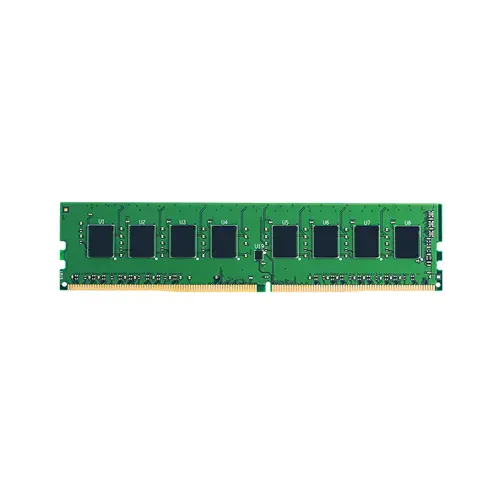
| Model | M393A1K43DB1-CWE |
|---|---|
| Product Type | Memory Module |
| Compliance Standards | EU RoHS,FCC |
| Memory Capacity | 8 GB |
| Memory Technology | DDR4 |
| Product Voltage | 1.2V |
| RAM Speed | 3200MHz |
| RAM Standard | DDR4-3200/PC4-25600 |
| Error Identifying | ECC |
| Signal Type | Registered |
| Column Access Strobe (CAS) | CL22 |
| Rank | Single Rank x8 |
| Quantity of Pins | 288-pin |
| RAM Genre | RDIMM |
Designed for server platforms, this DDR4-3200 Registered ECC RDIMM with Single Rank x8 configuration and CL22 latency ensures robust data integrity and signal stability under demanding workloads. It is ideally suited for virtualization, in-memory databases, and enterprise applications where reliable, high-capacity memory with hardware error correction is critical.
1. ECC error correction silently detects and fixes single-bit memory faults, preserving transactional integrity in financial databases and preventing hypervisor crashes in always-on virtualization clusters.
2. Registered signal type buffers command and address lines, enabling fully loaded server motherboards to run large memory populations without signal skew, a must for dense rack-scale deployments.
3. DDR4-3200 throughput supplies up to 25.6 GB/s per channel, dramatically reducing data delivery latency for in-memory caching and real-time analytics engines under concurrent user load.
4. Single Rank x8 organization minimizes bus loading, allowing the memory controller to sustain peak transfer rates across multiple DIMMs and simplifying qualification for 24/7 mission-critical host configurations.
5. 8 GB capacity offers a granular bill-of-materials option for cloud-native microservices nodes, keeping per-VM memory allocation lean while maintaining full ECC protection for bare-metal container platforms.
In the data center, the M393A1K43DB1-CWE is engineered specifically for server workloads where every bit and every nanosecond counts. This DDR4-3200 RDIMM features ECC error correction, silently detecting and correcting single-bit memory errors caused by cosmic radiation or electrical interference. In a dense virtualization cluster hosting dozens of VMs, a single uncorrected bit flip can corrupt a guest operating system, trigger an unexplained reboot, or propagate corrupted data into a database. ECC acts as an insurance policy against such silent data corruption, directly protecting uptime and trust.
Its Registered signal type buffers the command and address lines, stabilizing the heavy electrical loads found in fully populated server boards. When you populate all 24 DIMM slots in a rack server for an in-memory database like SAP HANA or Redis, registered buffering prevents signal degradation, ensuring consistent 3200 MT/s throughput under full load. The single-rank x8 organization further optimizes interleaving and reduces latency within a memory channel, allowing the CPU to fetch data faster from parallel banks. Combined with JEDEC-standard 1.2 V efficiency and a 288-pin footprint, the module delivers the reliability, bandwidth scalability, and power-conscious design that your virtualized infrastructure and business-critical OLTP workloads demand—because in a server room, resilience isnt a luxury, its the foundation.
General Virtualization
Deploy this RDIMM in balanced sets to maximize memory channels—typically six or eight identical modules per socket to populate all channels symmetrically. A common starting point is 64 GB (8 x 8 GB) for light to medium VM density, scaling to 128 GB or more for heavy consolidation. Always match DIMM ranks across channels to maintain consistent latency and avoid NUMA imbalances.
In-Memory Database
For latency-sensitive workloads like Redis or SAP HANA, leverage the module’s single-rank x8 design to keep command-to-data timing tight. Configure with at least four modules per CPU to sustain high bandwidth under concurrent access, and plan for headroom above the working dataset size—often 128 GB to 512 GB total. ECC and registered signaling guard against silent data corruption during sustained writes.
High-Performance Computing
Balance capacity against peak memory bandwidth by populating one DIMM per channel (e.g., eight identical 8 GB sticks across eight channels) to saturate the memory controller. This 8 GB RDIMM suits bandwidth-bound HPC jobs like CFD or molecular dynamics where per-core memory requirements are modest. For capacity-heavy simulation codes, double the module count while keeping population uniform to preserve interleaving and minimize channel contention.
Server-tested and proven compatible with Dell PowerEdge R760, HPE ProLiant DL380 Gen11, Lenovo ThinkSystem SR650 V3.
Q: Can I mix this M393A1K43DB1-CWE with other memory modules of different brands or speeds?
A: Mixing is not recommended. Server platforms demand exact matching of ECC, registered type, and rank. Different brands or speeds may cause training failures, stability issues, or even prevent boot.
Q: Is this memory compatible with my system? Which Intel or AMD platforms are supported?
A: This DDR4-3200 RDIMM is validated for platforms that accept 288-pin Registered ECC modules, such as Intel Xeon Scalable (2nd/3rd Gen) and AMD EPYC 7002/7003 series. Verify your motherboard's qualified vendor list.
Q: What is the recommended DIMM population order for optimal performance with this module?
A: Populate one DIMM per channel first, filling the furthest slot from the CPU (slot 1). For dual-socket servers, balance memory equally across both CPUs. Consult your motherboard manual for exact population diagrams.
Q: Does this module support overclocking or XMP profiles?
A: No. As a server-class registered ECC module, it adheres to JEDEC DDR4-3200 standard timings. Overclocking and XMP are not supported; stability and data integrity take priority over frequency tuning.
Q: What warranty and typical failure rate can I expect with this M393A1K43DB1-CWE?
A: It comes with a one-year warranty. The module is built to enterprise reliability standards, delivering an extremely low annualized failure rate (AFR) under normal server operating conditions.