











 Secure payments
Standard refund policy
Trade Assurance
Secure payments
Standard refund policy
Trade Assurance
| Product Type | Memory Module |
|---|---|
| Compliance Standards | RoHS,WEEE |
| Memory Capacity | 8 GB |
| Memory Technology | DDR4 |
| Product Voltage | 1.2 V |
| RAM Speed | 3200 MHz |
| RAM Standard | DDR4-3200/PC4-25600 |
| Error Identifying | ECC |
| Signal Type | Registered |
| Column Access Strobe (CAS) | CL22 |
| Rank | Single Rank x8 |
| Quantity of Pins | 288-pin |
| RAM Genre | RDIMM |
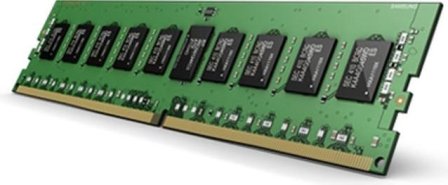
This Registered DDR4-3200 RDIMM with ECC is purpose-built for server platforms handling memory-intensive workloads such as virtualization and in-memory databases, where its error-correcting code ensures data integrity and the registered signal type enhances signal stability across high-density deployments. The single-rank x8 configuration minimizes electrical loading on the memory bus, enabling consistent low-latency operation at CL22 for reliable sustained throughput in 24/7 enterprise environments.
1. An 8 GB capacity per module allows precise memory allocation for lightweight containerized workloads, optimizing server density without wasted resources.
2. DDR4-3200 speed supplies 25.6 GB/s of peak bandwidth per channel, accelerating in-memory databases and virtualized environments where data throughput directly dictates response times.
3. ECC protection transparently corrects single-bit errors and detects multi-bit faults, preserving data integrity across weeks of continuous uptime that enterprise servers demand.
4. The registered buffer offloads electrical load from the memory controller, reliably sustaining full-channel population at high capacity for large-scale virtualization and database consolidation.
5. Single Rank x8 organization reduces inter-rank latency and lowers power consumption per channel, maintaining stable 3200 MT/s operation under heavy multi-DIMM configurations.
The Samsung M393A1K43DB2-CWE is a server-grade DDR4-3200 Registered DIMM with ECC. For a virtualization farm running VMware ESXi or Hyper-V, a single uncorrected memory error could cascade into VM failures and costly downtime. This module’s ECC engine instantly corrects single-bit errors, preserving data integrity across all guest operating systems. Its registered clock driver buffers command and address signals, allowing you to populate every DIMM slot without signal degradation—vital when scaling memory capacity for large virtual machine inventories. In-memory databases like Redis and SAP HANA require relentless low latency; the single-rank x8 organization and 3200MT/s speed provide the high-throughput, low-delay access that accelerates real-time analytics and transactions. Moreover, the 1.2V operating voltage significantly reduces power and cooling demands, lowering total cost of ownership in always-on data centers.
General Virtualization
For general virtualization hosts, balance memory capacity and cost by populating at least one DIMM per memory channel to maximize bandwidth. An 8GB RDIMM like the Samsung M393A1K43DB2-CWE is a solid building block; for a dual-socket server with 8 channels per CPU, installing 16 such modules yields 128GB of registered ECC memory, comfortably supporting dozens of moderate VMs. Always populate identical DIMMs symmetrically across CPU memory controllers to maintain NUMA balance and avoid performance cliffs under consolidation.
In-Memory Database
In-memory databases demand large capacity and low latency, so use multiple 8GB RDIMMs to fill all channels of each populated processor, scaling to hundreds of gigabytes or terabytes. Configure uniform single-rank x8 DIMMs across channels to sustain high bandwidth at 3200MT/s, and favor single-rank modules at one DIMM per channel to keep command rates low and latency predictable. Plan for at least 256–512GB by populating 32–64 identical 8GB RDIMMs across a dual-socket server to avoid swapping and maintain sub‑millisecond response times.
High-Performance Computing (HPC)
HPC workloads rely on memory bandwidth and balanced throughput, making 8GB DDR4-3200 RDIMMs ideal for mid‑density scaling when per‑core memory ratios are moderate. Populating all eight memory channels in a modern server processor with one single‑rank 8GB RDIMM per channel delivers peak bandwidth with reasonable 64GB per socket capacity for many CFD, molecular dynamics, or weather codes. For capacity‑hungry HPC jobs, move to dual‑rank DIMMs or larger capacities, but always test application sensitivity to interleaving and rank population to sustain optimized vectorization and MPI communication.
Rigorously tested, compatible with Dell PowerEdge R760, HPE ProLiant DL380 Gen11, Lenovo ThinkSystem SR650, and similar servers.
Q: Can I mix this M393A1K43DB2-CWE with other memory modules of different brands or speeds?
A: Not recommended. Mixing RDIMMs of different brands, speeds, or ranks can cause signal integrity issues and system instability. For server environments, always use identical, validated modules to ensure reliable, mission-critical operation.
Q: Is this memory compatible with my system?
A: This is a DDR4-3200 Registered ECC RDIMM. It is compatible with Intel Xeon Scalable and AMD EPYC platforms using C620/C741 or SP3/SP5 chipsets. Please verify your server board's qualified vendor list for M393A1K43DB2-CWE support.
Q: What is the recommended DIMM population order for optimal performance?
A: Populate identical DIMMs per channel, starting with the farthest slot from the CPU. For dual-socket servers, balance capacity evenly across both CPUs. Always follow your motherboard's memory population guidelines to maintain balanced memory interleaving.
Q: Does this module support overclocking or XMP profiles?
A: No. As an enterprise Registered ECC DIMM, it adheres strictly to JEDEC DDR4-3200 (PC4-25600) standards. It does not support XMP profiles or overclocking; reliability and data integrity are prioritized over performance tuning in server platforms.
Q: What warranty and typical failure rate can I expect?
A: This module includes a 1-year warranty. Typical annualized failure rates for Samsung server DRAM are under 0.5%, reflecting a mature, high-quality process. We replace any defective unit promptly within the warranty period.