











 Secure payments
Standard refund policy
Trade Assurance
Secure payments
Standard refund policy
Trade Assurance
| Product Type | Memory Module |
|---|---|
| Memory Capacity | 8 GB |
| Memory Technology | DDR4 |
| Product Voltage | 1.2 V |
| RAM Speed | 3200 MHz |
| RAM Standard | DDR4-3200/PC4-25600 |
| Error Identifying | ECC |
| Signal Type | Registered |
| Column Access Strobe (CAS) | CL22 |
| Rank | Single Rank x8 |
| Quantity of Pins | 288-pin |
| RAM Genre | RDIMM |
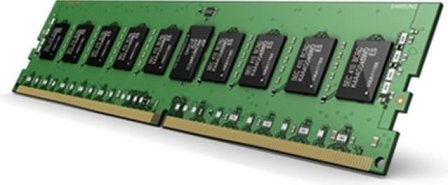
This DDR4-3200 registered ECC RDIMM is purpose-built for server platforms running virtualization, in-memory databases, and mission-critical workloads where data integrity is paramount. Its single-rank x8 configuration reduces electrical loading on the memory channel, ensuring superior signal stability and reliable operation at full speed even in densely populated servers.
1. Registered signal type buffers the command and address lines, enabling stable operation across densely populated server memory banks essential for large-scale virtualization.
2. ECC error identification automatically corrects single-bit memory errors, preventing silent data corruption in mission-critical database and financial transaction workloads.
3. RDIMM genre ensures compatibility with enterprise server platforms, offering the reliability and manageability required for 24/7 data center uptime.
4. 3200 MT/s memory speed accelerates in-memory analytics and real-time caching, reducing latency for high-concurrency cloud applications.
5. 1.2V low voltage minimizes per-DIMM power draw and thermal output, a key factor in reducing total cost of ownership across large server fleets.
The M393A1K43DB2-CWEGY is unmistakably a server-class DDR4 RDIMM, and its design directly addresses the unforgiving demands of enterprise data centers. In a virtualized cluster running dozens of VMs on a single host, conventional memory errors aren’t just a nuisance—they silently corrupt hypervisor data and risk cascading VM failures. The integrated ECC engine actively detects and corrects single-bit flips caused by cosmic radiation or electrical noise, preserving long-running workload integrity without administrator intervention. Meanwhile, the Registered signal buffer isn’t merely a feature for high capacities; it electrically isolates the memory controller from the ranks, so adding modules won’t degrade signal quality. This means a database server can populate all channels for maximum capacity while maintaining rock‑solid stability during in‑memory analytics on Redis or SAP HANA, where a single uncorrected error could translate into a corrupted financial transaction. The 3200 MT/s speed and Single Rank x8 organization combine to deliver consistent low‑latency bandwidth, critical when thousands of concurrent queries hit the buffer pool. At 1.2V, the module also shrinks the thermal footprint across dense server racks, trimming ongoing cooling costs without sacrificing the throughput your virtualized workloads demand.
General Virtualization
When deploying this 8GB DDR4-3200 ECC RDIMM for general virtualization, populate all available memory channels symmetrically to maximize memory bandwidth and capacity. A common configuration uses 8 identical modules across two processors (4 modules per CPU, one per channel) for a total of 64GB, which supports a moderate number of virtual machines with reliable error correction. For larger workloads, install two modules per channel (2DPC) to reach 128GB or more, but be mindful that memory speed may drop to 2933 MT/s or lower depending on the platform, so balance capacity needs against performance.
In-Memory Database
In-memory databases demand large, error-resilient memory pools, and this 8GB RDIMM provides the ECC and registered signaling essential for data integrity. Populate all DIMM slots with identical M393A1K43DB2-CWEGY modules to achieve maximum capacity—for example, 16 modules across a dual-socket server yield 128GB, while 32 modules give 256GB. Always install modules in matched sets per memory channel to maintain the highest possible frequency and avoid latency penalties that can undermine real-time transaction processing.
High-Performance Computing
For HPC workloads that prioritize bandwidth, install one module per channel (1DPC) to sustain the full 3200 MT/s speed and reduce access latency; this typically results in 32GB to 64GB on a single-socket system, suitable for memory-sensitive simulations. Where capacity is more critical, such as in large-scale modeling, a balanced 2DPC configuration using all 8GB RDIMMs can double total memory at the cost of a slight frequency reduction to 2933 MT/s or 2666 MT/s. Always populate channels identically and use the same single-rank x8 modules to ensure uniform thermal and electrical characteristics across the memory subsystem.
Strictly tested for compatibility with Dell PowerEdge R760, HPE ProLiant DL380 Gen11, Lenovo ThinkSystem SR650 V3, and similar servers.
Q: Can I mix this M393A1K43DB2-CWEGY with other memory modules of different brands or speeds?
A: Mixing different brands or speeds is not recommended for ECC RDIMMs. It can cause signal integrity issues, instability, or the system defaulting to the lowest common speed.
Q: Is this memory compatible with my system?
A: This DDR4-3200 ECC Registered DIMM requires a server motherboard and CPU that explicitly support RDIMMs, such as Intel Xeon Scalable or AMD EPYC platforms. Check your system's qualified vendor list.
Q: What is the recommended DIMM population order for optimal performance?
A: Populate identical modules per channel, starting with the slot farthest from the CPU. Follow your server manual's memory population guide to balance channels and maximize bandwidth.
Q: Does this module support overclocking or XMP profiles?
A: No. This is a registered ECC server module adhering to JEDEC standards. It prioritizes data integrity and 24/7 stability, and does not support overclocking or XMP profiles.
Q: What warranty and typical failure rate can I expect?
A: This module includes a one-year warranty. Enterprise-grade RDIMMs typically exhibit an extremely low annualized failure rate (AFR) under specified conditions, ensuring reliable long-term operation.