











 Secure payments
Standard refund policy
Trade Assurance
Secure payments
Standard refund policy
Trade Assurance
| Product Type | Memory Module |
|---|---|
| Memory Capacity | 16 GB |
| Memory Technology | DDR4 |
| Product Voltage | 1.2 V |
| RAM Speed | 2133 MHz |
| RAM Standard | DDR4-2133/PC4-17000 |
| Error Identifying | ECC |
| Signal Type | Registered |
| Column Access Strobe (CAS) | CL15 |
| Rank | Dual Rank x4 |
| Quantity of Pins | 288-pin |
| RAM Genre | RDIMM |
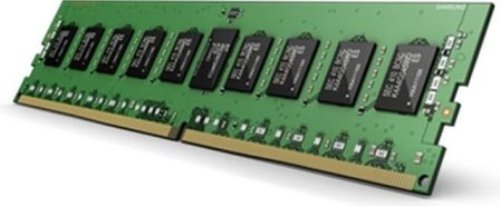
Designed specifically for server and enterprise environments, this 16GB DDR4-2133 RDIMM with ECC and registered signaling ensures robust data integrity and stability for mission-critical workloads such as virtualization, in-memory databases, and compute-intensive applications. Its dual-rank x4 configuration and CL15 latency optimize memory bandwidth and access efficiency, while the 288-pin form factor provides seamless compatibility with a wide range of server platforms.
1. ECC protection silently corrects single-bit errors in real time, safeguarding transactional databases and financial records from silent data corruption.
2. Registered signal type buffers the command and address buses, enabling fully populated memory channels across 24 or more DIMMs without degrading signal integrity.
3. Dual rank x4 organization interleaves access across internal banks, sustaining peak bandwidth for virtualized workloads even under heavy consolidation.
4. Sixteen-gigabyte capacity per module scales neatly to hundreds of gigabytes per server, meeting the memory footprint demands of dense container and VM deployments.
5. 1.2-volt low-power operation reduces thermal output inside rack enclosures, directly lowering cooling costs and improving long-term reliability for always-on infrastructure.
The Samsung M393A2G40DB0-CPB is a 16GB DDR4-2133 Registered DIMM engineered specifically for enterprise servers, where reliability and uptime are non-negotiable. In a virtualized cluster running dozens of mission-critical VMs, silent memory errors pose a tangible threat of hypervisor crashes or financial data corruption. This module’s ECC technology automatically detects and corrects single-bit flips caused by cosmic radiation, ensuring your transactional databases and ERP systems process every record with uncompromised integrity. The Registered buffer significantly reduces electrical loading on the server’s memory controller, allowing you to fully populate all channels for massive capacity without sacrificing signal stability—essential when scaling out a private cloud. Its dual-rank x4 organization further elevates real-world performance through interleaving: for an in-memory database like SAP HANA, this translates into consistently high sustained bandwidth during real-time analytics, preventing latency spikes that could delay time-sensitive business decisions. Operating at a cool 1.2V, the module also helps rein in energy costs across a dense server farm. From eliminating data corruption to maximizing throughput under heavy multi-tenant workloads, this RDIMM directly resolves the core pain points of data center operators—guaranteeing data integrity, scalable stability, and the sustained performance your critical applications demand.
General Virtualization
For a typical hypervisor hosting mixed workloads, populate your server with a balanced number of identical 16 GB RDIMMs to enable all memory channels. Aim for configurations like six or eight modules per CPU to maximize bandwidth while leaving room for future expansion, as registered ECC memory ensures stability under sustained multi-tenant pressure. Avoid single-channel setups, as they starve modern virtualization of the interleaving needed for responsive guest performance.
In-Memory Database
Memory-resident databases such as SAP HANA or Redis demand large capacity and uncompromised data integrity. Deploy multiple 16 GB dual-rank x4 RDIMMs to fill all available DIMM slots, prioritizing total capacity over speed because 2133 MT/s is sufficient when latency is already constrained by CL15 and rank interleaving. Always install modules in identical groups per memory controller to sustain the demanded throughput without risking silent data corruption.
HPC
Many HPC codes are bandwidth-sensitive, so a fully balanced population is critical. Use one 16 GB RDIMM per channel, leveraging dual-rank x4 organization for rank interleaving benefits; even at a base speed of 2133 MT/s, a fully populated eight- or twelve-DIMM configuration delivers high aggregate bandwidth. Ensure every CPU has identical DIMM placements to prevent NUMA imbalances that would bottleneck large-scale parallel jobs.
Certified compatible with Dell PowerEdge R640, R740, HPE DL380 Gen10, Lenovo SR650 — rigorously tested.
Q: Can I mix this M393A2G40DB0-CPB with other memory modules of different brands or speeds?
A: Mixing RDIMMs is strongly discouraged. Mismatched ranks, speeds, or vendors can cause signal integrity issues and system instability. For mission-critical servers, all modules should be identical to this Samsung DDR4-2133 ECC Registered DIMM.
Q: Is this memory compatible with my Intel Xeon or AMD EPYC server platform?
A: This is a standard DDR4-2133 ECC RDIMM, widely compatible with Intel Xeon E5-2600 v4/v3 and select AMD EPYC 7001 series platforms using a C612 or equivalent chipset. Verify 288-pin Registered support.
Q: What is the recommended DIMM population order for optimal performance with this RDIMM?
A: Populate identical modules in matching banks for balanced memory channels. Typically, fill blue slots first per the server motherboard manual to achieve channel interleaving and maximum throughput with this 16GB dual-rank x4 module.
Q: Does this Samsung server module support memory overclocking or XMP profiles?
A: No. This RDIMM adheres to JEDEC DDR4-2133 standards for enterprise reliability. Overclocking and XMP are not supported on registered server memory, as stability is prioritized over frequency adjustments.
Q: What warranty and typical failure rate can I expect for this M393A2G40DB0-CPB?
A: This module carries a one-year warranty. Samsung server DRAM typically exhibits an AFR below 0.5% under specified conditions, ensuring high reliability when operated within rated temperature and voltage limits.