











 Secure payments
Standard refund policy
Trade Assurance
Secure payments
Standard refund policy
Trade Assurance
| Model | M393A2G40DB0-CPB00 |
|---|---|
| Product Type | Memory Module |
| Compliance Standards | EU RoHS,FCC |
| Memory Capacity | 16 GB |
| Memory Technology | DDR4 |
| Product Voltage | 1.2V |
| RAM Speed | 2133MHz |
| RAM Standard | DDR4-2133/PC4-17000 |
| Error Identifying | ECC |
| Signal Type | Registered |
| Column Access Strobe (CAS) | CL15 |
| Rank | Dual Rank x4 |
| Quantity of Pins | 288-pin |
| RAM Genre | RDIMM |
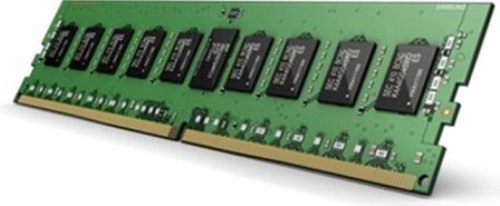
This 16GB DDR4-2133 registered ECC module (M393A2G40DB0-CPB00) is engineered for server platforms, delivering the data integrity and reliability essential for virtualization, in-memory databases, and mission-critical enterprise workloads. Its dual-rank x4 organization combined with registered signaling ensures stable operation under heavy load, while ECC actively corrects single-bit errors to prevent silent data corruption in high-uptime environments.
1. ECC protection detects and corrects single-bit errors in real time, preserving data integrity for mission-critical databases and financial transactions where even silent corruption is unacceptable.
2. Registered signal buffering stabilizes command and address lines across fully loaded server channels, enabling 24/7 operation with high-density memory configurations without signal degradation.
3. Dual Rank x4 organization interleaves access across two internal rank groups per module, maximizing channel utilization and sustaining throughput for virtualized workloads under heavy consolidation.
4. A 16GB capacity per DIMM builds substantial memory footprint per server node, directly boosting virtual machine density and in-memory cache sizes for responsive SaaS platforms.
5. Predictable CAS 15 latency provides deterministic memory access timing, ensuring consistently low query latency for latency-sensitive enterprise applications like in-memory databases and real-time analytics.
The Samsung M393A2G40DB0-CPB00 is a server-class registered DIMM, and its architecture is purpose-built for relentless data-center workloads. The first defining feature is its Error Correction Code (ECC). In a virtualized cluster running dozens of VMs, a single bit-flip caused by background radiation can silently corrupt a financial transaction or hypervisor memory. ECC detects and corrects these single-bit errors, preventing application crashes and data poison that would otherwise cascade into costly downtime. Second, the Registered signal type places a buffer on the command and address lines. This means in a fully populated 24-slot server, the memory controller drives a stable, manageable load rather than an erratic electrical mess, enabling you to scale capacity to terabytes without sacrificing signal integrity. Third, the Dual Rank x4 organization interleaves memory accesses across two internal ranks. For an in-memory database like SAP HANA, this rank interleaving reduces wait states by allowing concurrent page operations, directly accelerating real-time analytics throughput that gets bottlenecked by idle cycles. Finally, the 1.2V low voltage significantly cuts the power draw per module compared to legacy 1.35V or 1.5V designs. When multiplied across hundreds of nodes in a virtualized data center, that thermal and energy saving translates into lower cooling overhead and a measurably smaller OpEx, all while maintaining the 2133MHz stability guaranteed by the ECC and registering combination.
General Virtualization
Equip each dual-socket server with six to eight identical M393A2G40DB0 16 GB RDIMMs, distributing them evenly across all memory channels. This yields 96–128 GB of balanced capacity, leveraging the module’s registered ECC to sustain reliable multi-VM workloads. Avoid mixing different DIMM speeds or ranks to preserve uniform latency and prevent memory-controller bottlenecks during live migrations.
In-Memory Database
Maximise capacity and resilience by populating every available DIMM slot with these 16 GB Registered ECC modules. For a typical dual-socket platform, aim for 256 GB to 512 GB, depending on slot count, to keep entire datasets in DRAM. The dual-rank x4 organization and ECC guarantee strong single-bit error correction, a non-negotiable requirement for transactional databases. Maintain identical part numbers across all sockets to ensure rank-level sparing and consistent RAS features.
High-Performance Computing (HPC)
Configure one DIMM per channel to fully exploit the memory interleaving of modern server platforms (often eight modules per CPU). Using these 2133 MHz dual-rank RDIMMs, a 128 GB baseline per node delivers solid bandwidth for MPI and OpenMP codes. If additional capacity is needed beyond that, add identical 16 GB modules in balanced sets; unbalanced populations drastically reduce achievable bandwidth. Prioritise the same dual-rank module to sustain per‑DIMM throughput without sacrificing the parallelism essential for scientific simulations.
Rigorously tested server memory. Compatible with Dell PowerEdge R740, HPE ProLiant DL380 Gen10, Lenovo ThinkSystem SR650, and more.
Q: Can I mix this M393A2G40DB0-CPB00 with other memory modules of different brands or speeds?
A: Mixing different brands or speeds is not recommended for this registered ECC memory. It may cause system instability or prevent boot. For reliable operation, populate all channels with identical M393A2G40DB0-CPB00 modules.
Q: Is this memory compatible with my system?
A: This DDR4-2133 RDIMM is designed for servers using Intel Xeon E5-2600 v3/v4 or select AMD EPYC platforms. Please verify that your motherboard supports registered ECC DIMMs and 16GB dual-rank x4 modules before purchase.
Q: What is the recommended DIMM population order for optimal performance?
A: Follow your server motherboard's guidelines, typically populating all channels symmetrically. For dual-rank x4 modules like this, start with the first slot per channel to balance interleaving and maximize memory bandwidth.
Q: Does this module support overclocking or XMP profiles?
A: No. This is a server-grade registered DIMM built for stability. It adheres strictly to JEDEC DDR4-2133 standards and does not support overclocking or XMP profiles, ensuring reliable 24/7 operation under mission-critical workloads.
Q: What warranty and typical failure rate can I expect?
A: This module includes a one-year warranty. As enterprise-class memory with ECC and rigorous screening, it offers very low failure rates. Typical MTBF is measured in millions of hours when operated within specified voltage and temperature ranges.