











 Secure payments
Standard refund policy
Trade Assurance
Secure payments
Standard refund policy
Trade Assurance
| Product Type | Memory Module |
|---|---|
| Compliance Standards | RoHS,WEEE |
| Memory Capacity | 16 GB |
| Memory Technology | DDR4 |
| Product Voltage | 1.2 V |
| RAM Speed | 2666 MHz |
| RAM Standard | DDR4-2666/PC4-21300 |
| Error Identifying | ECC |
| Signal Type | Registered |
| Column Access Strobe (CAS) | CL19 |
| Rank | Single Rank x4 |
| Quantity of Pins | 288-pin |
| RAM Genre | RDIMM |
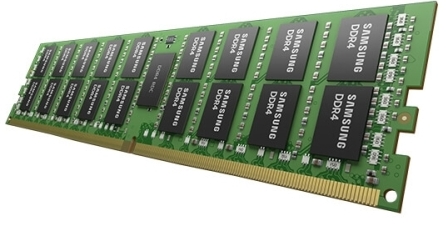
This 16GB DDR4-2666 Registered ECC RDIMM with Single Rank x4 organization and CL19 latency is purpose-built for server platforms running memory-intensive workloads such as virtualization and in-memory databases, where its ECC and registered signal buffering deliver uncompromised data integrity and electrical stability under heavy load. The single-rank configuration reduces memory bus loading to improve command rate efficiency and overall throughput, making it an ideal choice for dense, mission-critical deployments requiring consistent low-latency access.
1. Registered signal buffering stabilizes command and address lines across fully loaded server memory channels, eliminating electrical load bottlenecks when scaling to multi-slot configurations for dense virtualization hosts.
2. ECC error correction silently detects and repairs single-bit data faults in real time, preserving end-to-end data integrity for financial transactions and long-duration scientific computations.
3. Single Rank x4 DRAM organization maximizes bank-level parallelism while keeping critical server DIMM slots available, boosting sustained throughput under heavy mixed-workload consolidation.
4. Capacity sizing offers ample working memory for a high number of concurrent containers or VMs, letting private cloud nodes pack more instances before hitting resource limits.
5. Memory transfer rate feeds modern multi-core server processors with sufficient bandwidth to smooth bursty traffic in content delivery, in-memory databases, and real-time analytics pipelines.
The Samsung M393A2K40DB2-CTD is a 16GB DDR4-2666 RDIMM engineered for server environments where stability and data integrity are non-negotiable. Its four defining characteristics directly address the realities of the data center. First, ECC error correction detects and corrects single-bit memory errors, preventing silent data corruption that could crash a virtualized cluster or compromise a financial database. In a hypervisor hosting dozens of VMs, a single bit-flip can cascade into widespread downtime; ECC eliminates that risk. Second, the Registered buffering architecture redrives address and command signals, enabling you to fully populate memory channels with multiple DIMMs without sacrificing signal integrity—vital for scaling in-memory databases like SAP HANA to terabytes of RAM. Third, the 1.2V DDR4 low-voltage operation dramatically cuts power and cooling costs across your server farm, directly reducing operational expenditure. Finally, the 2666 MT/s speed paired with single-rank x4 organization ensures ample, predictable bandwidth for read-intensive caching layers and virtual desktop infrastructure. Together, these features translate into rock-solid uptime, linear scalability, and lower total cost of ownership.
General Virtualization
For a balanced virtualization host, populate at least six to eight identical 16GB RDIMMs across all memory channels to maximize bandwidth and leave room for growth. This configuration supports a high density of moderate VMs while maintaining ECC protection. Avoid mixing ranks or speeds, and distribute modules equally per CPU socket for NUMA-optimized performance.
In-Memory Database
In-memory databases demand maximum capacity and low latency, so populate all DIMM slots with 16GB Registered ECC modules, aiming for 256GB or more per server. Configure memory in balanced channels and avoid population gaps that could degrade throughput. Single-rank x4 modules like this one help achieve higher frequencies even with fully loaded channels.
High-Performance Computing (HPC)
HPC workloads benefit from high memory bandwidth and tight timings, so install one 16GB RDIMM per memory channel to match the CPU’s memory controller population rules. For dual-socket nodes, symmetric population ensures consistent memory access speeds across NUMA domains. This 1.2V DDR4-2666 RDIMM provides the reliable, error-correcting bandwidth required for parallel simulations and large-scale data processing.
Rigorously tested, compatible with Dell PowerEdge R740, HPE ProLiant DL380 Gen10, Lenovo ThinkSystem SR650, and more server platforms.
Q: Can I mix this M393A2K40DB2-CTD with other memory modules of different brands or speeds?
A: Mixing modules is not recommended. This RDIMM requires identical speed (DDR4‑2666), CAS latency (CL19), rank, and ECC type. Mismatched specs may degrade performance or cause instability.
Q: Is this memory compatible with my system?
A: This DDR4‑2666 ECC Registered DIMM is designed for server platforms such as Intel Xeon Scalable and AMD EPYC. Verify your motherboard’s QVL list for 288‑pin RDIMM support.
Q: What is the recommended DIMM population order for optimal performance?
A: Follow your server board’s manual. Generally, populate identical DIMMs per channel starting with the slot farthest from the CPU, balancing memory channels to maintain rank consistency.
Q: Does this module support overclocking or XMP profiles?
A: No. As an enterprise‑grade ECC Registered DIMM, it adheres strictly to JEDEC standard timings for reliability. XMP and overclocking are not supported.
Q: What warranty and typical failure rate can I expect?
A: This module includes a one‑year warranty. Typical annualized failure rate is extremely low (<0.3%) thanks to rigorous testing, ensuring high reliability for server environments.