











 Secure payments
Standard refund policy
Trade Assurance
Secure payments
Standard refund policy
Trade Assurance
| Product Type | Memory Module |
|---|---|
| Memory Capacity | 16 GB |
| Memory Technology | DDR4 |
| Product Voltage | 1.2 V |
| RAM Speed | 2933 MHz |
| RAM Standard | DDR4-2933/PC4-23400 |
| Error Identifying | ECC |
| Signal Type | Registered |
| Column Access Strobe (CAS) | CL21 |
| Rank | Single Rank x4 |
| Quantity of Pins | 288-pin |
| RAM Genre | RDIMM |
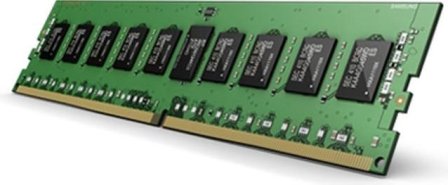
Designed specifically for server platforms, this Samsung M393A2K40DB2-CVFB0 16GB DDR4-2933 Registered ECC DIMM ensures data integrity and system stability in memory-intensive enterprise workloads such as virtualization and in-memory databases. Its single-rank x4 configuration combined with a CL21 latency and registered signal type delivers balanced performance and enhanced signal integrity on high-density 288-pin server boards.
1. A generous capacity per module underpins dense virtualized environments, letting more VMs run simultaneously without hitting physical memory limits.
2. ECC protection silently corrects single-bit errors, preserving data integrity and uptime for critical enterprise workloads around the clock.
3. Registered signal buffering stabilizes high-density memory configurations, enabling larger DIMM populations per channel to scale memory capacity reliably.
4. High-speed transfer bandwidth accelerates in-memory databases and real-time analytics, reducing latency spikes under heavy concurrent access.
5. Single-rank x4 organization cuts electrical loading on the bus, allowing faster command rates and enhancing responsiveness in latency-sensitive server tasks.
When you are managing a virtualized cluster or an in-memory database, the memory you choose does not merely influence speed—it determines whether your data remains intact and your services stay online. The Samsung M393A2K40DB2-CVFB0 is a server-grade DDR4-2933 RDIMM built specifically for these high-stakes environments, and its four defining characteristics solve real operational pain points.
First, ECC error correction continuously scans for and corrects single-bit errors caused by cosmic radiation or electrical noise. In a virtualized host running dozens of VMs, a single undetected bit flip can silently corrupt a financial record or a hypervisor control structure, leading to cascading failures. ECC turns that catastrophic risk into a stopped-and-logged event, preserving data integrity without service interruption. Second, the Registered (buffered) signal type addresses the signal-loading challenge when you populate many DIMMs per channel. In a dense virtualization server with 512 GB or more of memory, unbuffered designs would suffer from electrical signal degradation, forcing you to reduce speed or sacrifice capacity. The register chip cleans and re-drives command and address signals, allowing you to run large, stable memory configurations at the full 2933 MT/s across multiple ranks.
Third, the single-rank x4 organization strikes a careful balance for database and analytics workloads. An in-memory database such as Redis or SAP HANA thrives on high bandwidth, and single-rank DIMMs generally exhibit better clock-cycle efficiency and lower power draw than dual-rank equivalents when used in multi-DIMM configurations, helping you sustain low latency under heavy query loads. Finally, the 2933 MT/s speed with CL21 latency supplies the raw throughput that memory-intensive applications demand. For a virtualized SQL Server instance handling thousands of concurrent transactions, this bandwidth reduces access bottlenecks to the buffer pool, directly translating to faster report generation and smoother user experiences. Taken together, these features mean you do not have to choose between data safety, capacity, and performance—you get the reliability your infrastructure depends on and the headroom your critical applications need.
Server Memory – DDR4-2933 ECC RDIMM (16GB Module)
For registered ECC DDR4-2933 modules, capacity planning must balance channel population, rank efficiency, and fault tolerance. This 16GB single-rank x4 RDIMM is ideal for dense, reliable server configurations.
General Virtualization
Populate all memory channels symmetrically with at least one DIMM per channel to maximize bandwidth. For a dual-socket server with eight channels per CPU, eight 16GB modules provide 128GB per host — sufficient for 20–30 moderate VMs while leaving room for memory overcommit. Pair identical kits to maintain NUMA balance and enable mirroring or sparing if required.
In-Memory Database
Minimize latency and avoid NUMA penalties by deploying an even number of modules across all CPU memory controllers. Use six or twelve modules per socket (96GB or 192GB) to exploit multi-channel interleaving. This 16GB RDIMM’s single-rank design reduces bus loading, allowing higher population without dropping speed — critical for Redis or SAP HANA workloads where response time is paramount.
High Performance Computing
Maximize capacity per node while maintaining 2933MT/s speed; populate two DIMMs per channel (2DPC) only if the platform supports this speed without downclocking. For memory-bandwidth-bound HPC codes, use one DIMM per channel across all controllers (e.g., eight 16GB modules) for peak throughput. The registered ECC ensures result integrity during multi-day simulation runs.
Rigorously tested for server compatibility: Dell PowerEdge R750, R740, HPE ProLiant DL380 Gen10, Lenovo ThinkSystem SR650.
Q: Can I mix this M393A2K40DB2-CVFB0 with other memory modules of different brands or speeds?
A: Mixing is technically possible but strongly discouraged. Common outcome is system instability, fallback to lowest speed, or non-functional ECC. Uniform modules ensure validated performance and reliability in server environments.
Q: Is this memory compatible with my system?
A: Compatibility requires a server platform supporting DDR4-2933 Registered ECC DIMMs, typically Intel Xeon Scalable or AMD EPYC 7002/7003 series. Verify your motherboard's Qualified Vendor List (QVL) for this specific M393A2K40DB2-CVFB0 part number.
Q: What is the recommended DIMM population order for optimal performance?
A: Populate identical DIMMs per memory channel following the server board's manual. Typically, install one DIMM per Channel (1DPC) first to maximize speed. For this single-rank RDIMM, balanced interleaved population across all memory controllers yields optimal throughput.
Q: Does this module support overclocking or XMP profiles?
A: No. This is a JEDEC-compliant server-grade Registered DIMM operating at standard DDR4-2933. It does not support overclocking, XMP, or any non-standard voltage profiles. Reliability is prioritized over overclocking in enterprise memory.
Q: What warranty and typical failure rate can I expect?
A: This module includes a 1-year warranty. As an enterprise DDR4 RDIMM built with Samsung components, it exhibits a very low annualized failure rate (AFR), typically under 0.5%, assuming proper environmental conditions and compatible server hardware.