











 Secure payments
Standard refund policy
Trade Assurance
Secure payments
Standard refund policy
Trade Assurance
| Product Type | Memory Module |
|---|---|
| Memory Capacity | 16 GB |
| Memory Technology | DDR4 |
| Product Voltage | 1.2 V |
| RAM Speed | 2933 MHz |
| RAM Standard | DDR4-2933/PC4-23400 |
| Error Identifying | ECC |
| Signal Type | Registered |
| Column Access Strobe (CAS) | CL21 |
| Rank | Quad Rank |
| Quantity of Pins | 288-pin |
| RAM Genre | RDIMM |
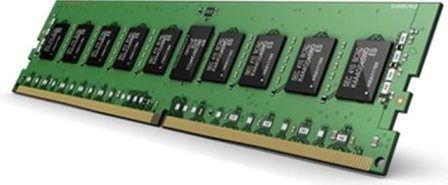
Designed for server platforms, this DDR4-2933 RDIMM with ECC and Registered signal type ensures data integrity in virtualized and memory-intensive workloads like in-memory databases. Its Quad Rank configuration and 1.2V low-voltage operation maximize capacity density while the CL21 latency provides reliable, efficient performance for enterprise-class deployments.
1. ECC protection actively corrects single-bit errors and detects multi-bit faults, safeguarding transactional data integrity for mission-critical enterprise applications.
2. Registered signal conditioning stabilizes command and address buses under heavy load, enabling fully populated server boards without compromising signal quality.
3. Quad Rank architecture doubles the device count per module to deliver high capacity density, allowing virtualization hosts to support more VMs within limited DIMM slots.
4. The DDR4-2933 data rate provides a balanced throughput sweet spot, maintaining consistent memory bandwidth for concurrent analytics queries and database operations.
5. Ultra-low 1.2V operation reduces overall server power draw and cooling overhead, improving total cost of ownership in large-scale data center deployments.
When deploying virtualization clusters or in-memory databases like SAP HANA, data integrity and consistent performance are non-negotiable. The M393A2K40DB2-CVFGQ is an RDIMM engineered precisely for these enterprise workloads, and its four core characteristics directly address what keeps IT managers awake at night. Its ECC technology continuously detects and corrects single-bit memory errors caused by background radiation, silently preventing silent data corruption that could crash a transactional database or cause a VM to produce incorrect financial figures — this means you avoid unpredictable downtime and uphold compliance in mission-critical services. The registered signal buffer stabilizes the command and address lines, enabling servers to support quad-rank, 16GB modules in fully populated 24-slot configurations without the signal integrity collapse that would halt boot processes; for you, this translates to trouble-free scaling of memory capacity as your virtual machine density grows. Running at DDR4-2933, that quad-rank design increases bank groups and interleaving, delivering higher sustained bandwidth under the concurrent read/write storms typical of multi-tenant cloud hosts or real-time analytics engines. In practice, your Redis cluster handles more queries per second, and your hypervisor launches and migrates VMs with noticeably lower latency, keeping service-level agreements firmly in reach.
General Virtualization
For a balanced virtualized host, deploy six to eight of these 16GB Registered ECC DDR4-2933 modules across the available memory channels. This 96–128 GB footprint lets you comfortably run 20–30 light-to-medium VMs while maintaining memory bandwidth and RAS features. Populate identical quad-rank DIMMs symmetrically per CPU to avoid performance penalties and ensure error correction coverage.
In-Memory Database
In-memory databases demand both capacity and low latency. Install a full population of 16GB RDIMMs—typically 12 or 16 modules per two-socket server—to reach 192–256 GB. This scale holds large working sets entirely in RAM and exploits the 2933 MT/s speed with CL21 latency. Quad-rank registered DIMMs deliver the high reliability essential for transactional consistency, while ECC guards against silent data corruption.
High-Performance Computing
HPC workloads thrive on memory bandwidth. Fill all eight channels of a modern dual-socket node with one DIMM per channel (8 x 16GB = 128 GB) to maximize bandwidth and avoid rank-stacking delays. The DDR4-2933 speed and quad-rank construction keep the data pipeline fed for simulation, modeling, or CFD codes. When node density matters, extend to 256 GB using 16 identical modules, closely monitoring thermal headroom and power draw.
Validated for server use, rigorously tested, compatible with Dell PowerEdge R740, R760, HPE ProLiant DL380 Gen10, and Lenovo ThinkSystem SR650.
Q: Can I mix this M393A2K40DB2-CVFGQ with other memory modules of different brands or speeds?
A: Mixing with different brands or speeds is not recommended. For RDIMMs, always match ECC and registered type, same rank and voltage. Mismatched population can cause instability or prevent boot in server platforms.
Q: Is this memory compatible with my server?
A: This DDR4-2933 ECC Registered DIMM is designed for Intel Xeon Scalable, AMD EPYC, and similar platforms with 288-pin slots. Verify your motherboard’s qualified vendor list (QVL) and support for quad-rank RDIMMs.
Q: What is the recommended DIMM population order for optimal performance?
A: For symmetric multiprocessing servers, populate identical DIMMs starting with the farthest slot from the CPU in each channel. With quad-rank modules, one DIMM per channel often maximizes speed due to memory bus loading.
Q: Does this module support overclocking or XMP profiles?
A: No, this server-grade RDIMM strictly follows JEDEC DDR4-2933 specifications. It does not support overclocking or XMP profiles to ensure maximum stability and data integrity in mission-critical environments.
Q: What warranty and typical failure rate can I expect?
A: This Samsung module includes a 1-year warranty. Enterprise-class memory typically exhibits an annualized failure rate well below 0.5%, backed by rigorous testing and reliability engineering for 24/7 operation.