











 Secure payments
Standard refund policy
Trade Assurance
Secure payments
Standard refund policy
Trade Assurance
| Product Type | Memory Module |
|---|---|
| Compliance Standards | EU RoHS,FCC |
| Memory Capacity | 16 GB |
| Memory Technology | DDR4 |
| Product Voltage | 1.2 V |
| RAM Speed | 3200 MHz |
| RAM Standard | DDR4-3200/PC4-25600 |
| Error Identifying | ECC |
| Signal Type | Registered |
| Column Access Strobe (CAS) | CL22 |
| Rank | Single Rank x4 |
| Quantity of Pins | 288-pin |
| RAM Genre | RDIMM |
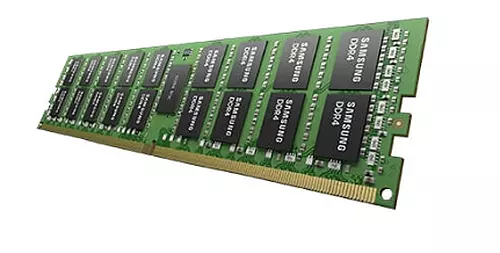
The Samsung M393A2K40DB3-CWE is a 16GB DDR4-3200 Registered ECC memory module ideally suited for enterprise servers and data centers handling virtualization or in-memory databases, where its error-correcting code and registered clock driver ensure unparalleled data integrity and signal stability across fully loaded multi-DIMM channels. The single-rank x4 organization at a low 1.2V operating voltage delivers consistent low-latency performance with CL22 timings, making it a power-efficient choice for dense, mission-critical deployments that demand reliable 24/7 operation.
1. ECC protection detects and corrects single-bit errors in real time, safeguarding transactional integrity for mission-critical databases and virtualization workloads.
2. Registered logic buffers clock and command signals, enabling large multi-DIMM server configurations without signal degradation under full load.
3. A balanced module density maximizes server memory scalability, allowing IT architects to hit optimal VM-per-node ratios without overspending on underutilized capacity.
4. High memory bandwidth accelerates parallel data access in cloud-native and analytics applications, shrinking query times when every millisecond counts.
5. Single Rank x4 organization delivers superior bank-level parallelism and robust ECC granularity, keeping latency low in latency-sensitive services like in-memory caching.
When you rely on a server to run a virtualized cluster or an in-memory database, memory errors aren’t just a nuisance—they’re a direct threat to business continuity. The Samsung M393A2K40DB3-CWE is built precisely for these high-stakes environments. As a DDR4-3200 Registered DIMM with ECC, it tackles the two most critical pain points in the data center: silent data corruption and signal integrity at scale. The ECC engine continuously detects and corrects single-bit flips caused by cosmic radiation or electrical noise. In a dense virtualization host running dozens of VMs, one undetected bit error can crash a guest, corrupt a transaction log, or silently poison a dataset. That risk is simply unacceptable, and this module makes it mathematically irrelevant. Meanwhile, the Registered buffer stabilizes command and address signals, allowing you to populate all memory channels with confidence—essential when scaling up to hundreds of gigabytes for memory-hungry applications like SAP HANA or Redis clusters. The single-rank x4 organization at CL22 strikes a deliberate balance between bank-level parallelism and latency, delivering consistent 25.6 GB/s bandwidth without compromising the predictable access times that real-time analytics demand. For your virtualized infrastructure or transactional database, this isn’t a commodity part; it’s an insurance policy that preserves uptime, consistency, and the trust your applications depend on.
Based on the specifications — Registered DIMM with ECC, 288-pin, 1.2V, and Single Rank x4 — this is server memory, designed for stability and reliability in enterprise environments. Below is the capacity planning guide for three typical server workloads.
General Virtualization
For consolidated virtualization hosts running multiple VMs, total memory capacity is often the bottleneck. Deploy at least 16 modules across dual-socket systems (8 DIMMs per CPU, one per channel) to achieve 256 GB, balancing density with memory bandwidth. Populating all channels evenly with these 16 GB RDIMMs ensures optimal interleaving and avoids NUMA penalties.
In-Memory Database
In-memory databases like Redis or SAP HANA demand extremely low latency and high capacity. Use the maximum supported DIMM slots per socket — typically 16 or 24 — with these 16 GB modules for a total of 256–384 GB per server, enabling full dataset caching. Favor a balanced configuration across all memory channels to sustain the high throughput required for real-time analytics.
High Performance Computing
HPC workloads thrive on memory bandwidth rather than sheer capacity. Install the minimum number of modules per CPU needed to populate all memory channels — one 16 GB DIMM per channel (e.g., 8 modules on an 8-channel platform) for a total of 128 GB. This single-rank x4 configuration maximizes frequency headroom and keeps latency low, critical for tightly coupled parallel simulations.
Validated server memory compatible with Dell PowerEdge R760, HPE ProLiant DL380 Gen11, Lenovo ThinkSystem SR650 V3, and more.
Q: Can I mix this M393A2K40DB3-CWE with other memory modules of different brands or speeds?
A: Mixing different brands or speeds is not recommended for server environments. This can cause system instability and compatibility issues. For reliable performance, populate identical modules with the same part number across all channels.
Q: Is this memory compatible with my system?
A: This DDR4 RDIMM is designed for servers supporting ECC Registered memory, such as Intel Xeon Scalable and AMD EPYC platforms. Please verify your system board supports 3200 MT/s RDIMMs and the required 288-pin configuration.
Q: What is the recommended DIMM population order for optimal performance?
A: Follow your server’s slot numbering: populate the first slot in each channel first (e.g., DIMM A1, B1, etc.) to balance interleaving. Always consult the system’s service guide to ensure proper population for maximum memory bandwidth.
Q: Does this module support overclocking or XMP profiles?
A: No. As an enterprise-grade ECC Registered DIMM, this module operates strictly at JEDEC standard DDR4-3200 with fixed CL22 timing at 1.2 V. It does not support overclocking or XMP; reliability and data integrity are prioritized.
Q: What warranty and typical failure rate can I expect?
A: This memory is backed by a one-year warranty. Built with premium components and subjected to rigorous testing, it delivers exceptionally low failure rates, meeting the high reliability demands of 24/7 server environments.