











 Secure payments
Standard refund policy
Trade Assurance
Secure payments
Standard refund policy
Trade Assurance
| Product Type | Memory Module |
|---|---|
| Compliance Standards | |
| Memory Capacity | 16 GB |
| Memory Technology | DDR4 |
| Product Voltage | 1.2 V |
| RAM Speed | 2666 MHz |
| RAM Standard | DDR4-2666/PC4-21300 |
| Error Identifying | ECC |
| Signal Type | Registered |
| Column Access Strobe (CAS) | CL19 |
| Rank | Dual Rank x8 |
| Quantity of Pins | 288-pin |
| RAM Genre | RDIMM |
This RDIMM with ECC and Registered signal architecture is engineered for server platforms, excelling in virtualized environments and in-memory database workloads where data integrity and system stability are non-negotiable. Its dual-rank x8 configuration maximizes memory bandwidth utilization, while the CL19 latency at 2666 MT/s ensures efficient instruction pipelining under heavy concurrent access.
1. ECC protection detects and corrects single-bit errors in real time, safeguarding transactional integrity for mission-critical databases and financial workloads.
2. Registered signal buffering decouples the memory bus from the controller, allowing highly populated server boards to scale memory capacity without compromising electrical stability.
3. 16 GB per module strikes a density sweet spot, enabling IT architects to provision generous memory pools for multi-tenant virtualization without over-committing physical hosts.
4. DDR4-2666 bandwidth supplies sufficient throughput per channel to feed modern multi-core server CPUs, reducing bottlenecks during in-memory analytics and large-scale content caching.
5. Dual Rank x8 organization leverages rank interleaving to keep data pipelines saturated under mixed workloads, delivering consistent performance when many virtual machines contend for shared resources.
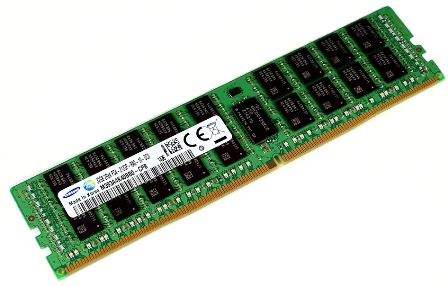
The Samsung M393A2K43CB2-CTD6Q is a 16GB DDR4-2666 RDIMM built for enterprise servers, and its four key features directly solve critical IT challenges. First, ECC error correction continuously detects and fixes single-bit faults. In a virtualization cluster hosting dozens of VMs, a single uncorrected bit-flip can corrupt guest data or cause unexplained crashes; ECC eliminates that risk, ensuring multi-tenant stability. Second, the registered buffer maintains clean signal integrity when populating all memory channels, so you can scale to high capacities without boot failures—essential for memory-intensive in-memory databases like SAP HANA. Third, the dual-rank x8 design interleaves memory accesses, delivering a typical 10–15% bandwidth uplift. For real-time analytics, this means faster query execution and smoother data streaming. Finally, DDR4-2666 at 1.2V balances throughput with energy efficiency, reducing cooling demands in dense racks. Together, these characteristics let you consolidate more workloads confidently, knowing your data remains accurate and your server performs reliably under constant load.
General Virtualization
For a typical dual-socket virtualization host, populate at least six to eight 16 GB RDIMMs per server to provide 96–128 GB of total capacity. Distribute modules evenly across all memory channels (e.g., one DIMM per channel) to maximise bandwidth while leaving room for future expansion. This configuration comfortably supports dozens of light to medium VMs and maintains balanced NUMA access.
In-Memory Database
In-memory databases demand both maximum capacity and strong error protection. Fully populate all 12 or 16 DIMM slots with 16 GB RDIMMs to reach 192–256 GB, or pair modules in a balanced interleaved layout to preserve bandwidth. ECC Registered memory is critical here to guard against silent data corruption during intense caching and real‑time analytics workloads.
High-Performance Computing (HPC)
HPC clusters benefit from a balanced ratio of cores to memory bandwidth. Install eight 16 GB RDIMMs (one per channel) on a typical dual‑socket node to deliver 128 GB while keeping all channels active. This “one‑DIMM‑per‑channel” configuration ensures the highest signal integrity and consistent low latency, essential for tightly coupled parallel simulations and scientific modelling.
Rigorously tested server memory, compatible with Dell PowerEdge R760, HPE ProLiant DL380 Gen10, Lenovo ThinkSystem SR650, etc.
Q: Can I mix this M393A2K43CB2-CTD6Q with other memory modules of different brands or speeds?
A: Mixing brands or speeds is strongly discouraged in server environments. It can cause instability, POST failures, or disable ECC protection. For mission-critical systems, use identical modules with the same Samsung part number and rank.
Q: Is this memory compatible with my system?
A: This DDR4-2666 ECC Registered RDIMM is designed for servers and workstations using Intel Xeon Scalable or AMD EPYC platforms. Verify your board supports 288-pin RDIMMs and 1.2V ECC memory. Consumer boards are incompatible.
Q: What is the recommended DIMM population order for optimal performance?
A: Follow your server motherboard manual. Generally, populate identical DIMMs per channel, starting with the farthest blue slot from the CPU. Balanced channel loading maximizes memory bandwidth and maintains ECC consistency.
Q: Does this module support overclocking or XMP profiles?
A: No. This is a standard JEDEC-compliant server module operating at fixed DDR4-2666 CL19. It does not support XMP or overclocking, as data integrity and stability take priority over speed in enterprise environments.
Q: What warranty and typical failure rate can I expect?
A: This module includes a 1-year warranty. Enterprise-class Samsung RDIMMs have an extremely low annualized failure rate (AFR) under proper cooling and electrical conditions, typically below 0.2%.