











 Secure payments
Standard refund policy
Trade Assurance
Secure payments
Standard refund policy
Trade Assurance
| Product Type | Memory Module |
|---|---|
| Memory Capacity | 16 GB |
| Memory Technology | DDR4 |
| Product Voltage | 1.2V |
| RAM Speed | 3200MHz |
| RAM Standard | DDR4-3200/PC4-25600 |
| Error Identifying | ECC |
| Signal Type | Registered |
| Column Access Strobe (CAS) | CL22 |
| Rank | Dual Rank x8 |
| Quantity of Pins | 288-pin |
| RAM Genre | RDIMM |
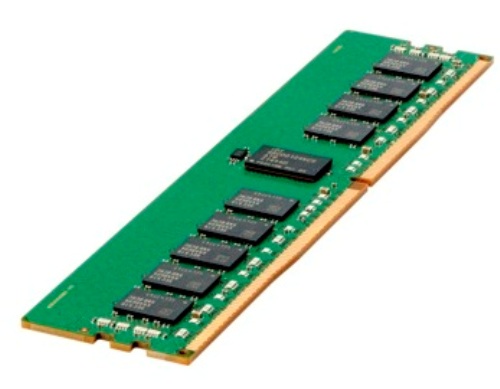
This DDR4-3200 RDIMM with ECC and registered signaling is engineered for server platforms, where its dual-rank x8 organization and low CL22 latency maximize throughput in virtualized environments and in-memory databases. The ECC and registered architecture ensure critical data integrity and signal stability under heavy multi-DIMM workloads, making it ideal for reliable, high-density enterprise deployments.
1. DDR4 technology delivers a refined balance of speed and power efficiency, boosting server throughput per watt in dense data center environments.
2. The 3200MHz speed elevates memory bandwidth, enabling faster in-memory analytics and smoother database transactions under peak query loads.
3. Integrated ECC automatically corrects single-bit errors, preserving long-term data integrity vital for financial calculations and mission-critical workloads.
4. Registered signal buffering stabilizes command and address lines, supporting higher memory population counts without compromising signal integrity in large-scale virtualization hosts.
5. Dual Rank x8 organization interleaves memory accesses across two internal rank groups, amplifying sustained bandwidth that keeps latency-sensitive VMs responsive during consolidation spikes.
Identifying the module as a server-grade RDIMM instantly shifts the conversation from peak frame rates to data center integrity. This M393A2K43DB2-CWE leverages four critical features that directly counter the chaos of enterprise computing. The integrated ECC continuously detects and corrects single-bit memory errors caused by cosmic radiation or electrical noise. In a heavily loaded virtualization cluster running dozens of guest VMs, a single uncorrected bit flip can silently corrupt a financial record or crash a kernel; ECC turns a statistical inevitability into a non-event.
Similarly, the Registered signal buffer stabilizes the command and address lines, allowing a dual-socket server to populate all memory channels with multiple DIMMs without signal degradation. This is vital for memory databases like SAP HANA where terabytes of data must reside in RAM simultaneously. The dual-rank design then enhances throughput through rank interleaving, letting the memory controller read from one rank while the other prepares its next transaction. Combined with a 3200MT/s transfer rate at the efficient 1.2V standard, you get sustained, high-bandwidth access that prevents I/O stalls during massive concurrent queries, transforming raw reliability into predictable, wall-clock performance where downtime is never an option.
General Virtualization
Populate at least one 16GB RDIMM per memory channel to balance capacity, cost, and speed. In a typical dual‑socket server with eight channels per CPU, sixteen modules (1 DIMM per channel) deliver 256 GB while maintaining the full 3200 MT/s data rate. This approach avoids multi‑rank performance penalties and provides comfortable headroom for dozens of virtual machines without over‑committing memory.
In‑Memory Database
In‑memory databases demand maximum capacity and low latency. Fill all channels with two dual‑rank 16GB RDIMMs when the platform supports 2 DIMMs per channel, accepting a slight speed drop to 2933 MT/s to reach 512 GB or more. The registered ECC corrects single‑bit errors and detects multi‑bit faults, safeguarding the integrity of transactional and analytical datasets.
High‑Performance Computing
HPC workloads reward bandwidth over sheer capacity. Install exactly one 16GB RDIMM per populated channel across all sockets to sustain the full 3200 MT/s frequency, yielding 128–256 GB per node. This 1‑DIMM‑per‑channel configuration keeps latency low and delivers peak memory throughput for simulation, modeling, and parallel I/O codes that scale with memory bandwidth.
Server memory rigorously validated for Dell PowerEdge R750, HPE DL380 Gen10 Plus, Lenovo SR650 V2.
Q: Can I mix this M393A2K43DB2-CWE with other memory modules of different brands or speeds?
A: We strongly advise against mixing brands or speeds in servers. Mismatched Registered DIMMs often cause stability issues and memory errors. Use identical Samsung M393A2K43DB2-CWE modules for guaranteed compatibility and reliable 24/7 operation.
Q: Is this memory compatible with my system?
A: This DDR4-3200 ECC Registered RDIMM is compatible with servers using Intel Xeon Scalable (2nd/3rd Gen) or AMD EPYC 7002/7003 platforms. Please verify your motherboard’s QVL and support for 288-pin Registered DIMMs before purchasing.
Q: What is the recommended DIMM population order for optimal performance?
A: Follow your server board’s memory population guide, typically filling identical DIMMs in balanced channels. For dual-socket systems, install matching pairs per channel and follow the silk-screened slot numbering to achieve optimal interleaving and bandwidth.
Q: Does this module support overclocking or XMP profiles?
A: No, this server-grade memory uses JEDEC-standard DDR4-3200 specifications for maximum stability. It does not support overclocking or XMP profiles, which are typical for consumer desktops. Enterprise reliability is the priority here.
Q: What warranty and typical failure rate can I expect?
A: This Samsung RDIMM includes a 1-year warranty. Enterprise-class RDIMMs exhibit extremely low Annualized Failure Rates (AFR), typically under 0.5% in properly cooled environments, ensuring long-term data integrity for your mission-critical workloads.