











 Secure payments
Standard refund policy
Trade Assurance
Secure payments
Standard refund policy
Trade Assurance
| Product Type | Memory Module |
|---|---|
| Memory Capacity | 16 GB |
| Memory Technology | DDR4 |
| Product Voltage | 1.2 V |
| RAM Speed | 3200 MHz |
| RAM Standard | DDR4-3200/PC4-25600 |
| Error Identifying | ECC |
| Signal Type | Registered |
| Column Access Strobe (CAS) | CL22 |
| Rank | Dual Rank |
| Quantity of Pins | 288-pin |
| RAM Genre | RDIMM |
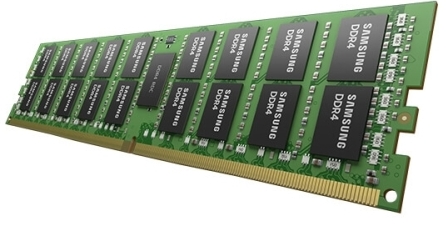
This Samsung M393A2K43DB3-CWEBYSM is a server-grade DDR4-3200 Registered DIMM with ECC, purpose-built for mission-critical enterprise platforms running virtualization, in-memory databases, or dense cloud workloads where data integrity and uptime are non-negotiable. Its dual-rank configuration and CL22 latency optimize interleaving and command efficiency on multi-DIMM-per-channel memory controllers, while the 1.2 V operating voltage and registered signal type maintain stable signal integrity across fully populated 288-pin slots.
1. ECC protection detects and corrects single-bit memory errors in real time, preserving data integrity for financial transactions and mission-critical database workloads.
2. Registered clock driver buffers command and address signals, enabling stable operation in high-density server configurations with extensive memory population.
3. Dual Rank organization interleaves accesses across two internal rank groups, increasing effective bandwidth for virtualized environments handling concurrent tenant requests.
4. 16 GB capacity per module strikes a balance between virtual machine density and cost, allowing fine-grained memory provisioning for containers and light hypervisor nodes.
5. 3200 MT/s transfer rate elevates peak throughput, reducing latency for in-memory caching tiers that accelerate analytics and large-scale content delivery.
The Samsung M393A2K43DB3-CWEBYSM is unmistakably a server-grade memory module, a DDR4-3200 Registered DIMM engineered for mission-critical enterprise workloads. Its four defining characteristics directly address real-world data center pain points.
First, ECC error correction silently intercepts single-bit memory errors caused by cosmic radiation or electrical noise, preventing silent data corruption that could crash a virtual machine fleet or poison a financial transaction. For a hypervisor hosting dozens of virtualized applications, this means avoiding an entire afternoon of root-cause analysis and unplanned downtime. Second, the Registered signal architecture buffers the command and address lines, enabling servers to populate all 24 or more DIMM slots without electrical loading issues. This directly supports dense virtualization clusters where you must maximize memory capacity per NUMA node without sacrificing stability. Third, the 3200 MT/s speed paired with Dual Rank organization lifts throughput through rank interleaving—while one rank refreshes, the other accepts read/write commands. In an in-memory database like Redis or SAP HANA, this overlap translates into measurably lower latency and higher transactions per second under real concurrent user loads. Finally, the 1.2V operating voltage keeps thermals in check across fully populated racks, and the standard 288-pin footprint guarantees seamless integration into existing server fleets. The end result is not just a component specification, but a guarantee of predictability when your business depends on every bit being right.
General Virtualization
For moderate consolidation of virtual machines, populate four or six identical 16 GB RDIMMs per CPU to balance capacity with memory bandwidth. The dual-rank design and 3200 MT/s speed ensure stable, responsive performance under mixed workloads, while registered ECC protects against in-memory data corruption.
In-Memory Database
Maximize capacity by filling all available DIMM slots with these 16 GB RDIMMs, aiming for 256 GB or more per node. The low 1.2 V operating voltage keeps thermal and power budgets in check, and the CL22 latency is well suited to large dataset retrieval where raw capacity matters most.
High-Performance Computing (HPC)
Populate memory channels symmetrically—typically eight or more modules for an eight-channel platform—to deliver the sustained bandwidth required by simulation and modeling codes. The registered signal type and dual-rank architecture permit high-density configurations without sacrificing signal integrity, while ECC ensures long-running compute jobs complete accurately.
Server-validated RDIMM: rigorously tested, compatible with Dell PowerEdge R760, HPE ProLiant DL380 Gen11, Lenovo ThinkSystem SR650 V3.
Q: Can I mix this M393A2K43DB3-CWEBYSM with other memory modules of different brands or speeds?
A: Mixing is not recommended for server environments. Mismatched modules may force the system to run at the lowest common speed, potentially causing instability and compromising ECC protection. For optimal reliability, use identical modules.
Q: Is this memory compatible with my system (e.g., Intel or AMD server platform)?
A: This DDR4-3200 Registered ECC RDIMM is compatible with servers supporting 288-pin DDR4 RDIMM slots, including Intel Xeon Scalable (2nd Gen+) and AMD EPYC 7002/7003 series. Please verify against your motherboard’s QVL.
Q: What is the recommended DIMM population order for optimal performance?
A: For dual-rank RDIMMs, populate memory channels evenly across processors, adhering to the motherboard’s specific slot numbering (often blue slots first). Consult the server manual for balanced interleaving and maximum memory bandwidth.
Q: Does this module support overclocking or XMP profiles?
A: No. This is a JEDEC-compliant server memory module operating at standard DDR4-3200 (PC4-25600) with CAS 22. It does not support XMP profiles or overclocking, ensuring enterprise stability and data integrity.
Q: What warranty and typical failure rate can I expect?
A: This Samsung module comes with a 1-year warranty. Enterprise-grade RDIMMs like this exhibit extremely low annualized failure rates (AFR), typically below 0.2%, due to rigorous testing and premium component selection.