











 Secure payments
Standard refund policy
Trade Assurance
Secure payments
Standard refund policy
Trade Assurance
| Product Type | Memory Module |
|---|---|
| Memory Capacity | 16 GB |
| Memory Technology | DDR4 |
| Product Voltage | 1.2 V |
| RAM Speed | 3200 MHz |
| RAM Standard | DDR4-3200/PC4-25600 |
| Error Identifying | ECC |
| Signal Type | Registered |
| Column Access Strobe (CAS) | CL22 |
| Rank | Dual Rank x8 |
| Quantity of Pins | 288-pin |
| RAM Genre | RDIMM |
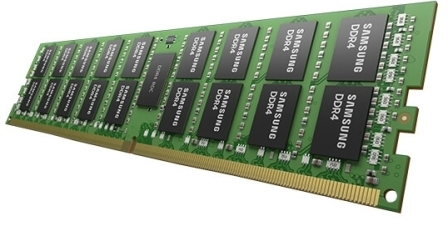
This 16 GB DDR4-3200 registered ECC module is purpose-built for server platforms handling virtualization, in-memory databases, and critical enterprise workloads that demand uncompromising data integrity. Its dual-rank x8 organization leverages rank interleaving to improve effective bandwidth while the registered buffer reduces channel loading, ensuring signal stability in fully populated memory configurations.
1. ECC error correction continuously detects and fixes single-bit memory faults, preserving data integrity for mission-critical database and transaction servers where even one bit flip could corrupt financial records.
2. Registered signal buffering decouples the command and address bus from the memory controller, enabling stable operation with fully loaded DIMM slots essential for dense virtualization farms.
3. Dual Rank x8 organization alternates between two internal rank groups to interleave requests, effectively boosting accessible bandwidth when hosting numerous concurrent virtual machines.
4. 3200MT/s transfer rate elevates the data pipe per channel, absorbing bursty traffic peaks during live migration orchestration or real-time analytics aggregation.
5. 1.2V operating voltage reduces thermal load per module, lowering overall rack power consumption and easing cooling demands inside always-on enterprise data centers.
When your virtualized cluster hosts dozens of mission-critical VMs, a single undetected bit flip in memory can corrupt a database transaction or silently cascade into service outages. The M393A2K43DB3-CWERF, an RDIMM built for server precision, transforms that risk into assurance through four architectural decisions that directly answer enterprise pain points. Its ECC engine actively corrects single-bit errors in real time, shielding your memory-resident databases like SAP HANA or Redis from data poisoning without performance penalty—financial integrity simply isn’t negotiable. The registered signal buffer on this 288-pin DDR4-3200 module stabilizes command and address lines across dense DIMM populations, so you can populate all channels in a 2-socket virtualization host without signal collapse, achieving the massive 512 GB+ footprints your hypervisor demands. With a dual-rank x8 organization at CL22, interleaved access boosts effective bandwidth; when hundreds of VMs contend for memory, that parallelized data fetch reduces latency jitter under load, keeping container orchestration responsive. And at the standard 1.2 V, power draw stays contained across a rack full of machines, lowering your thermal and operating cost profile. This module doesn’t just meet spec—it becomes the silent foundation where every additional virtual machine and every in-memory query simply runs without compromise.
Capacity Planning for DDR4-3200 Registered ECC Memory (16GB RDIMM)
This is a server-class DDR4-3200 Registered DIMM with ECC, dual-rank x8 organization and CL22 latency. It is designed for stable, high-density deployments in dual-socket platforms that support up to 288-pin RDIMM slots. Use the following guidance to match module counts and configurations to your workload.
General Virtualization
Aim for balanced capacity and bandwidth by populating all memory channels symmetrically. In a typical dual-socket server with eight channels per CPU, install one 16GB RDIMM per channel (16 modules total) to achieve 256GB while maintaining maximum native speed. This supports a high density of virtual machines and allows future expansion by filling the remaining DIMM slots.
In-Memory Database
Maximize capacity first, as in-memory datasets directly dictate performance. Populate all available DIMM slots with 16GB RDIMMs—often reaching 512GB or more per node—while keeping a balanced channel configuration. The dual-rank design delivers good bank-level parallelism, which helps sustain high throughput under random access patterns common in Redis, Memcached, or SAP HANA deployments.
High Performance Computing
Prioritize memory bandwidth by adhering to a one-DIMM-per-channel configuration, which prevents speed downgrades to 2933MT/s or lower on many platforms. Install eight identical 16GB RDIMMs per socket (128GB per CPU) to keep the interconnection fabric fully utilized. If per-node capacity falls short, scale out with additional compute nodes rather than adding a second DIMM per channel, preserving peak bandwidth for simulation, modeling, and data analytics workloads.
Rigorously tested, compatible with Dell PowerEdge R750, HPE ProLiant DL380 Gen10 Plus, Lenovo ThinkSystem SR650 V2, and similar servers.
Q: Can I mix this M393A2K43DB3-CWERF with other memory modules of different brands or speeds?
A: Mixing RDIMMs of different brands, speeds, or ranks is strongly discouraged. For reliable server operation, all modules should be identical in part number, speed, and rank to avoid signal integrity and stability issues.
Q: Is this memory compatible with my system? Which Intel or AMD platforms are supported?
A: This DDR4-3200 Registered ECC RDIMM is validated for Intel Xeon Scalable (2nd Gen and newer) and AMD EPYC 7002/7003 series platforms. Verify that your server board supports 288-pin 1.2V Registered ECC memory.
Q: What is the recommended DIMM population order for optimal performance?
A: For optimal performance, populate identical DIMMs per channel according to your server board's manual. Typically, fill slots starting with the first channel of each CPU, balancing capacity across all memory channels symmetrically.
Q: Does this module support overclocking or XMP profiles?
A: No, this is a JEDEC-standard RDIMM designed for server reliability. It does not support overclocking or XMP profiles and strictly adheres to the DDR4-3200/PC4-25600 specification with fixed CL22 timing.
Q: What warranty and typical failure rate can I expect?
A: This module carries a 1-year warranty. Built with Samsung B-die and 1.2V low-power design, its annualized failure rate (AFR) is extremely low under normal server operating conditions, typically below 0.5%.